

Ethiopia's Prime Minister Abiy Ahmed Ali delivers a speech during the inauguration of the Grand Ethiopian Renaissance Dam, in Benishangul-Gumuz, Ethiopia, Sept. 9, 2025. (AP Photo)
Conflict has returned to Ethiopia’s Tigray region as the Tigray People’s Liberation Front (TPLF) led a coalition of armed groups that took control of three airports in the region on Sept. 23. It had only been four years since the last war ended that left millions displaced. Now, former rivals have become allies to topple Prime Minister Abiy Ahmed from power.
Smaller clashes have occurred over the last two months as the peace agreement signed in Pretoria broke down, with the federal government not complying with the return of displaced people and the reestablishment of TPLF military capacities. Having yet to recover from the war, Tigray is hit with another that has already spread to the nearby Amhara and Afar regions.
Regionally, the conflict could also spread across sovereign states. Sudan’s fractionalization provides a new dimension to conflict in both states; meanwhile, several others have been accused of supporting the TPLF and joining an anti-Ethiopia coalition. With the fighting now raging in Tigray and other neighboring regions, the regional balance of power appears to be shifting.
Eritrea, Somalia, and Sudan have all experienced grievances against the Ethiopian state in recent years. However, this ‘alliance’ is fragile and has never attempted multilateral discussions. What ties them together is Egypt.
Egyptian-Ethiopian relations have become tense since the development of the Grand Ethiopian Renaissance Dam (GERD), which Egypt considers an existential threat due to concerns of water insecurity, a grievance also shared with Sudan. Egypt and Sudan have called for a trilateral agreement between the three states to monitor water levels, but after the signing of a 2015 declaration with no obligatory or accountability mechanisms, negotiations broke down in 2023.
Subsequently, Egypt moved to establish stronger relationships with states in the Horn of Africa, a move that has widely been perceived as diplomatically isolating Ethiopia. While Egypt’s main concern remains Nile water security, it has begun to connect the issues faced by Eritrea, Somalia and Sudan.
Eritrea is the first of several states accused by Ethiopia of aiding the TPLF. Since independence, Eritrean-Ethiopian relations have been rocky. The two states operated under a “no war, no peace” ideology until Abiy’s accession to the Ethiopian premiership in 2018. Abiy restored relations, and for his diplomatic efforts, won the Nobel Peace Prize. With the relationship supposedly healing, Eritrean President Isaias Afwerki assisted Ethiopia in its latest war against the TPLF in 2020. Abiy’s rhetoric changed soon after, and he has made claims to the Eritrean port of Assab, adding that Ethiopia requires a port city to accommodate the economic and developmental needs of a growing population.
From this diplomatic souring, Egypt has replaced Ethiopia as Eritrea’s security partner. Several bilateral meetings have taken place between the two countries since the 2020 Tigray War, emphasizing the need for cooperation both economically and militarily to secure threats in the Red Sea and the Horn of Africa. As Eritrea warms up to Egypt, Ethiopia has accused it of directly supporting the TPLF, and both countries have cut ties since the current war’s beginning.
Assab is not the only port that Abiy has sought. In 2024, Ethiopia signed a memorandum of understanding with Somaliland, a breakaway state in the north of Somalia with little international recognition. The memorandum allows Ethiopia to rent the port of Berbera in exchange for recognition of Somaliland after certain conditions are met.
In response, Somalia signed an agreement with Egypt, pledging stronger military cooperation, alongside Eritrea. Ethiopia regarded the summit as a maneuver to prevent it from receiving port access, and Somalia’s refusals stalled the Somaliland agreement from proceeding, leading to Abiy’s current rhetoric regarding the port of Assab and his accusations against Eritrea.
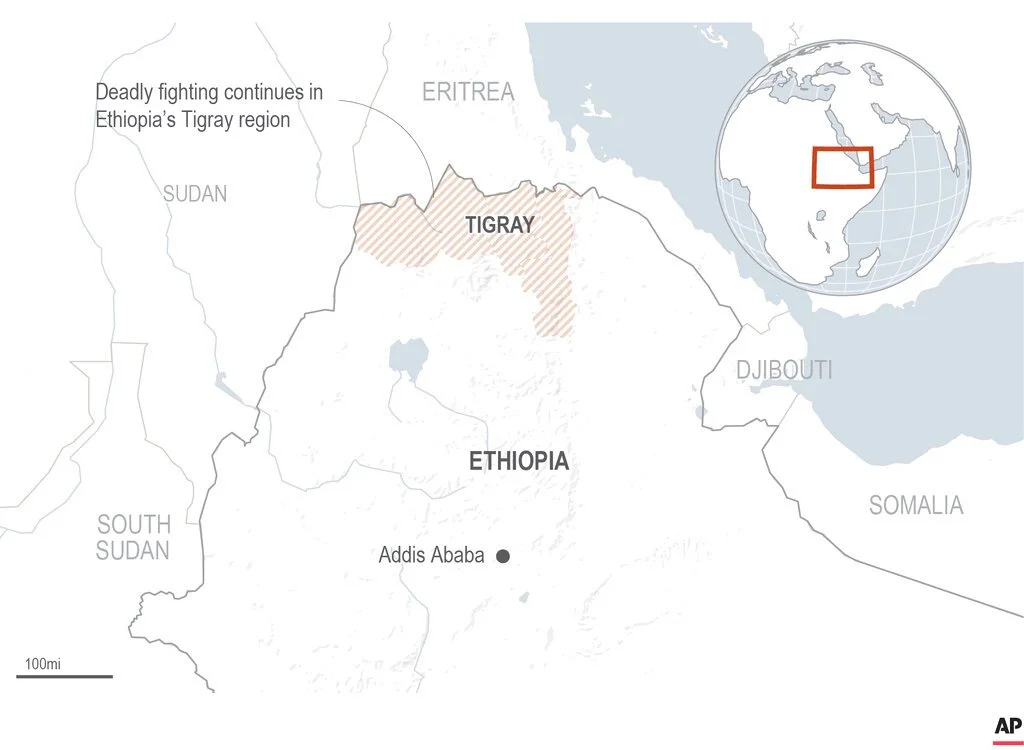
Map locates the Tigray area, Nov. 10, 2020. (AP Photo/F. Duckett)
Neighboring Sudan, caught up in its own civil war, has also been brought into Ethiopia’s war. Ethiopia has accused the Sudanese military of supporting the TPLF and has also strained diplomatic ties with the recognized government.
The Sudanese Armed Forces (SAF) receives support from Eritrea and Egypt, Ethiopia’s regional rivals. In retaliation, the SAF has similarly accused Abiy of supporting the Rapid Support Forces (RSF), the paramilitary force fighting against the SAF. The main element that could escalate Sudanese-Ethiopian relations is that of border crossings.
During the rule of Omar al-Bashir, former president of Sudan, an agreement allowed Ethiopian farmers to cultivate lands in Sudan, permitting them to return seasonally. The agreement broke down during the Tigray War, where rebels crossed the border to escape Ethiopia’s reach. Due to Sudan’s fragmentation, the border has returned as a crossing ground, particularly for the RSF and allied groups who control these borderlands, which allowed Ethiopia to build training camps for these groups with Emirati financing. With the current conflict, this element is considered a matter of life or death by the TPLF, allowing the group to protect itself from isolation and receive broad support from its foreign allies.
The role that Ethiopia and Egypt have played in Sudan’s civil war adds another layer to the importance of the new conflict in Tigray. The United Arab Emirates (UAE) has financed Ethiopian efforts to support the RSF in Sudan, which Ethiopia deems in its interest, as Sudan has raised concerns regarding water security and the GERD. The SAF maintains the position of al-Bashir’s government, supported by Egypt, and Ethiopia fears it may retaliate against the GERD if it emerges victorious in the conflict.
Understanding this, it is in Ethiopia’s interest to support the UAE and invest in the RSF, as an RSF victory may establish a friendly government in place of an uncooperative one. Both Ethiopia and Egypt have big stakes in Sudan with regard to the future of their foreign policy. The conflict in Tigray could have implications in both states, as the border becomes an exchange point for arms and supplies for all parties.
As the war continues in Ethiopia, developments are being watched closely in Egypt, as the conflict may spill over into neighboring Eritrea, Somalia, and Sudan. It is impossible to understand this conflict without accounting for the regional powers that have shaped it. And while regional power balances and geography have always played a part in warfare, technology has evolved, and it may lead to more devastating outcomes.