
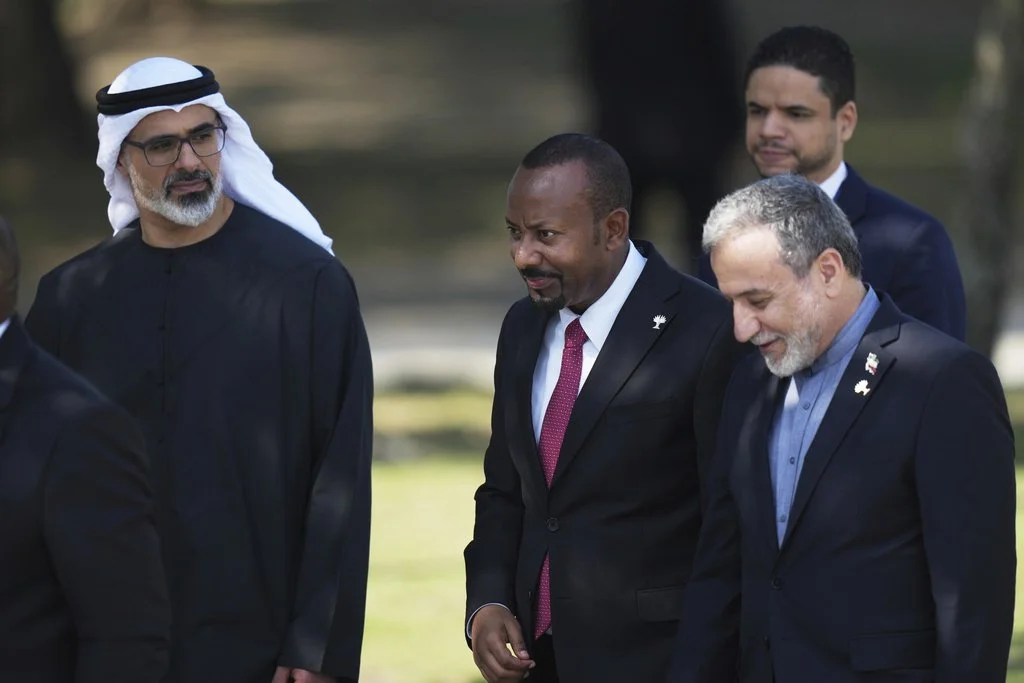
Crown Prince of Abu Dhabi Sheikh Khaled Bin Mohamed Bin Zayed Al Nahyan, left, Prime Minister of Ethiopia Abiy Ahmed, center, and Iranian Foreign Minister Abbas Araghchi, leave after taking a group photo before the start of the 17th annual BRICS summit in Rio de Janeiro, Sunday, July 6, 2025. (AP Photo/Silvia Izquierdo)
The United Arab Emirates (UAE) has emerged as a global power in recent years. In an attempt to diversify its economy, it has moved away from oil into becoming a trade hub and developing its financial services. Using this new global position, the UAE has expanded its sphere of influence globally. Nowhere is this more present than in East Africa, where it has created a web of alliances to serve its geopolitical interests, while being relatively unaffected by its consequences.
The most renowned of the UAE’s African ventures is that of Sudan. The Sudanese people revolted against dictator Omar al-Bashir in 2019. The former president was eventually removed from power following a military coup by the Sudanese Armed Forces (SAF), led by Abdelfattah al-Burhan. The SAF was supported by the Rapid Support Forces (RSF), a militia created by al-Bashir that effectively served as his private army.
Al-Burhan was eventually established as the interim leader of Sudan by 2022. Mohamed Hamdan Dagalo, known as Hemedti and the leader of the RSF, acted as his deputy. A deal struck in December 2022 effectively made Hemedti and al-Burhan military equals, as it specified the RSF’s integration into the SAF, and conflict started in April 2023.
Since the start of the conflict, the UAE has been accused of supporting the RSF, as the militia commits atrocities that have been considered acts of genocide by many. Sudan is one of the largest producers of gold in the world, and the UAE, being one of the biggest markets for the material, has put matters in its own hands to receive massive imports of gold at a cheap cost. Most of the shipments of gold received by the Emirates have been smuggled across borders, or come from gold mines under direct ownership of the Emirati government.
Smuggling the gold is only possible because of intricate alliances between the UAE and many of Sudan’s neighbors, including Ethiopia. Ethiopia was supported by the UAE in the Tigray War of 2020-22, in which it received drones from the Emirati government. Since this war, the relationship between the two states has been quite positive, with the Emirates providing financial support, while Ethiopia has allowed the Emirates to use its territory as a logistics hub, particularly important for the UAE’s role as the RSF’s chief financier.
Particularly important is the development of a secret military base in the Benishangul-Gumuz region of Ethiopia. The UAE plays a fundamental role in the base’s operations, having financed its construction and providing military trainers to the site. The base, located close to the Ethiopian border with Sudan, provides training to RSF fighters. Ethiopia has also played a major role in the distribution of supplies to the RSF, with many Emirati flights traveling to Ethiopia with this goal in mind.
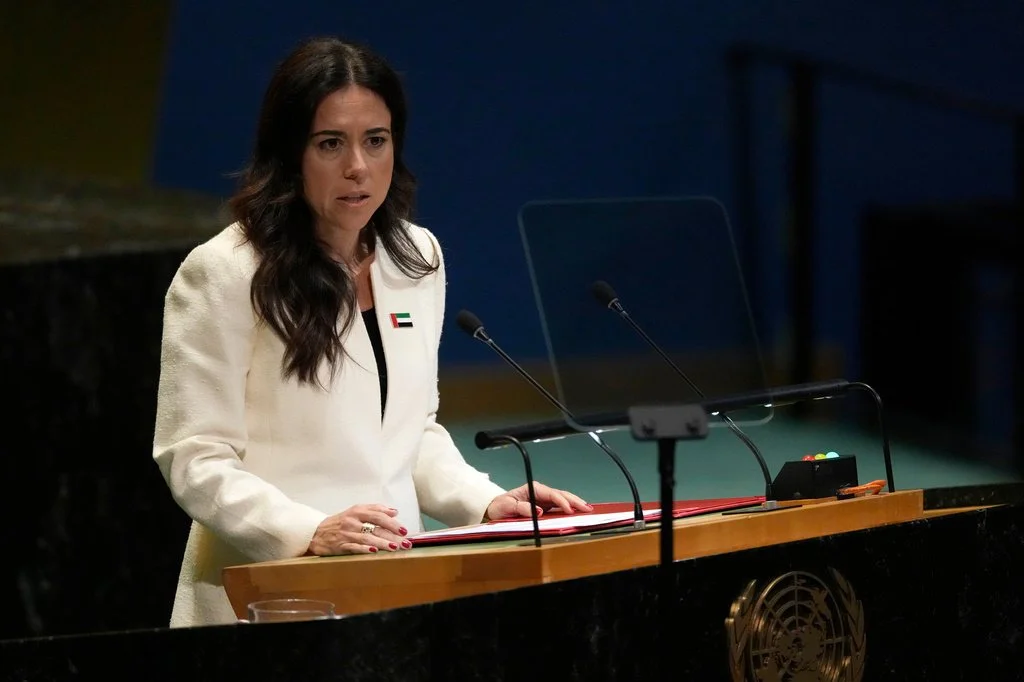
Minister for Foreign Affairs of the United Arab Emirates Lana Nusseibeh addresses the 80th session of the United Nations General Assembly, Saturday, Sept. 27, 2025, at U.N. headquarters. (AP Photo/Pamela Smith)
As of January 2026, Saudi Arabia and Somalia, among others, have closed their airspace to Emirati cargo flights carrying supplies for the RSF. Somalia is especially important in this matter. The semi-autonomous region of Puntland, as well as bases in Somaliland, had previously played an important role in housing Colombian mercenaries bound for Sudan. Puntland has rejected the Somali state’s diplomatic boycott of the UAE. Nevertheless, the uncertainty presented in Somalia has led the UAE to strengthen ties with Ethiopia, as well as with Chad, with both countries receiving large sums of money to allow for logistical support of the RSF.
Sudan is not the only theatre in which the UAE has based all of these connections. The war in Yemen also has important ramifications on Emirati policy, particularly in the Horn of Africa. The Houthis emerged in 2014, taking over large areas of northern Yemen. Backed by Iran, Saudi Arabia immediately intervened in the conflict in support of the internationally recognized government; the UAE supported the Southern Transitional Council (STC), since dissolved in January 2026. Prior to its dissolution, Emirati support of the STC severely strained Emirati ties with Saudi Arabia, a major factor in the aforementioned airspace shutdown.
To counter airspace shutdowns, the UAE utilized a strategy of port development, particularly important in the Horn of Africa. These ports are not exclusive to the Horn, as ports can be found in Tanzania and Egypt; however, those in the Horn come with significant military importance in the Yemen War, while the others have remained mostly commercial. One of these ports is the port of Assab in Eritrea, where an Emirati military base was established in 2016. With the current war in Tigray pitting Ethiopia against Eritrea, the prospect of an Emirati port in Eritrea has become increasingly unwelcome. At its time, however, the port was essential for Emirati operations in Yemen, and allowed Eritrea to return to the international stage after years of sanctions and isolation. In Somaliland, the port of Berbera was similarly used by the Emirates, a move heavily supported by Ethiopia, which aimed to strike a deal with Somaliland to receive preferential access to the port, although talks stalled.
What’s most important to recognize is that the Emirates is far removed from the consequences of these actions. While international critiques have occurred, a 2024 report on the Sudan War by a panel of experts at the United Nations (UN) did not mention Emirati support for the RSF. A resolution passed by the Parliament of the European Union (EU) similarly excluded the Emirates from the document, coming after Lana Nusseibeh, Emirati Minister for Foreign Affairs, traveled to Strasbourg to lobby Members of the European Parliament (MEPs) against internationally condemning the UAE. Furthermore, the conflict in Sudan has seen millions flee as refugees, or remain as internally displaced persons, mostly to neighboring states such as Egypt, Ethiopia, Chad, and Libya. Refugees are not exclusive to these states; on the contrary, many have fled further, crossing the Mediterranean into Europe via Italy and Greece.
What is more dystopian than the lack of accountability is the continued ignorance of the Emirates. Lana Nusseibeh has become a candidate for the position of Secretary-General of the UN, with many human rights groups protesting her candidacy as she has spent the last decade denying claims of atrocities in Yemen and Sudan and lobbying foreign governments against condemning the Emirates. Her introduction has shaken up the race, as there is no clear winner as of yet.
In an effort to become a global power, the Emirates has disrupted a vulnerable region and taken advantage of conflicts for its own benefit. In spite of clear evidence of its role in exacerbating conflicts, diplomats such as Lana Nusseibeh have cleared the Emirates’ name in the eyes of the international community. With the world turning a blind eye to this role, how can accountability for human rights violations be achieved, and how can international law be upheld if there are exceptions to the rules?