
India Collaborates on Climate Goals at COP33
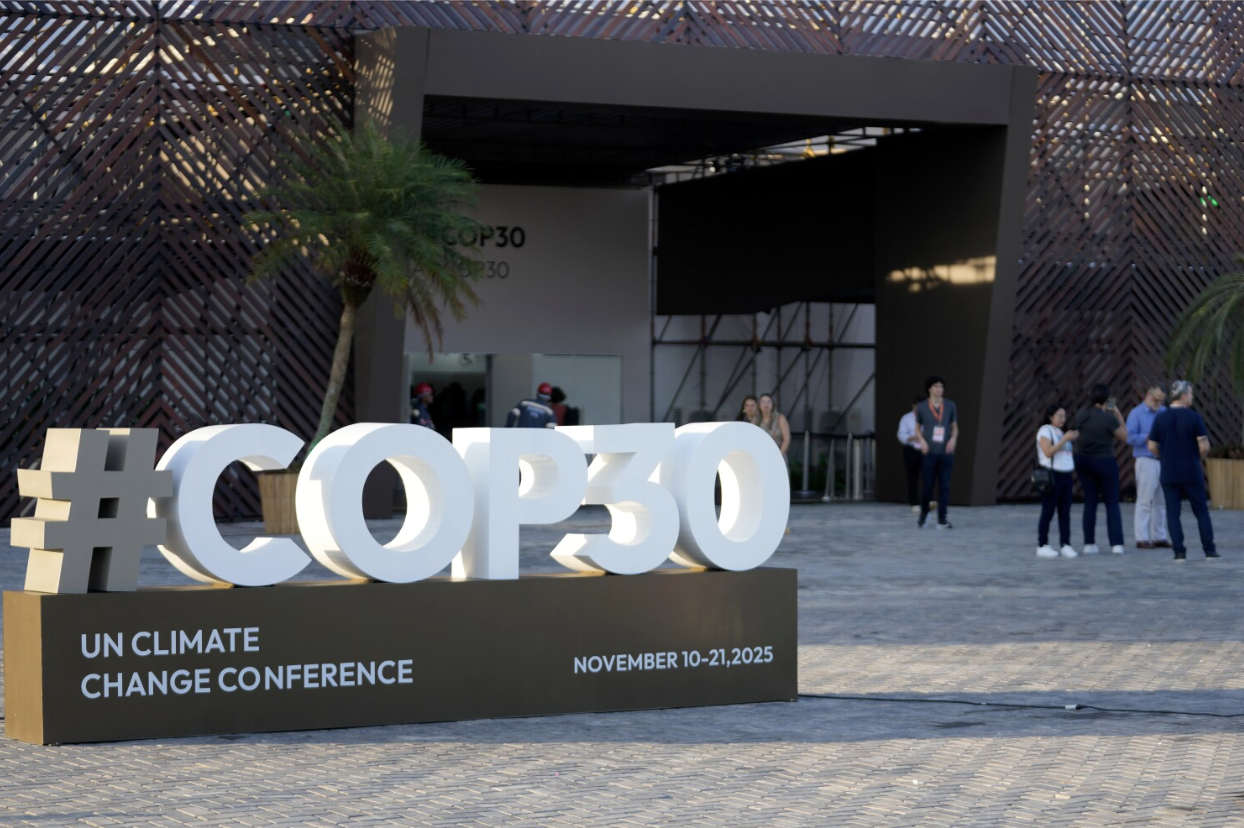
A sign for the upcoming COP30 U.N. Climate Summit sits outside of the press center in Belem, Para state, Brazil, Tuesday, Nov. 4, 2025. (AP Photo/Eraldo Peres)
India’s position at the 30th Conference of the Parties (COP30) to the United Nations Framework Convention on Climate Change (UNFCCC) has drawn heightened attention as the nation continues to delay announcing its 2035 emissions target. India is the world’s most populous country, and the third largest emitter of greenhouse gases, making it an important member of the COP30.
As negotiations progress and most G20 countries meet their nationally determined contribution (NDC) deadlines as mandated under the Paris Agreement, India’s silence has created a space for speculation about both its strategy and its broader environmental trajectory.
This hesitation is not entirely unprecedented. India has previously emphasized that its priorities center on production, reflecting the need to support a developing economy. Prime Minister Narendra Modi has long emphasized the UNFCCC principle which acknowledges the distribution of economic and developmental circumstances in countries participating in the climate fight. As Modi put it in an address at the 2015 Sustainable Development Summit, “the principle of common but differentiated responsibilities is the bedrock of our collective enterprise.”
While India has participated in this collective enterprise by making substantial commitments in the past—such as reducing emissions intensity by 45 percent (from 2005 levels) by 2030, achieving 50 percent non-fossil fuel power capacity, and reaching net-zero by 2070—setting a future target involves balancing complex domestic and international priorities. India’s economic structure is closely tied to energy-intensive sectors such as steel, cement, manufacturing, and an expanding transportation network. Rapidly growing industrial aims accounted for over 40% of India’s energy consumption in 2022, and contribute 30% to the nation’s GDP, thus functioning as an integral sector, one that is difficult to shift away from. At the same time, India faces significant and undeniable exposure to climate risks: heatwaves, erratic monsoons, flooding, water scarcity, and agricultural disruption threaten both livelihoods and the long-term economic growth many worry about safeguarding.
Against this backdrop, observers at COP30 are trying to interpret what India’s delay signals. Some analysts argue that the government may be waiting to secure better financing commitments from developed countries before finalizing a new target. India has consistently stated that meaningful progress on climate mitigation depends on enhanced climate finance, technology transfer, and capacity-building support from wealthier countries. In recent years, climate finance has especially become a point of discussion and frustration for economically developing countries struggling to meet climate goals. The climate finance deal agreed upon at COP29, which was intended to facilitate the transfer of funds from more wealthy nations to developing nations, to support the decarbonization of their economies, fell short, with one Indian representative, Chandni Raina, calling it “abysmally poor” compared to what is realistically needed. Global climate negotiations are increasingly focused on accountability, implementation, and a history of tension during negotiations; therefore India may be leveraging its position to ensure that new pledges are backed by credible financing mechanisms.
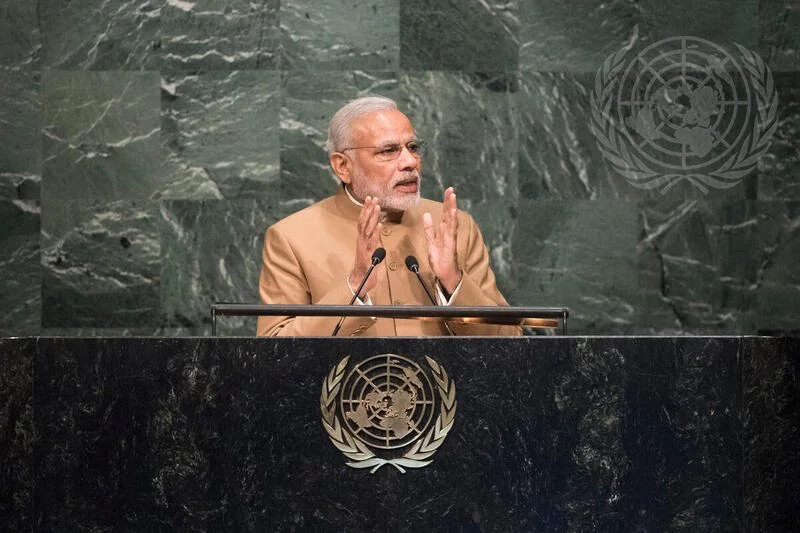
Narendra Modi, Prime Minister of India, addresses the United Nations summit for the adoption of the post-2015 development agenda. UN Photo/Mark Garten
Another interpretation is that India is aiming for a more multilateral, collaborative stance. Rather than announcing an ambitious new number, the country may focus on strengthening existing commitments, particularly around renewable energy scaling and energy-efficiency improvements. India’s rapid deployment of solar and wind power—among the fastest in the world—illustrates that the government is not opposed to climate ambition. COP30’s President André Corrêa do Lago has affirmed that this year’s conference must be remembered as one of “adaptation and implementation,” perhaps reflecting the immediate urgency of taking steps forward in the climate fight.
Though aligning these priorities while maintaining affordable energy access remains a central challenge, India’s role is too large for the world to ignore. As a rapidly developing economy with enormous energy demand, the country’s choices will significantly shape global emissions trajectories. Its vulnerability to climate impacts only deepens the urgency: without decisive action, the human and economic toll of warming will fall disproportionately on India’s population.
The international community is watching closely as India expresses its intention to host the COP33 conference in 2028, signalling leadership in the climate fight. Whether India ultimately reveals an ambitious 2035 target or doubles down on existing, realistic pledges, their approach will signal how the world’s most populous nation balances development, responsibility, and resilience in the decade ahead.