

India’s Prime Minister Narendra Modi, seventh left, poses for photographs with chief executive officers of various AI groups during the AI Summit in New Delhi, India, Thursday, Feb. 19, 2026. (Indian Prime Minister's Office via AP)
India’s Prime Minister Narendra Modi, seventh left, poses for photographs with chief executive officers of various AI groups during the AI Summit in New Delhi, India, Thursday, Feb. 19, 2026. (Indian Prime Minister's Office via AP)
Artificial intelligence is rapidly becoming one of the most energy-intensive forces in the modern economy. At the India AI Impact Summit earlier this year, OpenAI CEO Sam Altman stirred up debate when he dismissed worries about AI's water usage as “fake” and “completely untrue.” He argued that we should compare AI's energy consumption to the resources needed to “train a human.” However, his remarks have intensified a global debate among policymakers and researchers about the physical requirements of our digital age, highlighting that AI is reshaping energy consumption in ways reminiscent of the Industrial Revolution.
The tension of this new era was on full display at the summit. Prime Minister Modi tried to present a united global front, but the spotlight quickly shifted to rivals Sam Altman and Dario Amodei, who very noticeably avoided holding hands during the group photo. This viral moment underscored a hard truth: despite the rhetoric surrounding “AI for good,” the industry’s biggest players are locked in a zero-sum race for the energy and water needed to keep their models running.
When we talk about AI, we often think of code and algorithms, but there’s a huge physical component behind the scenes. Data centers and powerful chips are the backbone of AI, and their energy demands are significant. This is not merely a technical shift but a geopolitical one. Announced foreign direct investment (FDI) in digital infrastructure exceeded $270 billion in 2025, capturing more than one-fifth of all global greenfield investment. The United States currently dominates this landscape, housing 4,165 operational data centers, roughly 51% of global hyperscale capacity. Just like the industrial growth of the past, tech giants like Amazon, Microsoft, and Google collectively spent over $200 billion on capital expenditures in 2024 to secure future competitive advantages.
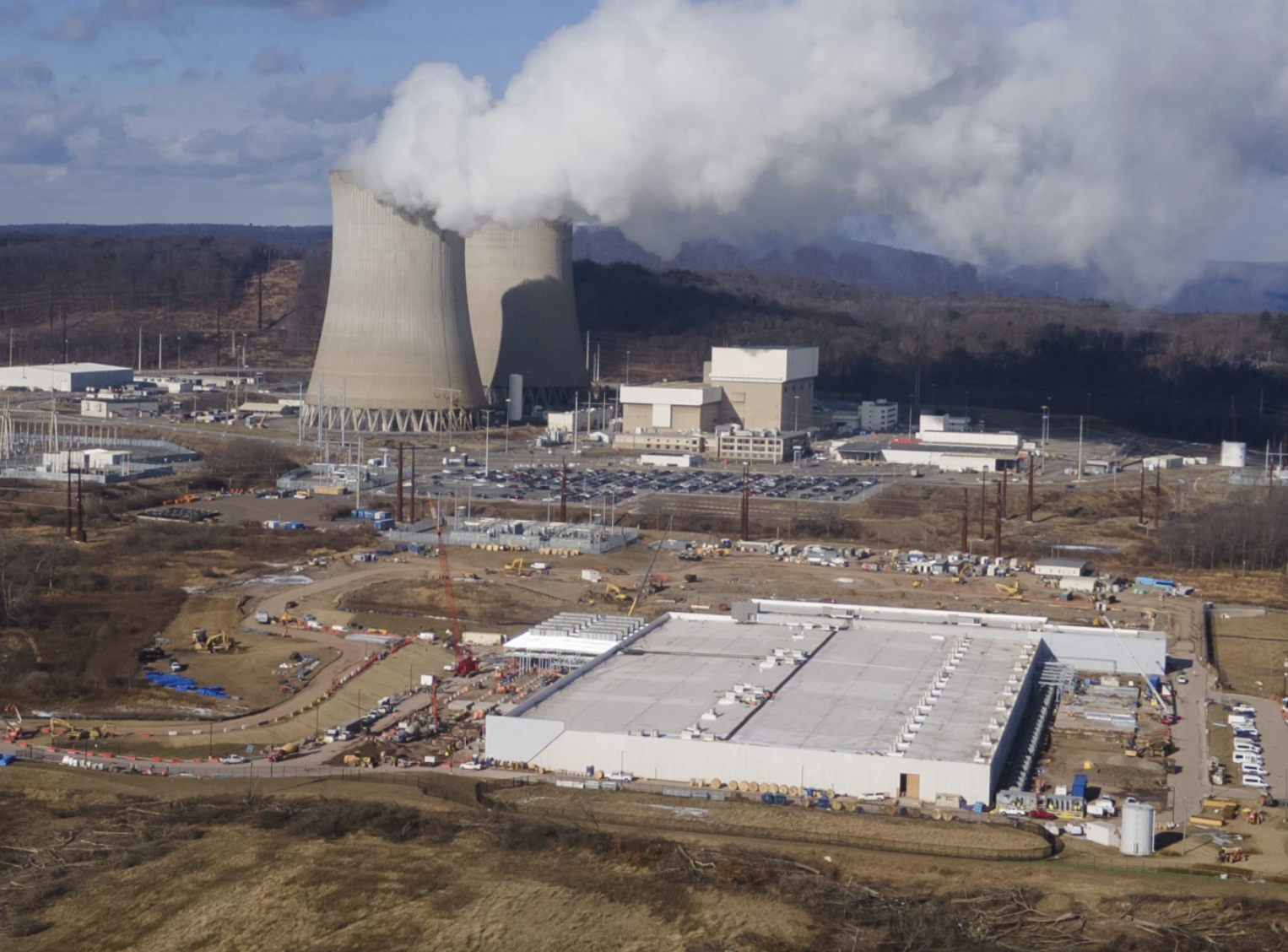
A data center owned by Amazon Web Services, front right, is under construction next to the Susquehanna nuclear power plant in Berwick, Pa., on Jan. 14, 2025. (AP Photo/Ted Shaffrey, file)
However, this “build-out moment” is unfolding unevenly. While investment flows toward a handful of hosts like the US, France, and South Korea, emerging markets in Southeast Asia and Latin America are racing to develop their own “digital backbones” to avoid long-term dependence on Western resources.
Despite Altman's downplaying of environmental impacts, the environmental footprint of artificial intelligence is complex and daunting. A primary concern is water scarcity. Data centers rely on extensive cooling systems to prevent server failure, with researchers at Cornell University estimating that by 2030, AI infrastructure could drain up to 1,125 million cubic meters of water annually. A volume equivalent to the annual usage of about 10 million American households.
The energy demands are equally alarming, as a single ChatGPT query consumes ten times the electricity of a standard Google search. In fact, the US data center demand is projected to surge from 4.4% of total national electricity consumption in 2023 to as much as 12.0% by 2028. Furthermore, producing a single 2-kilogram computer requires 800 kilograms of raw materials, often involving the unsustainable mining of rare earth elements and leaving behind a generation of hazardous electronic waste.
This rush to build out digital infrastructure is already testing the limits of local governance. In July 2024, a voltage fluctuation in northern Virginia caused 60 data centers to disconnect simultaneously, narrowly avoiding a cascading grid failure. Such risks are prompting new regulations. In Texas, the recent Senate Bill 6 aims to protect the grid from speculative large-load requests and ensure fair cost-sharing, while the City Council of San Marcos recently rejected a $1.5 billion data center project due to public fears of grid strain and rising costs.
As Altman himself noted, the industry must move toward nuclear, wind, and solar “very quickly” to sustain this scale. However, the United Nations Environment Programme warns that while governments are racing to develop national AI strategies, they often overlook essential environmental protections.
The global race for AI is no longer just a competition over computing power. It is a test of how societies will balance borderless technological ambition with the reality of the planet’s limited natural resources.