
Artemis II Launch Marks the First Manned Mission to the Moon Since 1972

The Apollo 17 command module America makes a perfect splashdown in the Pacific south of Pago Pago Tuesday Dec. 19, 1972, at the end of the final lunar mission of the Apollo series. (AP Photo/PL)
For the first time since 1972, NASA will send astronauts on a mission to the Moon with the Artemis II launch on April 1, 2026. The last manned Moon mission was Apollo 17 in 1972, in which NASA sent astronauts for geological surveying and material sampling. Under President Nixon, the remaining planned Apollo missions were canceled, as debates arose about NASA funding. Since then, no humans have set foot on the surface of the Moon due to further financial and political constraints.
While the Artemis II mission does not send astronauts to the surface of the Moon, it marks the farthest crewed mission from Earth ever, as astronauts will circle the Moon to see its far side. The Orion Spacecraft launched at 6:35 pm EDT on April 1, 2026, out of the Kennedy Space Center in Florida, marking the beginning of the Artemis II mission. The Orion spent its first two days in testing within the Earth’s orbit, and then reached its farthest point from Earth on the far side of the Moon on April 6, 2026. It will splash down back on Earth on April 10, 2026, in the Pacific Ocean.
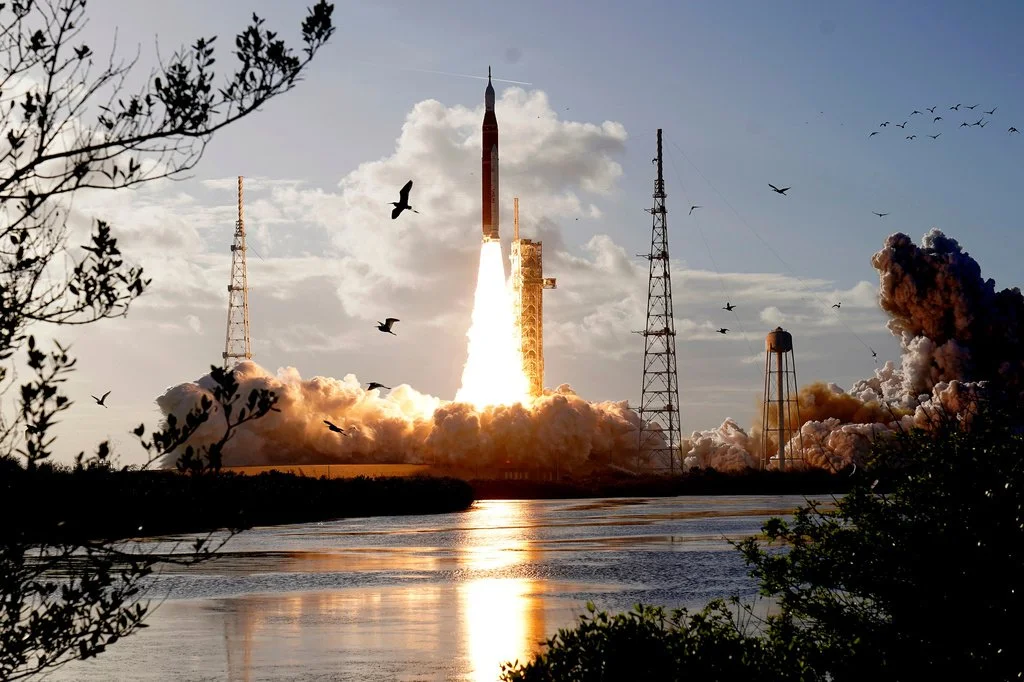
NASA's Artemis II moon rocket lifts off from the Kennedy Space Center's Launch Pad 39-B Wednesday, April 1, 2026, in Cape Canaveral, Fla. (AP Photo/Chris O'Meara)
The Artemis II crew consists of four astronauts: Reid Wiseman (Commander), Victor Glover (Pilot), Christina Koch (Mission Specialist), and Jeremy Hansen (Mission Specialist). This diverse team set new records, with Glover being the first black astronaut to visit the Moon, Koch being the first woman to visit the Moon, and Hansen being the first non-American to visit the Moon, as he is an astronaut of the Canadian Space Agency. Their training has been ongoing since June of 2023, and has progressed from learning system fundamentals to being put in unexpected situations in which they had to adapt. This involved preparation in flying and simulations, as well as scientific and geology training.
The ultimate goal of this mission is to gather critical information about deep space travel to further inform future missions to the Moon and Mars. Additionally, NASA seeks to obtain extensive geological information about the Moon’s far side, which always faces away from the Earth. NASA scientists are also focusing on the health of the astronauts aboard the Orion Spacecraft, detailing the effects of deep space travel on the physical, mental, and behavioral states. Several of these scientific studies included in the Artemis II mission are the Immune Biomarkers Study, the ARCHeR Study, and the Artemis II Standard Measures Study. The Immune Biomarkers Study targets how space travel affects the immune system of astronauts, by collecting and analyzing saliva samples from them throughout the mission to monitor virus, hormone, and protein levels. Additionally, the ARCHeR Study utilizes sleep and movement monitors before, during, and after the mission to monitor any effects on behavior. Lastly, the Artemis II Standard Measures Study includes psychological assessments and blood sample analysis before, during, and after the mission, gathering critical health information. Further, NASA is utilizing organ-on-a-chip devices to hold collected cells from the astronauts within the Orion, to monitor the effect of radiation and microgravity during deep space travel.
Moving forward, the Artemis III and IV missions are set to occur within the next two years, as NASA plans to return humans to the surface of the Moon. The Artemis III mission is expected to launch in 2027, docking the Orion Spacecraft with commercially designed lunar landers from Elon Musk’s SpaceX and Jeff Bezos’ Blue Origin. In this mission, NASA intends to further test the space suits developed by Axiom Space for the lunar surface. Then, the Artemis IV mission is planned to launch in 2028, bringing humans back to the surface of the Moon. On this mission, NASA plans to explore the lunar South Pole region, collecting critical samples and data. Further, after these Artemis missions are completed, NASA Administrator Jared Isaacman states that the agency hopes to send humans to the surface of the Moon at least twice a year.