
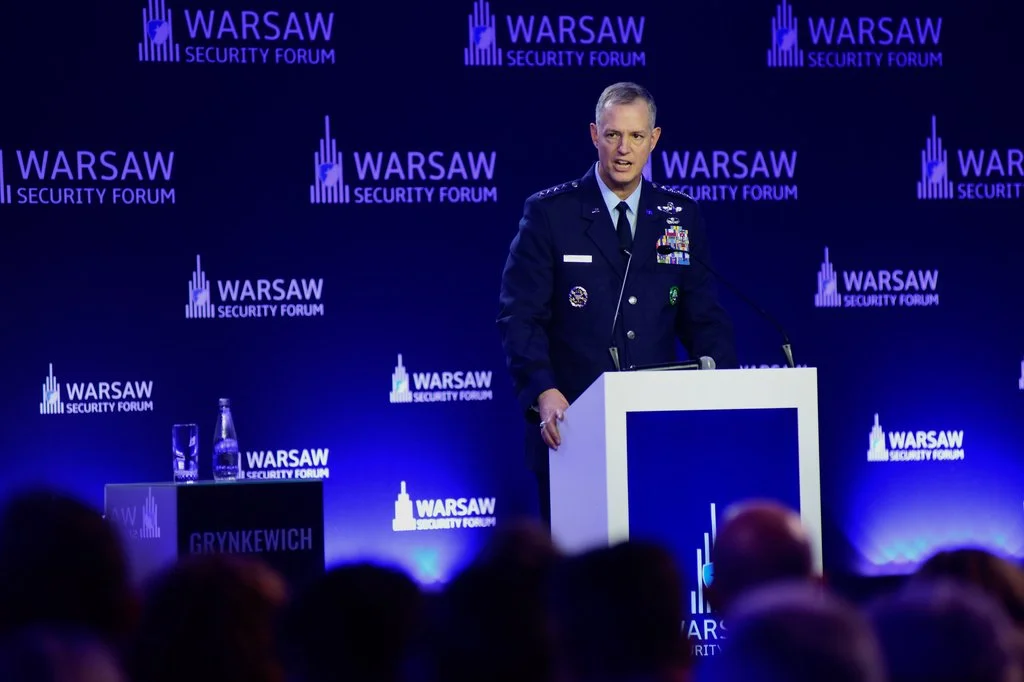
Air Force Gen. Alexus G. Grynkewich, commander of the United States European Command and Supreme Allied Commander Europe, speaks at the Warsaw Security Forum in Warsaw, Poland, Monday, Oct. 12, 2026. (AP Photo/Attila Husejnow)
On Oct. 12, NATO's top military commander told the Warsaw Security Forum that the alliance does not seek war but is " ready to fight tonight" if attacked. U.S. Air Force Gen. Alexus Grynkewich laid out what he called NATO's theory of victory: block an initial attack, blunt it if it persists and, if required, break the enemy's forces along with everything that sustains them. He added that conflict is neither imminent nor inevitable and that the surest way to keep the peace is to prepare for war while keeping lines open with Moscow. The setting mattered as much as the message. Western officials have blamed Russia for at least 211 sabotage and covert incidents since the 2022 invasion of Ukraine, from an arson attack on an Estonian defense company to a failed drone plot against a Ukrainian aircraft at Leipzig airport. Danish military intelligence sees a low but growing risk of a limited Russian attack on a NATO state bordering Russia, and Prime Minister Donald Tusk has warned that Moscow may disguise strikes as accidents to sap the allies' will to respond.
A day later, at the same forum, Foreign Minister Radosław Sikorski made Warsaw's request explicit: a permanent American base on Polish soil. He urged President Karol Nawrocki to use his rapport with Donald Trump to secure that presence and to make it clear in Washington that Russia is the aggressor and Ukraine cannot be pushed into surrender. In late September, at the Council on Foreign Relations in New York, Sikorski said the two governments were discussing a facility for up to 10,000 troops, a presence that would reassure Poland but not threaten Russia. The timing is striking. Washington has announced a drawdown of roughly 5,000 troops from Germany, drained Europe's stock of air defense interceptors for its war with Iran, and struck a diesel deal with Moscow ahead of the midterms. Poland is asking for more Americans, not fewer. The reason lies in its history.
For Poles, Russia is not an abstraction in a strategy paper. In September 1939, Britain and France declared war on Germany to honor their guarantee to Poland, then offered almost no practical help. Sixteen days after the Wehrmacht crossed from the north, south, and west, the Red Army invaded from the east under the secret protocol of the Molotov-Ribbentrop Pact. In the spring of 1940, the NKVD shot roughly 22,000 Polish officers, policemen, and intellectuals at Katyn and other sites. After the war came a satellite regime, a secret police, and four decades without freedom. Poles drew two lessons from that history, and both still shape their strategy: Moscow fills every vacuum it finds, and a guarantee is worth exactly as much as the soldiers standing behind it.
When resistance finally broke through, it came from the shipyards. In August 1980, some 17,000 workers occupied the Lenin Shipyard in Gdańsk after the firing of crane operator Anna Walentynowicz. Their leader, Lech Wałęsa, was an electrician who had been sacked for union activism and who climbed the shipyard wall to join the strike. On Aug. 31, the regime signed the Gdańsk Agreement, and Solidarność became the first independent trade union in the Soviet bloc. Within about a year, it counted close to ten million members, roughly a quarter of the country.
Moscow's answer was force. On Dec. 13, 1981, under Soviet pressure, Gen. Wojciech Jaruzelski declared martial law, outlawed the union and jailed its leaders, Wałęsa among them, for nearly a year. In 1984, the secret police murdered Solidarity's chaplain, Father Jerzy Popiełuszko. None of it worked. The Round Table talks of 1989 produced semi-free elections that Solidarity swept; Tadeusz Mazowiecki became the first non-communist prime minister in the Soviet bloc, and in December 1990 Wałęsa was elected president. It can be argued that the end of the Cold War started in Poland.
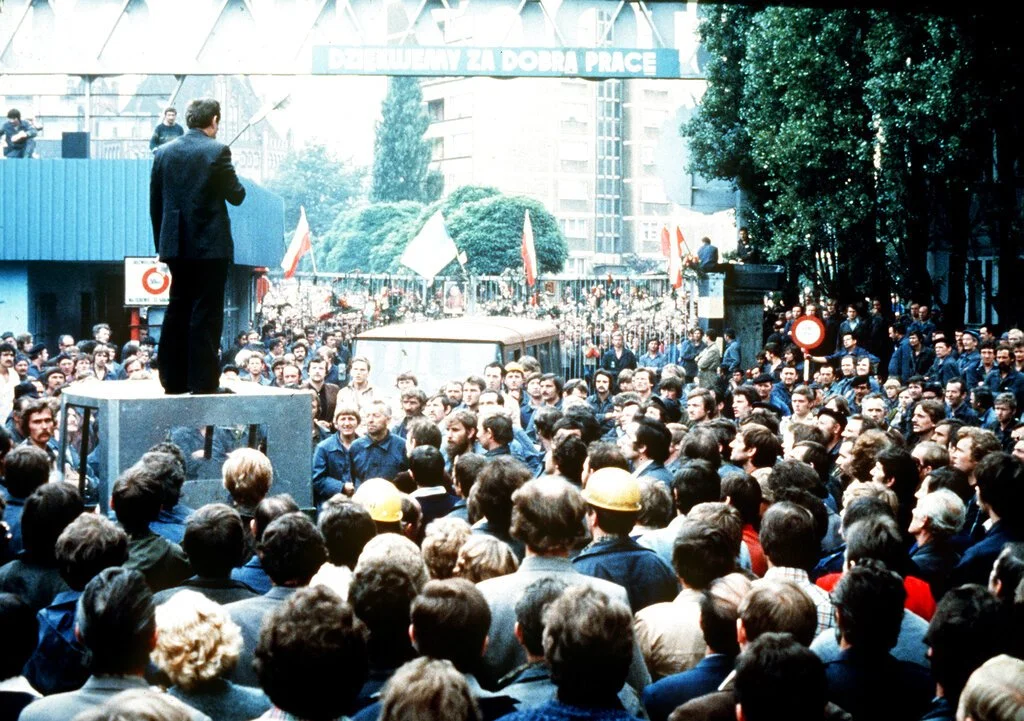
Strikes in Gdansk, August 1980 - Hundreds of sympathizers stood outside the gates of the Lenin shipyard in Gdansk, Northern Poland as strikings workers held a series of meetings inside. Gates of the yard were decorated with flowers, the Polish national flag, and a picture of Pope John Paul II. Crowds outside had continued to bring food, flowers and money. (AP-Photo/Sixten Johannson)
Memory explains why Poland wants American soldiers. Money explains why it can ask for them. When Poland joined the EU in 2004, its GDP per capita adjusted for purchasing power stood at 49 percent of the bloc's average. In 2025, Eurostat put it at 81 percent, the highest on record, level with Portugal and well ahead of Greece. The economy grew 3.6 percent last year. According to Poland's foreign ministry, cumulative growth between 2003 and 2025 reached almost 130 percent, against 34.5 percent for the EU as a whole, while unemployment fell from 19 percent to 3 percent. Poland is now the world's 20th-largest economy, with more than $1 trillion in annual output.
That wealth has turned into hard power faster than anywhere else in the alliance. Defense spending has risen from 2.2 percent of GDP in 2022 to 4.8 percent in the 2026 budget, about 200 billion zloty, and is one of the highest shares in NATO. According to NATO's own estimates, the United States spends about 3.2 percent and France about 2 percent. The bill is real. In September, Moody's downgraded Poland's credit rating and said it expects the deficit to stay near 7 percent of GDP through 2027, with public debt rising from 59.7 percent to 68.9 percent. Warsaw is betting that being unprepared would cost more.
This is the paradox of the transatlantic relationship in 2026. The broader American posture in Europe is contracting, and even the general who promised to fight tonight conceded that troop deployments are ultimately a political decision. In Poland, the line points the other way. Roughly 10,000 U.S. service members are already in the country, most of them on rotation, alongside the forward headquarters of the Army's V Corps in Poznań. Earlier this year, the Pentagon reversed a decision to cancel a 4,000-troop deployment. A permanent base, which Nawrocki has already baptized "Fort Trump," is now under negotiation.
Poland earned that exception by speaking this administration's language. It outspends every ally relative to the size of its economy, buys American hardware from Patriot batteries to Abrams tanks, and frames the U.S. presence as a good deal rather than a favor. Washington has called it a model ally and on burden sharing, the label is hard to dispute. Yet reading this as Poland choosing America over Europe would be a mistake. According to the foreign ministry, about 85 percent of foreign investment in Poland comes from other EU states, and Brussels has allowed Warsaw and fourteen other capitals to keep defense spending outside the bloc's fiscal rules. Poland is Atlanticist because it is European and European because it is Atlanticist. It wants an American tripwire and a European rearmament at once.
That combination makes Poland the EU's most credible safeguard, on three counts. The first is ideological. The European project rests on the promise that the continent will never again be carved up by empires, and Poland is the member state that knows from living memory what the absence of that promise looks like. Solidarity was the moment the Iron Curtain began to crack, and that memory gives Warsaw a clarity on Russia that Paris, Rome, and Berlin have often lacked. The second is economic: a country that has more than doubled its output in two decades and spends close to 5 percent of GDP on defense is no longer the junior partner of the 2004 enlargement but one of the Union's engines. The third concerns the future. With nearly 38 million people and one of the largest land armies on the continent under construction, Poland is the natural anchor for the frontline states that see Russia as it does: the Baltic republics, Romania and the other Bucharest Nine members, along with Finland.
That role has a precedent. In 1569, the Union of Lublin merged Poland and Lithuania into a Commonwealth. For two centuries it ranked among the largest states in Europe, and it held together because its members pooled what neither could defend alone. Today's frontline states face the same choice. Poland, the Baltic republics and their Nordic and Romanian partners share a reading of the Russian threat and defense budgets well above the European average. Coordinating procurement, air defense and the Suwałki Gap, the narrow strip between Belarus and Kaliningrad that forms the only land link between Poland and the Baltics, would turn them into a coherent eastern bloc inside the EU and NATO rather than a row of exposed borders. The Lublin Triangle, which Poland, Lithuania and Ukraine launched in 2020 and named for the 1569 union, shows Warsaw already thinks in these terms.
The Commonwealth also shows how such a bloc dies. It fell not for lack of soldiers but because the liberum veto let a single deputy paralyze every decision, giving Russia, Prussia and Austria the opening to partition it by 1795. An EU in which one government can stall sanctions or aid by veto should recognize the pattern. So should Poland, where the standoff between Tusk's government and Nawrocki's presidency over the Constitutional Tribunal is exactly the kind of fracture Moscow knows how to exploit. Warsaw must also lead as a first among equals, not an heir to the empire. Lithuanians remember the Commonwealth too, and not all of those memories are warm.
Grynkewich's message was that NATO will not be caught by surprise. Poland's is that it refuses to be caught alone again. The open question is not whether Poland is ready. It has spent, built, and lobbied as if its existence depended on it, because twice in the last century it did. The question is whether the rest of Europe treats the security of its eastern frontier as its own or as a problem to subcontract to Washington. In 1980, a shipyard electrician climbed a wall and helped bring down an empire. Whether Europe defends the country where that happened will show what European integration is worth. That is why Poland is Europe's stress test.