
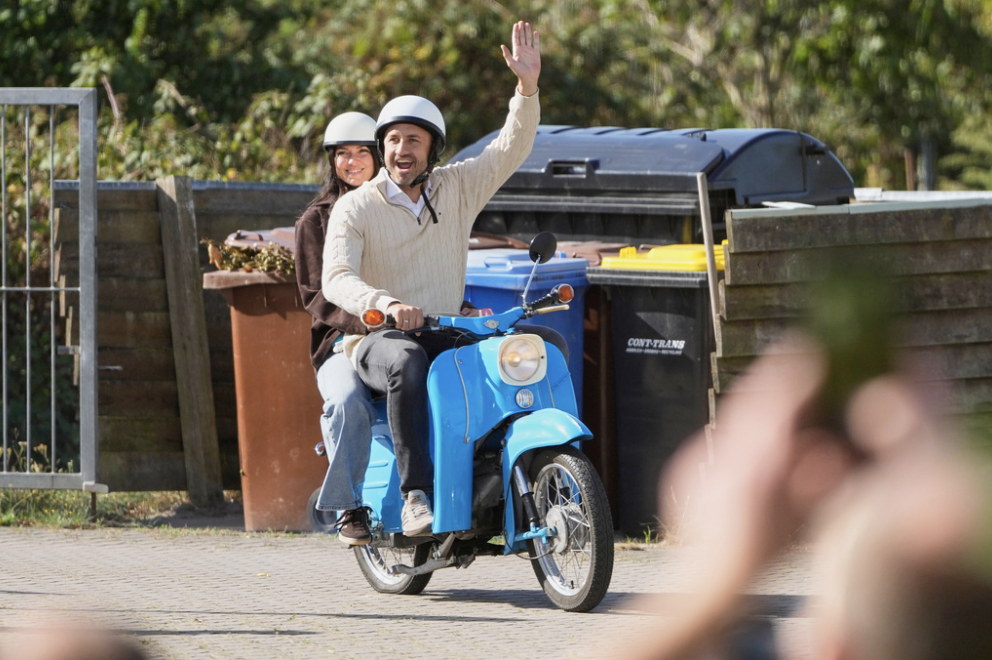
Ulrich Siegmund, top candidate for the Alternative for Germany (AfD) party arrives with his wife Julia on a small Schwalbe motorcycle to vote at a polling station during the Saxony-Anhalt state elections in Tangermuende, eastern Germany, Sunday, Sept. 6, 2026. (AP Photo/Matthias Schrader)
In the wake of the recent protests throughout Germany and state elections, the question of what is mobilizing the youth is at the forefront of many analysts’ minds. Throughout the country, German youth have expressed their attitudes towards politics and governance through an increasingly anti-centrist approach. Gender differences and nostalgia for the former GDR in the form of Simson motorcycle iconography are factors in the youth response to governance and to which political parties they seek allegiance. For young voters growing up after unification, the Simson motorcycle has been passed down through generations, and remains a symbol of youth rebellion and GDR culture. It connects young voters to the notion of first-time independence, just as it did for their parents and grandparents living in the GDR. This familial and East German cultural significance breeds a sense of nostalgia for a time they never actually lived through.
Key structural differences between the lives of women and men in rural Europe motivate many young women to move to urban centers to pursue greater opportunity. This shift in urban-rural demographic composition influences whom political parties try to appeal to, as well as the imagery and narratives they use to do so. Women in rural areas are often driven to move to urban areas because, compared to men of the same age living in the same regions, they experience more limited access to services, rural organisations, and suitable, stable employment as opposed to part-time positions.
Further, women’s achievements in these regions are frequently less valued or recognized as those made by men. Reports from women living and working in rural agriculture highlight their heavy involvement in the business and management of their holdings, with many considering themselves as co-entrepreneurs. However, they are rarely legally recognized as having equal holdings to their male counterparts. At the same time they bear the primary responsibility for household management and childcare, which is often undervalued and unpaid. Further, they feel compelled to migrate when the area is sparsely populated, and the economy is struggling to facilitate their personal development, pursue higher education, and escape the ‘brain drain’ caused by the traditional rural lifestyle. Rural parts of the EU are oftentimes characterized by this gender-specific migration in which young women move out of these areas more often than young men.
Narrowing the focus to Germany, young people in former East Germany, a disproportionate number of them being women, are moving away from former industrial regions and rural areas in the East to urbanized areas to seek work and educational opportunities. This trend in youth opportunity-seeking migration can be traced back to the fall of the Berlin Wall in 1989, which opened direct migration from East to West Germany. Between 1989 and 2007, more than 1.7 million people migrated from East to West, and in that period, with women accounting for roughly 55 percent of that net migration.
This migration trend has lessened in recent years, wherein the East-West migration balance has become more stable. However, there still remains a shortage of young women in rural East German areas, which can be traced back to post-reunification gender specific migration trends. The regions in Germany most impacted by this phenomenon are former East German states of Brandenburg, Mecklenburg-Western Pomerania, and Saxony-Anhalt.
Those left behind in poorer rural areas are often tasked with maintaining businesses amid aging populations and a lack of economic development. The remaining, male dominated, population is left to deal with this cycle of a shrinking workforce and economy, which the New York Times coined as the ‘demographic doom loop.’ This has created a demographic that feels resentment and frustration towards the German government and their own economic situations, creating a population primed for targeting by the rising far-right extremist party, the AfD.
The AfD has built a party platform tailored to this electorate, largely targeting young men in former East German states, through the perpetuation of masculine imagery and a collective identity narrative. They validate young German men's concerns that the federal government is failing them and leaving them behind (at the same time that young women are when moving to urban centers). Study on emigration and far-right populism found that when there is an influx of emigration away from a particular region, the people in that region tend to blame the national government and mainstream political parties. This leaves them to turn to far-right populism in the case of East Germany and the AfD. The people left behind in poor, rural East German communities are more often young men and are more likely to support the AfD. To solidify voter loyalty, the party has crafted a visual icon that serves as the face of youth, masculinity, freedom, and nostalgia: the Simson motorcycle.
This motorcycle harkens back to the GDR, when it was mass-produced and served as the primary form of transportation due to the scarcity of automobiles. Since its creation, it has been a symbol of freedom and rebellion, and its iconography is now being capitalized upon by the AfD, which wants to identify with those who live in former East Germany and monopolize the aesthetic of youth rebellion. The leaders of the party, Bjorn Hocke in Thuringia and Ulrich Siegmund in neighboring Saxony-Anhalt, are frequently seen riding their Simsons at campaign events. In addition to rebellion, they intend to cast the image of nostalgia towards the “Ostblock” and a return to former East Germany before their electorate faced mass emigration and economic struggles.
The AfD was founded as a single issue, Euroskeptic party at the height of the Eurozone debt crisis. Initially, its focus was to oppose the Euro as the European form of currency. However, since the refugee crisis in 2015, it has gained support for its xenophobic, islamophobic stance. Now, it serves to promote an anti-woke and anti-immigration stance. They seek to prevent asylum seekers from entering Germany and want to deport people of non-German origin. Ironically, the Simson motorcycle, whose imagery the AfD regularly uses as part of its brand, was founded by a Jewish family who have protested the use of their product to perpetuate their discriminatory, far-right extremist agenda. Further, they oppose the very immigration that would stimulate the economies of their electorate in rural East Germany. Despite these logical and ideological issues with their branding and party stance, in the September Saxony-Anhalt state elections, they garnered 44% of the vote. Subsequently, on October 6, the Saxony-Anhalt AfD elected the first far-right extremist AfD politician, Tobias Rausch, as parliamentary speaker. The younger audience, and especially young men, in Saxony-Anhalt, persuaded by nostalgia and masculinity, showed support for the AfD.
Meanwhile, in September, Germany’s capital city of Berlin held its state elections. The left-wing party, Die Linke, secured 25.7% of the vote, running on a platform that champions affordable housing and social inclusivity. This success was driven primarily by young voters and the immigrant population in Berlin. 51% of young women in the electorate chose Die Linke compared to 34% of young men. This highlights a prominent gendered divide among the young electorate, influenced by party rhetoric and migration tendencies, in Germany.
In Germany, youth politics is deeply polarized and far from centrist. These political affiliations are driven by interconnected factors, including gender and urbanization, which have pushed many young men in Saxony-Anhalt to the far right and women in urban centers such as Berlin to the left. Yet, it is not only women in Berlin who advocate for the left. The ongoing Gen-Z protests across Germany, known as Gen-Z Regelt or “Gen-Z takes charge,” exhibit another layer of left-leaning anti-centrism that extends beyond the voting booth. The protests are occurring in the wake of education reform, climate change, and housing affordability protests across Europe, but they are salient for many young Berliners.
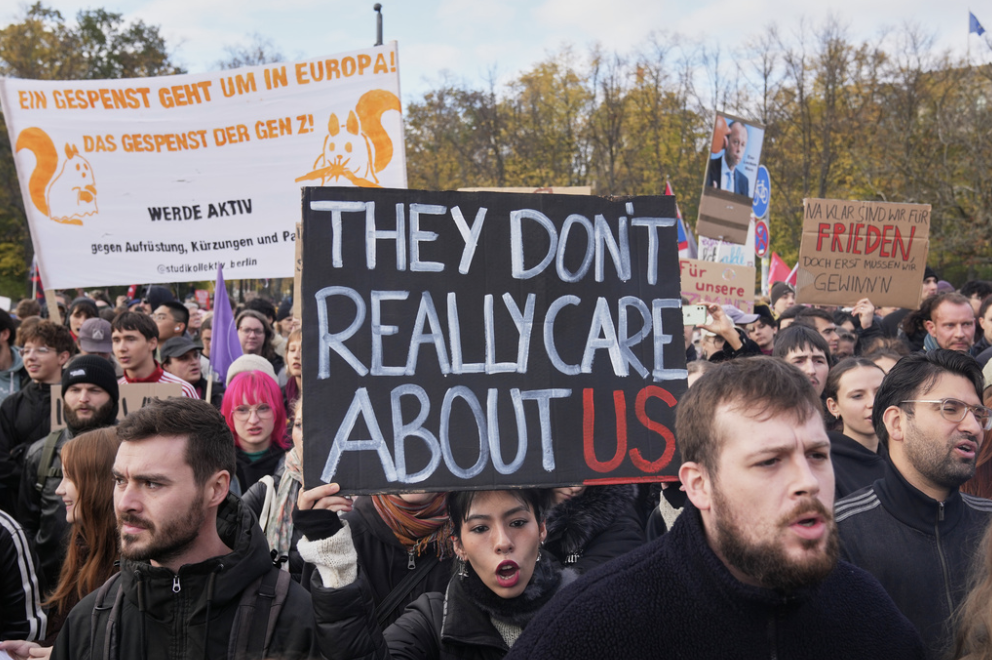
Demonstrators hold posters and chant slogans during a protest under the slogan “Gen Z Takes Care of It” in Berlin, Germany, Saturday, Oct. 31, 2026. (AP Photo/Ebrahim Noroozi)
While the youth in eastern Germany express rebellion through right-wing nostalgic iconography like the Simson, urban Berlin youth express theirs through left-party identification and mass street mobilization, influenced by the European housing crisis and international protests. While they appear very different, both movements exhibit a similar notion, which is that there is a crisis of governmental trust and being left behind by the German state.
If these anti-centrist voting patterns persist, mainstream parties, such as the Christian Democratic Union (CDU) led by chancellor Friedrich Merz, may be pushed further to the right on immigration to win back the young male German electorate, further tightening border controls and expanding deportation policies. This rightward shift is already occurring and faces pushback from Berlin protestors and human rights advocates, pointing out that some of the proposed migration restrictions are a breach of migrant and refugee rights. Conversely, Germany’s developing stance on migration limitation may serve as the blueprint for EU member states to strengthen their own border controls.