
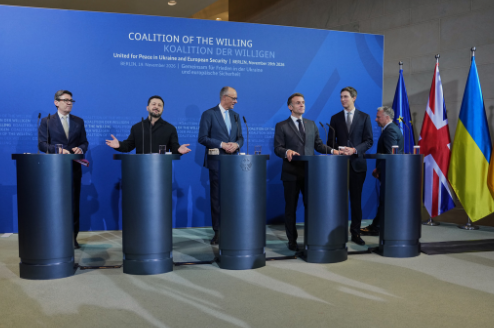
UK Prime Minister Andy Burnham, Ukraine’s President Volodymyr Zelenskyy, German Chancellor Friedrich Merz, French President Emmanuel Macron, and U.S. special envoys Jared Kushner and Steve Witkoff, from left, attend a press conference after a meeting of the “Coalition of the Willing” at the Chancellery in Berlin, Germany, Thursday, Nov. 19, 2026. (AP Photo/Markus Schreiber)
As Washington and Moscow continue to shape the diplomatic landscape surrounding the war in Ukraine, European leaders gathered in Berlin on Thursday, November 19, to ensure no peace negotiations take place without Europe’s input. The largest summit to date, the discussions were attended by 44 delegates, with around twenty heads of state and government, with primarily European officials as well as Ukrainian President Volodymyr Zelenskyy and U.S. Presidential envoys Steve Witkoff and Jared Kushner. The group planned to discuss ongoing peace negotiations, security guarantees for Ukraine, and continued European militaristic and financial support.
Formed in 2025 and spearheaded by Germany, France, and Britain, the Coalition of the Willing comprises 37 country representatives, including non-European partners, and Ukraine. While the Ukraine Defense Contact Group, has coordinated regular military aid since Russia’s full-scale invasion in 2022, the Coalition of the Willing is mapping out a broader, long-term framework for European-led peacekeeping operations during and after a ceasefire The Coalition plans to support a military-backed peacekeeping force on Ukrainian territory but only after an acceptable ceasefire agreement has been reached, and has expressed readiness to expand military support and increase European sanctions on Russia if ongoing peace deal negotiations continue to fall through. However, there has not yet been a strict timeline set on these installments.
Chancellor Merz outlines that the goal of Thursday’s talks was to reach an agreement on the 2027 funding for Ukraine’s defense and establish a European position on peace negotiations. The Berlin summit this week was largely prompted by the domination of Russo-Ukrainian discussions by the U.S., Russia, and China. Alongside demanding a seat at the negotiating table, European leaders called for a Russian energy ceasefire for the duration of this winter. Hours before the ‘mega-summit’ of the Coalition of the Willing, on November 19th, the US, China, and Russia met for a trilateral summit in Shenzhen, China.
Following the Asia-Pacific Economic Cooperation (APEC) summit, Washington, Beijing, and Moscow issued a joint peace statement, however, the declaration omitted any mentions of the wars in Ukraine and Iran. During their 90-minute meeting, the three leaders outlined priorities including reforming the UN, boosting oil supplies, and the protection of diplomatic immunity, while exchanging views on preventing the proliferation of nuclear weapons, the Ukraine crisis, and the Middle East. Critics widely dismissed the talks as being purely symbolic, and that they did not achieve any real progress through their trilateral discussion.
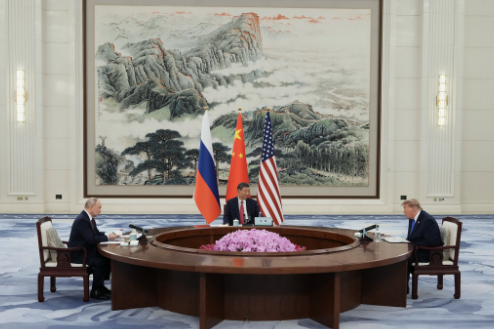
U.S. President Donald Trump, from right, meets with Chinese President Xi Jinping and Russian President Vladimir Putin at the Kylin Villa in Shenzhen in southern China’s Guangdong Province, Thursday, Nov. 19, 2026. (AP Photo/Mark Schiefelbein)
On November 18th, Zelensky said that Witkoff and Kushner would debrief European and Ukrainian leaders on the Shenzhen discussions to help prepare them for the next rounds of peace talks In response to the trilateral summit, members of the Coalition of the Willing responded unfavorably, with Merz saying that it was no more than a “photo-op.” In the first moments of the Shenzhen summit, Trump greeted Putin by calling him “my friend.” This oddly warm reception of the Russian leader sparked a dialogue at the Coalition of the Willing summit, wherein reporters asked Zelensky if he had ever been called a friend by Trump. Zelensky responded that he could not recall. In his remarks, he called for further talks with Europe. While the US, China, and Russia are having diplomatic discussions that exclude Europe and Ukraine, the Coalition is responding directly, mobilizing to be heard in the negotiations to end the war in Ukraine and ensure Europe’s security order. Importantly, this coalition meeting has Ukraine’s strongest allies a platform to react quickly to what they have heard from China.
The Berlin venue itself carried deliberate symbolism. Merz gave a piece of the Berlin Wall to each conference attendee, noting that the wall which divided Berlin for decades once stood meters from the Chancellery, a warning against allowing new division between Europe and Ukraine. With the fall of the wall in 1989 and the 1990 reunification of East and West Germany serving as the historical background of the discussion, the Coalition of the Willing intends to communicate that freedom and peace are stronger than oppression and division, and ensures that further avenues of discussion and alliance are open with Ukraine. Merz also warned against a Yalta format of the APEC summit, arguing that Europe’s perspective is crucial to advancing progress in a ceasefire agreement. In response to the two summits, Putin extended a Moscow invitation to European leaders through diplomatic channels to discuss ending the war; however, made no concrete commitment that Europe would have a formal role in the peace process. If allowed more room to speak in talks involving Russia, Ukraine, and the US, who would speak for Europe? The Berlin Coalition of the Willing summit was a major step forward in Europe establishing a place for themselves in the peace negotiations of this conflict, yet it is still to be seen how Europe will represent itself going forward.