
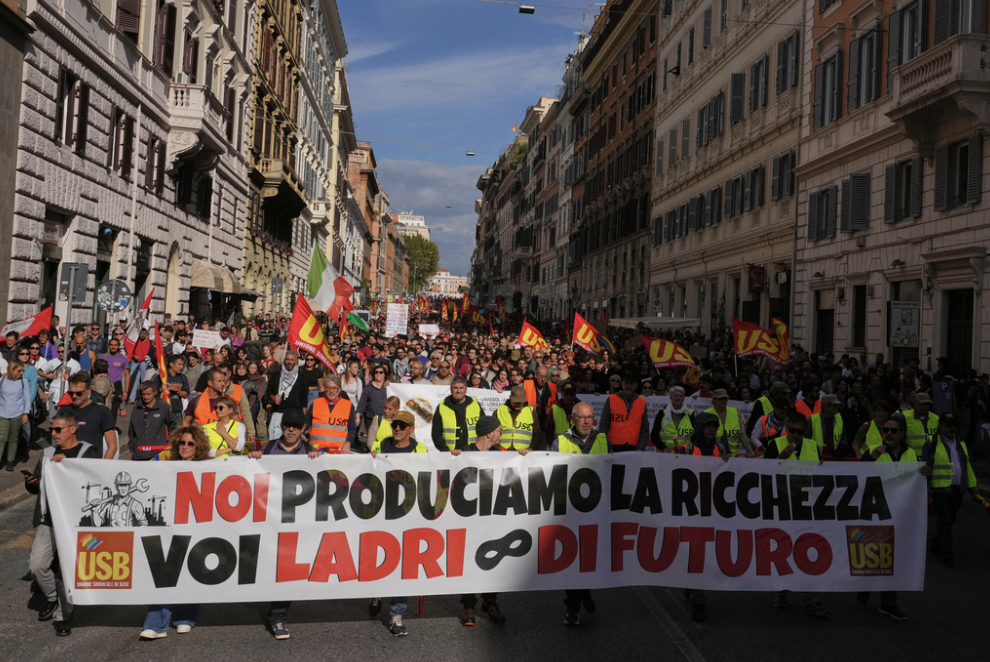
During a nationwide general strike, demonstrators march the streets of Rome to protest the rising costs of living, low wages, and military spending. The Unione Sindacale di Base (USB), an Italian trade union, holds a sign that says, “We produce wealth, you steal our future.” Rome, Italy, Friday, October 30, 2026. (AP Photo/Alessandra Tarantino)
On October 16, 2026, also known as the “No Meloni Day,” localized protests in Turin fueled by anger and frustration quickly expanded into major demonstrations in Rome, Bologna, Milan, and even in Florence, where New York University’s campus resides. Florentines, like many protestors nationwide, marched along the street chanting “più aule, meno bombe,” (“more classrooms, fewer bombs”). Italy has promised NATO it will invest 5% of its GDP annually in defense by 2035. In its attempt to fulfill NATO obligations and maintain sovereignty, Italy risks jeopardizing the quality of its education and healthcare. More specifically, the government’s 2027 Budget Bill will eliminate 6,974 positions available in education starting in the 2027-2028 school year. This cut is predicted to help Italy save €335.60 million once fully executed.
At the June 2025 NATO Summit, Italy and fellow NATO members agreed to raise individual military spending to improve collective security. Italy’s commitment is driven both by U.S. pressure and a perceived need to combat hybrid warfare. Furthermore, instability in the enlarged Mediterranean, including conflicts in the Middle East and terrorism in North Africa, has inclined Italy to expand its military efforts to protect its economic and energy security. The 5% GDP goal by 2035 is divided into 2 categories: 3.5% will be dedicated to quantitative military needs such as ammunition, troops, and weapons, and the remaining 1.5% will be allocated to structural security, such as cyber protection and defense infrastructure. This pledge is a broader response to the Russia-Ukraine war, where state-sponsored Russian cyberattacks threaten Europe and Ukraine military resources are depleting. Alongside the pressure of interstate conflict, the pledge stems from the Trump administration demanding the EU to quit “free-riding” on the U.S. for military. In March 2025, Trump stated that the U.S. will not uphold NATO’s collective defense clause (Article 5) if member nations fail to meet their financial defense obligations. Since the Cold War, Italy has become a major tool for the U.S. and NATO in carrying out operations in the Middle East, the Mediterranean, and all of Europe, making the threat of spillover conflict very possible. Thus, Italy needs to maintain a transatlantic alliance with the U.S. in order to receive protection against any external threats. In terms of commerce, more than 36% of Italy’s trade value and over 55% of its total trade travels by sea; when conflicts erupt near these trading points, such as in the Strait of Hormuz, Italy’s commercial shipping is directly threatened. Meanwhile, civil wars in Libya, Mali, and Sudan have created lawless zones, allowing rival powers like Russia’s Africa Corps to move in and establish military bases. Security analysts and Defense Minister Guido Crossetto argue that these bases pose a direct security risk, as they are situated just miles from Sicily, Italy.
Italy’s decision to commit 5% of its GDP to military spending by 2035 is shocking given its current massive public debt, which reached an overwhelmingly 139.9% of GDP in the second quarter of 2026. While the U.S. alliance is crucial for Italy, its priority in endorsing an EU agreement highlights Italy’s deep desire in becoming internationally relevant over focusing on its already impoverished economy. At the 2025 NATO Summit press conference, Prime Minister Giorgia Meloni stated, “It is time for Europe to guarantee its own security on its own, and not to do someone a favour but in order not to depend on anyone else. It is therefore a matter of sovereignty, even before it is a matter of defence.” By agreeing to this budget reallocation, Rome has now aligned its goals with Washington, thus gaining U.S. goodwill and reinforcing a vital alliance. Not only will Rome’s decision in adhering allow Italy to stay involved in major European and Atlantic discussions, but it will also give them the space to raise their own demands. Historically, Italy has struggled with a reputation of political and financial instability. Since the Unification of Italy in 1861, the nation has carried a heavy public debt from unification wars, widespread corruption, shifting electoral systems, high voter volatility, and the frequent rise and fall of political coalitions. According to Massimo Morelli, a professor of political science and economics at Bocconi University, Italy’s historically weak institutional effectiveness has caused its economic capacity to lag. As a result its poor economic performance has shaped the way international observers view Italy’s financial stability and political reliability. In this context, Italy’s adherence to the NATO summit is a strategic bid to rebuild its reputation on the international stage, signaling to allies that it possesses the economic capacity and confidence to manage any domestic backlash that comes from reallocating the budget away from citizens. Showing to the allies its ability to contribute internationally despite historically facing internal disorder.
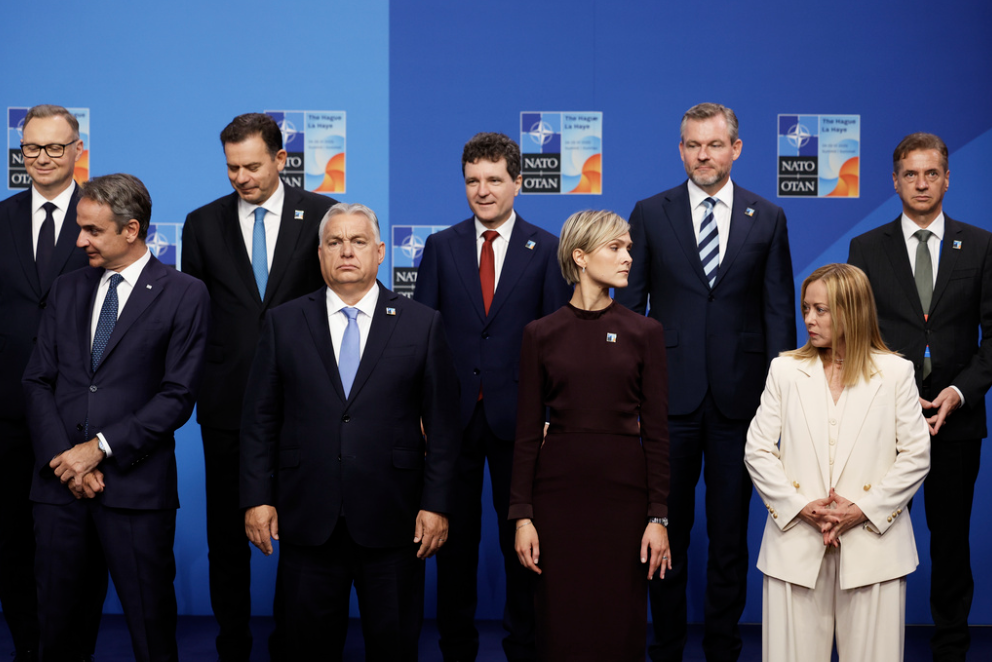
A gathering for a group photo of NATO heads of state and governments: Front row from left to right, Greece’s Prime Minister Kyriakos Mitsotakis, Hungary’s Prime Minister Viktor Orban, Iceland’s Prime Minister Kristrun Frostadottir and Italy’s Prime Minister Giorgia Meloni. The NATO Hague Summit was where members reaffirmed their commitments to collective defense, pledging to direct 5% of their country’s GDP towards military expenditures. The Hague, Netherlands, Wednesday, June 25, 2025. (AP Photo/Geert Vanden Wijngaert)
However, the government’s enthusiasm for collective defence is not shared by the public, which remains largely against war and military spending. According to a 2026 survey commissioned by the European Council on Foreign Relations (ECFR), while citizens across most of 15 surveyed European countries favor increased defense spending, 58% of Italians oppose military expansion. Because of Italy’s massive public debt, in order for military expenditures to increase, money from civilian priorities must be pulled out. Inevitably, this will cause the domestic economy to be severely neglected. The decline of social welfare can be seen through citizens experiencing a loss of purchasing power. According to a recent survey, 55% of Italians believe their household income is insufficient in meeting basic needs; and 44% express their inability to save due to the rising cost for housing, fuel, and basic necessities. Healthcare is increasingly becoming an individual and regional struggle. Furthermore, education has faced a decline, with expenditure on primary to post-secondary non tertiary education falling from 2.8% to 2.7% of GDP between 2015 to 2023.
The chronic underfunding across multiple sectors reveals the lack of economic attention given to improving social welfare. Social infrastructure still remains to be in poor conditions and with the increase in military expansion, the neglect of the domestic economy will only worsen as the national budget is constrained. Italy’s fear for external threats shown by their desire to win international favor will instead be replaced by internal threats fueled by the high costs of living and underfundings of public sectors. If left unaddressed, Italy will risk facing the effects of long-term government neglect that happened to post-unification Southern Italy. Similar to the current economic conditions of the south, the whole country will face a contraction of domestic consumption and the emigration of young educated professionals, commonly known as brain drain.
Defense Minister Guido Crosetto, maintains the additional funds are essential to counter modern threats, such as the increasingly prevalent cyberattacks in Europe. By inducing fear into the citizens about cognitive warfare, Crosetto justifies massive defense expenditures as a necessary shield. However, according to an analysis of the 2026-2028 Multiannual Defense Planning Document (DPP) by la Repubblica, out of the €22 billion military investments, only around €200 million of it is allocated to cybersecurity. Furthermore from Cybersecurity360, the 2027 budget forecast for four military cyber defense programs was actually cut from €68.66 million in the 2026 plan to €52.31 million. The majority of the DPP 2026-2028 budget plans, which is estimated to be over €42 billion, is instead intended for armored land vehicles, warships, and submarines. These analyses reveal the contradiction between how military expansion is being justified and how spendings are actually being made. How can Italy stop cyberattacks through investing in conventional military equipment such as fighter jets and artillery shells? If the government truly intends on protecting its citizens against cyber warfare, it would have invested more of its budget on digital infrastructure rather than stockpiling on armaments.
Meloni’s government insists that compliance with the NATO target is necessary for Europe to develop long-term autonomy and become self-reliant for security. In December 2025, at the Italian Joint Operations command, Meloni stated “only a credible military force can deter war, because peace does not come spontaneously; peace is above all a balance of power: weakness invites the aggressor, strength repels the aggressor.” By “weakness invites the aggressor,” she argues that if Italy fails to strengthen its defense against external threats, Europe will become an easy target for hostile powers. Yet the social and economic disruption shown by local riots and protests reveal that military expansion has already caused a weak domestic economy and a power imbalance between the state and its people. Ultimately, by fixating on external threats, Italy forgets to take into account how weaknesses from within can also invite “the aggressor.” Foreign Minister Antonio Tajani has frequently emphasized the importance of a strong, independent partnership between the EU and NATO. However, no matter how well equipped Italy is in weapons, the decline of its domestic economy and its future generations will eventually undermine the stronghold of Italy and its ability to make strong alliances.
Italy’s shift into becoming a wartime economy before fixing its domestic economy illustrates a desire to prove its stability to outside forces, but the strength of a country cannot be truly possible if it is hollowed out from within. Rome’s adherence to the collective increase of military spending highlights how geopolitical context and historical reputation can play a major role in influencing the priorities of the state. By strengthening defense measures, Italy is more secure than before in driving away external threats. But given Italy’s substantial national debt, neglected youth, underfunded healthcare, and an education reform expected to reduce staffing and save the government €335.60 million, the country’s priorities appear increasingly focused on short-term savings rather than long-term investments for its people. In her rush to establish an international stronghold, Meloni warns that weakness invites outside aggressors, yet she has failed to realize that her country’s fear of instability and vulnerability has already done its damage, not through external threats, but from within. Looking ahead, Italy should ensure a balanced allocation of public resources, avoiding excessive military expenditure at the expense of public service funds that safeguard the basic livelihoods of its population. If Italy fails to take care of its own people, it cannot hope to build and maintain strong relationships beyond its borders.