
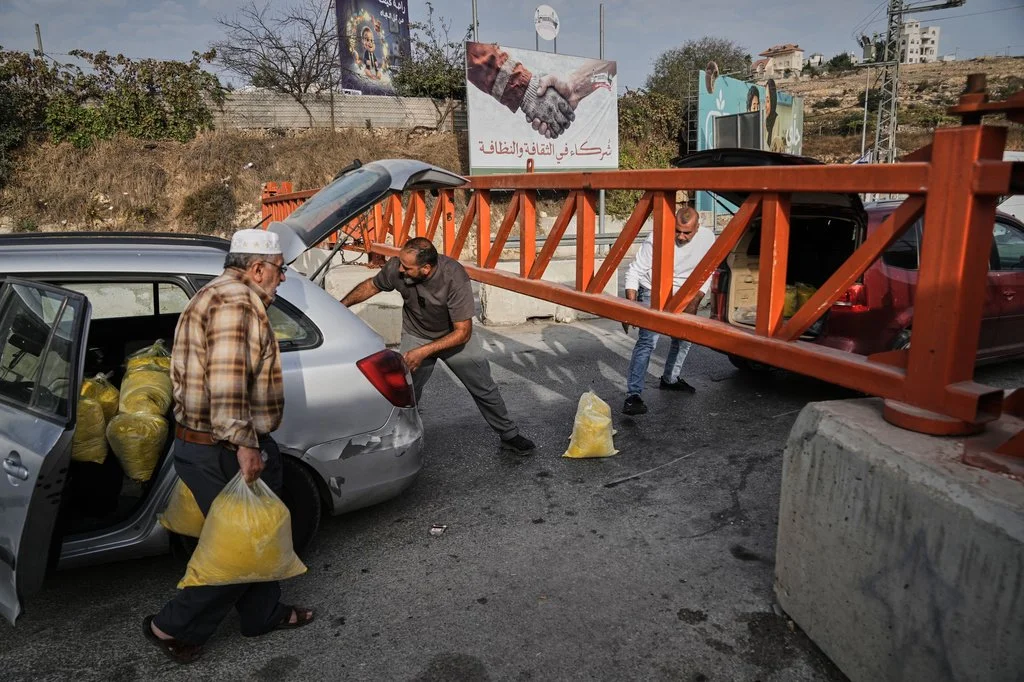
Palestinians transport bags of semolina past a military gate closed to vehicles during an Israeli army operation in Hebron, in the occupied West Bank, Saturday, Oct. 24, 2026, a day after a Palestinian shooting attack in the area. (AP Photo/Mahmoud Illean)
On Oct. 23, two Palestinian gunmen fired at an Israeli military checkpoint in Hebron in the occupied West Bank, killing two soldiers before Israeli troops killed them. According to the Israeli Defense Forces (IDF), three additional soldiers were lightly wounded in the attack.
In response, Prime Minister Benjamin Netanyahu ordered the immediate closure of Hebron and told Israeli forces to prepare a wider lockdown of the West Bank. Israeli Defense Minister Israel Katz stated that residents “will not be allowed to return to their neighborhood until we’ve finished dealing with all the Hamas issues in Hebron.”
Katz stated that 2,000 people had been displaced by the operation as of Oct. 24. Palestinian Prime Minister Mohammad Mustafa stated that “over 2,670 Palestinians have been forcibly displaced from their homes in Hebron by Israeli occupation forces” as of Oct. 25. According to the Hebron municipality, approximately 15 buildings were destroyed or marked for demolition, primarily in the Farsh Al-Hawa and Ein Deir Baha neighborhoods. Wafa, the official Palestinian news agency, reported that Israeli forces are using Palestinian homes as barracks and observation posts.
The lockdown entered its seventh day on Oct. 29, with city entrances and exits closed and residents’ access to services restricted. Israeli forces had detained at least 110 people in the Hebron governorate as of Oct. 28, including three women and seven children, according to the Palestinian Prisoners’ Society. Al Jazeera reported that the Israeli military also isolated 12 villages and hamlets in the Masafer Yatta region. The New Arab further reported that in-person classes were suspended at dozens of schools in the area. The Israeli lockdown had isolated the city by blocking 10 entry points and displaced almost 5,000 people as of Oct. 30.
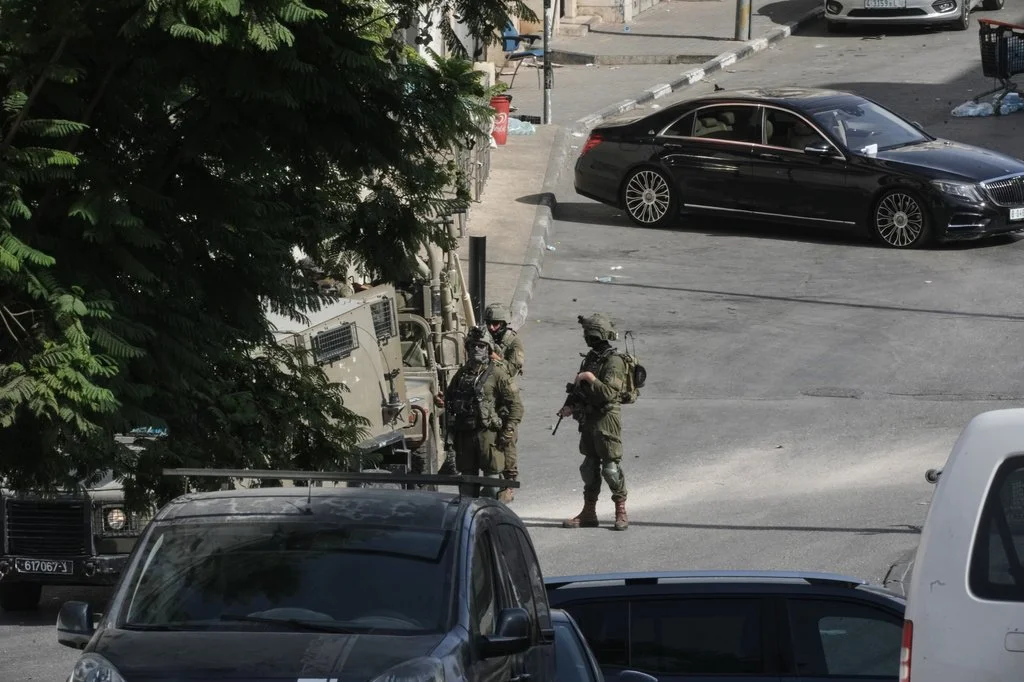
Israeli soldiers take up positions during an army operation in the West Bank city of Hebron Saturday, Oct. 24, 2026. A day after a Palestinian shooting attack in the area. (AP Photo/Mahmoud Illean)
According to Haaretz, Eyal Zamir, chief of staff of the IDF, intended to end the operation by Oct. 24, but Netanyahu and Katz pushed to continue the operation and to keep residents from returning home. The operation began four days before Israel’s Oct. 27 election, and Israel announced that it would close West Bank border crossings on election day.
Palestinian officials have criticized the operation as yet another act of collective punishment, accusing the Israeli government of pursuing electoral gain. Yousef Jabari, the mayor of Hebron, said, “Netanyahu wants images of displacement, destroyed buildings and repression to appeal to voters.” UN human rights chief Volker Türk warned that collective punishment violates international law.
Israeli officials have tied the operation to Hamas, which has not claimed responsibility but praised the attack. Bezalel Smotrich, Israeli Finance Minister, stated that the only way forward is a “comprehensive military campaign … to dismantle the Palestinian Authority, collect the weapons and eliminate the terrorists.”
Hebron governor Khaled Dudin warned that the operation may expand, and Netanyahu has told Israeli forces to prepare for an expanded lockdown in the area. On the morning of Nov. 2, Israeli forces withdrew from Hebron, and the 3,300 Palestinians who had been displaced began to return.