
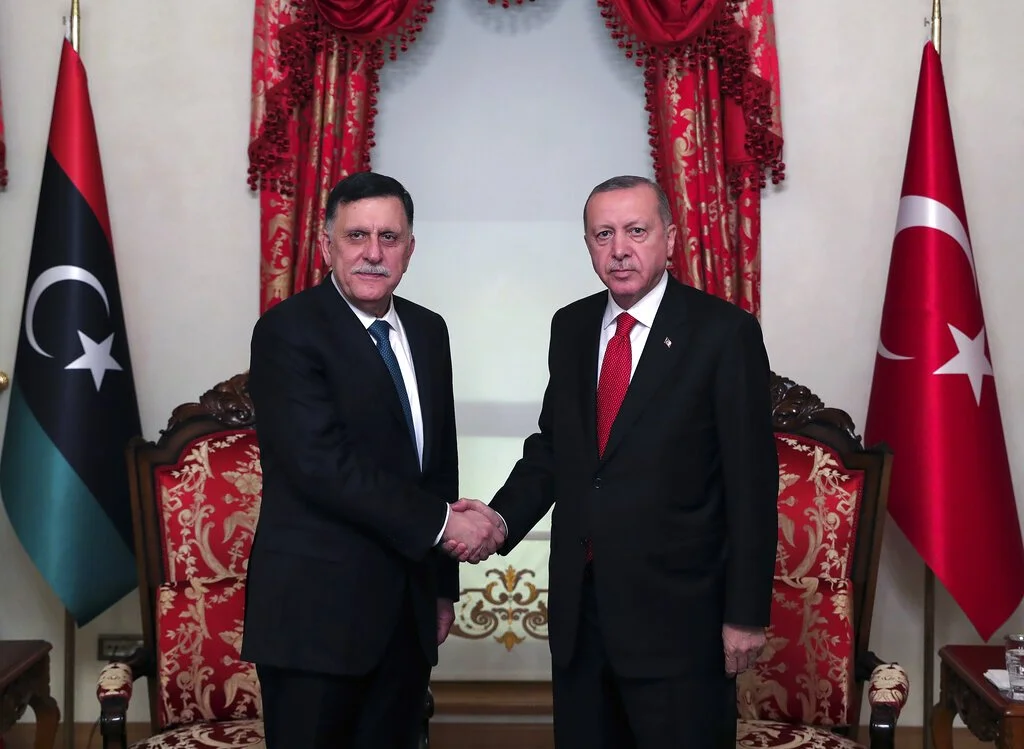
Turkey's President Recep Tayyip Erdogan, right, shakes hands with Fayez al Sarraj, left, the head of Libya's internationally recognized government, prior to their meeting in Istanbul, Wednesday, Nov. 27, 2019. Erdogan's office said Thursday that the Turkish leader and al Sarraj reached an agreement on the delineation of maritime boundaries in the Mediterranean. Asked to comment on the maritime agreement, Turkish Foreign Minister Mevlut Cavusoglu said Thursday that Turkey had the right to hold talks on maritime boundaries with all countries in the Mediterranean Sea, except for the government of Cyprus, which Turkey does not recognize. (Presidential Press Service via AP, Pool)
Libya’s eastern-based House of Representatives, one of the country’s two rival political centers, unanimously approved the 2019 Turkey-Libya maritime agreement on Oct. 20, taking over six years to pass. In 2020, the same agreement was unanimously rejected, making the recent undisputed approval more than unexpected. The rejection coincided with Eastern Libya severing ties with Turkey. The firm rejection came after Turkey backed Western Libyan forces against Eastern forces during the 2019–2020 offensive on Tripoli. To justify the change in behavior, the Eastern Parliament now says the deal will provide Libya with economic and national security advantages it previously lacked. The reversal could have a major impact on Libya's divided future, while also entangling its internal conflict in larger international maritime disputes.
What the agreement does
In November 2019, Turkey and Libya’s Tripoli-based Government of National Accord signed a Memorandum of Understanding on the Delimitation of the Maritime Jurisdiction Areas in the Mediterranean. At the time, the Government of National Accord represented Libya’s western political camp, while the eastern-based House of Representatives remained a rival institution and did not support the agreement. This memorandum draws a maritime boundary between areas claimed by Turkey and the Tripoli government in the eastern Mediterranean. Countries use maritime boundaries to determine economic rights over waters and the seabed underneath. These boundaries are crucial for economic development as they include the rights to explore oil, gas, and other offshore resources.
Many neighboring countries quickly saw the agreement as controversial. Greece first objected because it believed the agreement disregarded the maritime rights of Greek islands. After Greece's rejection, Egypt and Cyprus said they felt it neglected maritime claims already set in the eastern Mediterranean. Turkey argues that the agreement actually protects Turkish and Libyan maritime rights and is consistent with international law and equity. The agreement has been controversial long before Eastern Libya even approved it. The 2026 reversal now places Eastern Libya on one side of an already existing regional dispute.
Why Eastern Libya Rejected Turkey
After the 2011 Arab Spring, Libya had a political breakdown. Rival governments and military coalitions were created in both East Libya and West Libya. The House of Representatives based itself in Tobruk in Eastern Libya, aligning with military commander Khalifa Haftar and his Libyan National Army. The internationally recognized Government of National Accord was based in Western Libya’s Tripoli. In April 2019, Haftar’s forces launched a plan to capture Tripoli. This fighting is the clearest military incident to come from Libya’s east-west divide. Reuters describes the conflict as a failed eastern offensive against the Tripoli authorities.
At the conflict's height, Turkey intervened on behalf of the Western government. Their military support effectively stopped Haftar’s offensive and prevented his forces from taking control of Tripoli. This happened after Turkey had already signed the 2019 Turkey-Libya maritime agreement with the Western government. Turkey had signed a maritime deal with Eastern Libya's rival, and then supported the Western Libyan government in an ongoing war. In January 2020, to no surprise, Eastern Libya rejected the deal and voted to cut political relations with Turkey. Its statement credited Turkish intervention in Libya as the reason for the decision. That history makes the parliament’s unanimous approval of the same maritime agreement six years later more than just a technical policy change. This is objectively a sharp reversal in eastern Libya’s relationship with Turkey.
What Changed?
Despite tensions in 2019-2020, Turkey still rebuilt and maintained relations with Libya’s Eastern leaders. Turkey gradually reopened engagement with Eastern Libyan officials and Khalifa Haftar in the years that followed the Tripoli war. For example, in June 2026, Turkish Intelligence Chief Ibrahim Kalin met with Saddam Haftar, the son of Khalifa, in Benghazi to discuss expanding cooperation and efforts to reunify Libya’s eastern and western institutions. The meeting marked a significant shift from 2020, when the Eastern Parliament voted to cut political relations with Ankara. The change suggests that the alliances created during Libya’s civil war are less rigid as both sides pursue new interests beyond their domestic situation.
Lawmaker Tarek al-Jeroushi has stated that the agreement serves Libya’s “National Interest.” They specifically mentioned three categories that could benefit from the deal: economic, political, and national security advantages. Al-Jeroushi argues that the deal could strengthen Libya's position as a political and economic partner to major powers. This shows eastern lawmakers are no longer viewing Turkey only through its role during the civil war and are increasingly viewing Ankara as a potential partner.
What Libya Stands to Gain
Closer relations with Turkey could expand cooperation in trade, investment, infrastructure, and energy. Maritime jurisdiction can provide opportunities for offshore resources and future energy exploration. Turkey’s foreign ministry said that the agreement protects the two countries’ shared interests and can deepen their cooperation. For Eastern Libyan authorities, strengthening relations with another major Mediterranean economy could provide options that were completely unavailable while relations with Ankara were frozen.
The agreement was signed by Turkey and Libya’s Western government of national accord in 2019. On this particular foreign-policy issue, Libya's rival eastern and western leaders are now closer than they were in 2020 to finding an agreement. AP noted that both Libya’s eastern and western political camps welcomed the 2026 decision. This does not mean Libya’s broader political division has disappeared. But still, agreement on a major foreign policy-based decision could represent a small point of similarity in a state whose government institutions remain deeply divided. That convergence, however, has become more complicated due to Libya’s neighbors, most notably Greece.
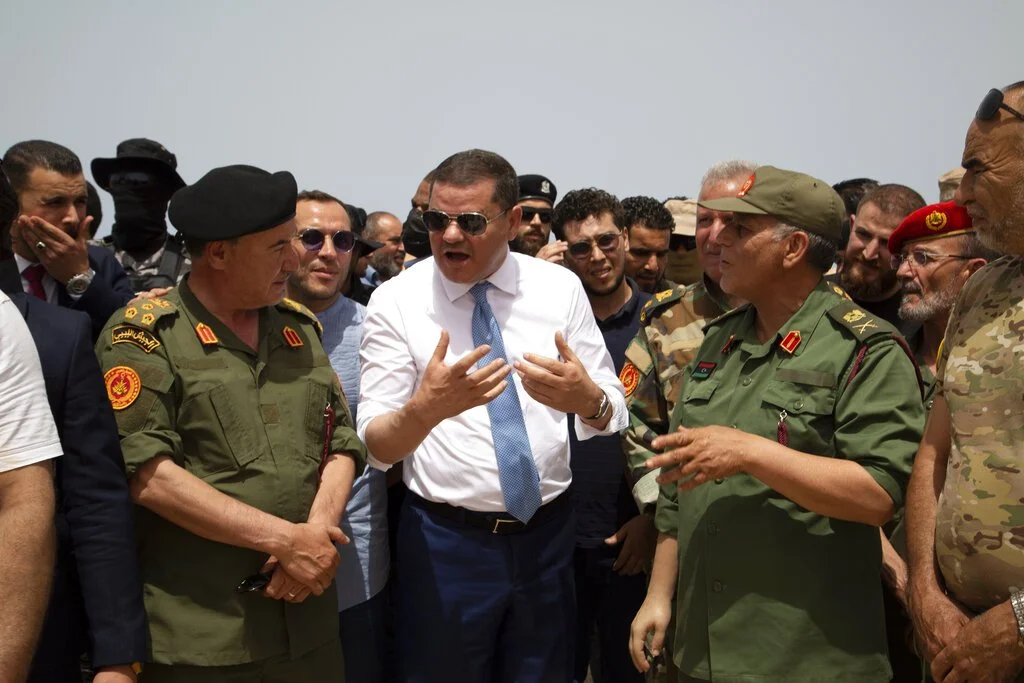
Libyan Prime Minister Abdul Hamid Dbeibah attends the reopening of the road between the cities of Misrata and Sirte Sunday, June 20, 2021. Libya's interim authorities reopened on Sunday the Mediterranean coastal highway linking the country's long-divided eastern and western cities, in the latest bid to reunite the territories after years of civil war. (AP Photo/Yousef Murad)
A Mediterranean Dispute
Greece rejected Libya’s eastern-based House of Representatives’ Oct. 20 decision. Athens argues that the Turkey-Libya boundary completely ignores the maritime rights of Greek islands. Greece claims that Turkey and Libya do not have opposite or adjacent coastlines that would justify the maritime boundary they established in the memorandum. Ankara argues that the memorandum is more equitable for Turkey and Libya. However, this is an unresolved and contested legal dispute with no resolution as of now. In its approval, Eastern Libya took another step towards rebuilding ties with Ankara, but it also endorsed the Turkish position on international waters in a dispute that reaches far beyond Libya.
The EU also maintains that the memorandum infringes the sovereign rights of third states and does not comply with the international Law of the Sea. These objections were raised before the Eastern Parliaments' decision to approve the memorandum; therefore, Libya knowingly entered an already-existing dispute on the side of Turkey. Greece and Turkey have a long dispute over maritime boundaries and sovereignty in the Eastern Mediterranean. By approving the agreement despite Greek and European opposition, Eastern Libya appears to see the potential diplomatic and economic gains of this agreement strong enough to outweigh the risks of placing itself in a regional maritime dispute it cannot control.
Regional Alliances
Opposition to the agreement quickly spread beyond Greece. On Oct. 27, Egypt, Bahrain, and the UAE joined Athens in criticizing the maritime accord. Egypt is especially concerned because it is both geographically involved in Eastern Mediterranean maritime politics and has historically close ties with the Haftar regime in Eastern Libya. Bahrain and the UAE’s opposition shows that the diplomatic fallout has expanded beyond the countries bordering the Mediterranean. The dispute now involves North African, the Gulf, and European states alongside Turkey. The web of reactions that spiraled from this long-awaited agreement shows how intertwined Libya’s internal divisions are with broader international rivalries.
What the Reversal Exposes
Eastern Libya has legitimate reasons to view renewed cooperation with Turkey as potentially useful. It stands to gain economic cooperation, energy possibilities, diplomatic flexibility, and a rare point of agreement with its rival domestic partners. However, Libya remains divided between rival governments in the east and west. A divided country has a harder time maintaining one coherent foreign policy under the circumstances of outsized foreign influence. Turkey, Greece, Egypt, and other governments are pursuing their own national interests in the Mediterranean. Libya's interests may overlap here and there, but they aren’t actually identical. For example, Libya may see closer ties with Turkey as an economic opportunity, while Ankara can turn Libya’s support into leverage for its own contested maritime goals, creating the risk that Libya is advancing a regional strategy that could ultimately serve Turkey more than Libya itself. Libya’s opportunity is simultaneously its vulnerability. Partnerships give its leaders more diplomatic and economic options, but political fragmentation may make those relationships harder to control.
The reversal itself is not objectively harmful, as improving relations with Turkey could be useful for Libya. Likewise, the fact that both Libyan administrations now support the agreement may be the most encouraging aspect of the change. But economic opportunity will not resolve Libya’s institutional division on its own. If different Libyan political leaders continue to rely on outside powers, new partnerships could simply deepen Libya’s domestic divisions as foreign powers back rival Libyan factions. It is unclear whether Libya is politically unified enough to benefit from such a controversial agreement. If Libya can turn the warm relationship with Turkey into a coherent foreign policy, the east’s reversal could become a noteworthy agreement despite persisting domestic division. If it cannot, the agreement risks tangling another international rivalry into a political system already shaped by unstable domestic and foreign competition.