
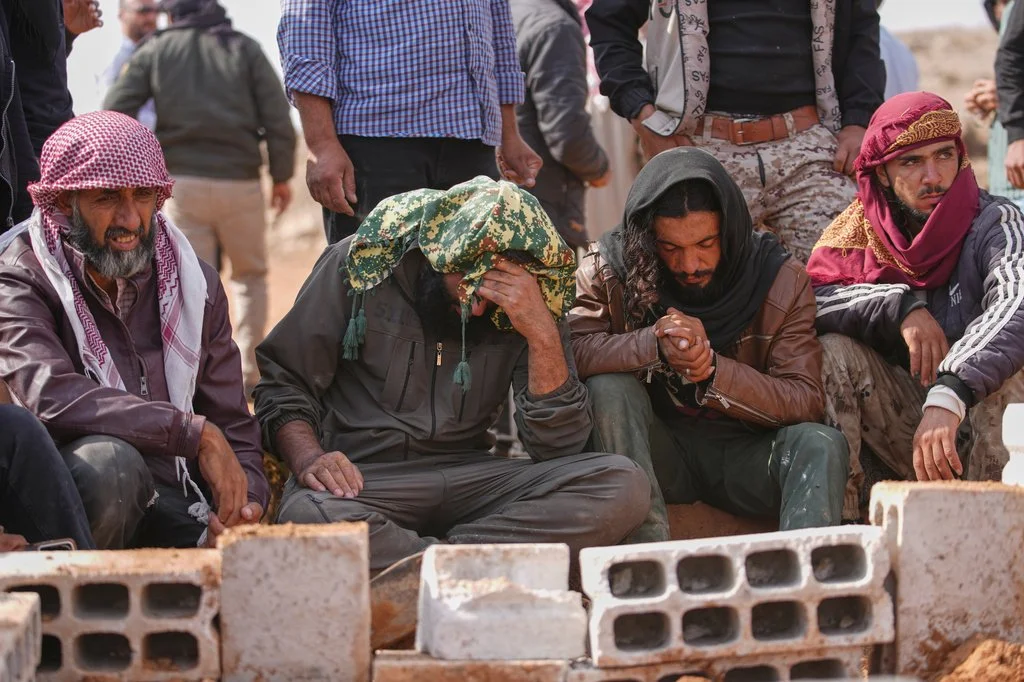
Mourners pray during the funeral for victims of Jordanian airstrike in Daraa, Syria, Tuesday, Oct. 27, 2026. (AP Photo/Ghaith Alsayed)
On Oct. 26, Jordan launched airstrikes against ISIS targets in Syria in retaliation for the Oct. 23 shooting at St. George’s Greek Orthodox Church in the Jordanian village of Hmoud, an act ISIS has claimed responsibility for. Jordan has presented its decision to strike ISIS strongholds in Syria as a commitment to neutralizing terrorist and national security threats. Following Amman’s airstrikes, the Jordanian government’s spokesperson, Mohammad Al Momani, declared that "Jordan's patience has ran out as far as the movements of these terrorist organisations and their targeting of national security." Syria condemned the airstrikes, denouncing them as “unacceptable violation and encroachment” of Syrian airspace.
The Jordanian military announced that the strikes on Syria had killed 20 ISIS members. It also claimed that the operation was carried out in coordination with Damascus. The Syrian Ministry of Foreign Affairs reported the seven civilian casualties as a result of the strikes to counter Jordan’s account, stating that the airstrikes were carried out without prior notice or coordination.
Despite Syria’s condemnations of the Jordanian airstrikes, Jordanian Foreign Minister Ayman Safadi and his Syrian counterpart Assad Hassan al-Shaibani spoke by phone the following day on Oct. 28, during which they reasserted the importance of their bilateral relations and agreed to form a joint security committee to institutionalize cross-border security management. The primary goals of the committee are to ensure coordinated security initiatives as well as to investigate the Jordanian airstrikes and their civilian casualties. Both parties agreed that counter-terrorism initiatives require consistent collaboration, and al-Shibani reiterated their mutual security interests, stating, “Jordan’s security is part of Syria’s security, and Syria’s security is part of Jordan’s security.”
Their announcement is the most recent initiative in efforts to solidify post-Assad Syrian-Jordanian diplomatic relations. Al-Shibaini described their bilateral ties as the strongest they have been in a century. Bilateral trade reached a record of $1 billion in 2025, a significant landmark in bilateral commerce. In May 2025, the Higher Coordination Council was formed to strengthen collaboration on water, energy, and trade. At the council’s second session in April 2026, officials signed more than 20 agreements regarding economic and security projects.
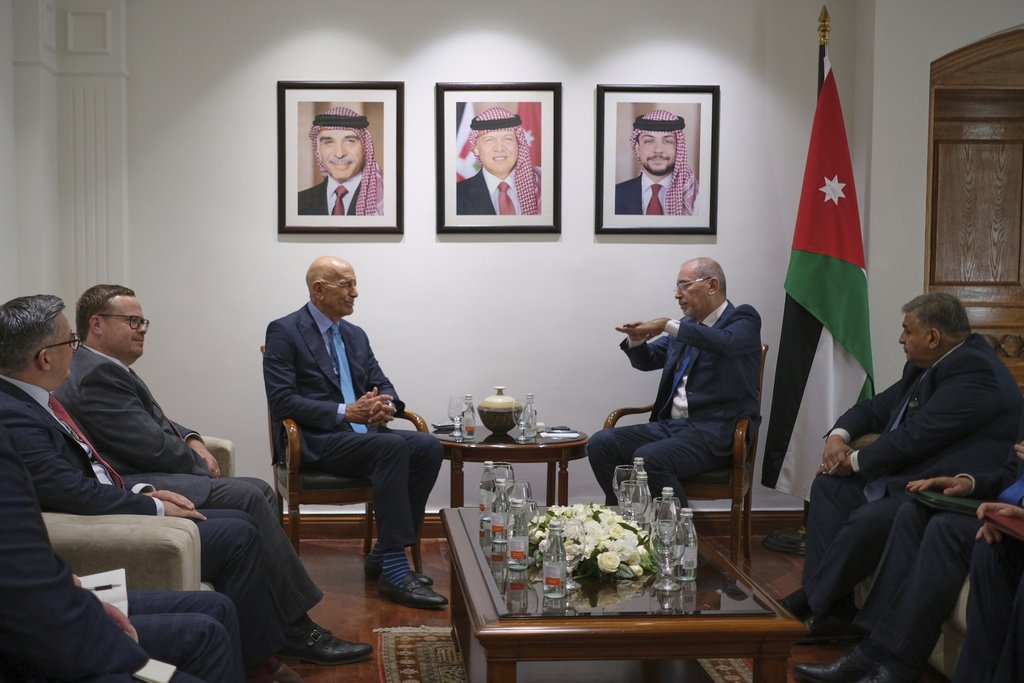
Jordan's Foreign Minister Ayman Safadi, center right, meets with U.S. Ambassador to Turkey and Special Envoy to Syria Tom Barrack, center left, in Amman, Jordan, Tuesday, Aug. 12, 2025. (AP Photo/Delara Shakib)
The measures taken by Syria and Jordan to promote diplomatic ties before the Oct. 26 airstrike were, however, insufficient to prevent the lack of coordination and communication, thus leading to civilian fatalities. If successful in its objective to prevent such incidents in the future, the joint security council may fulfill the role of a body that ensures more efficient cross-border coordination and prevents future incidents.