
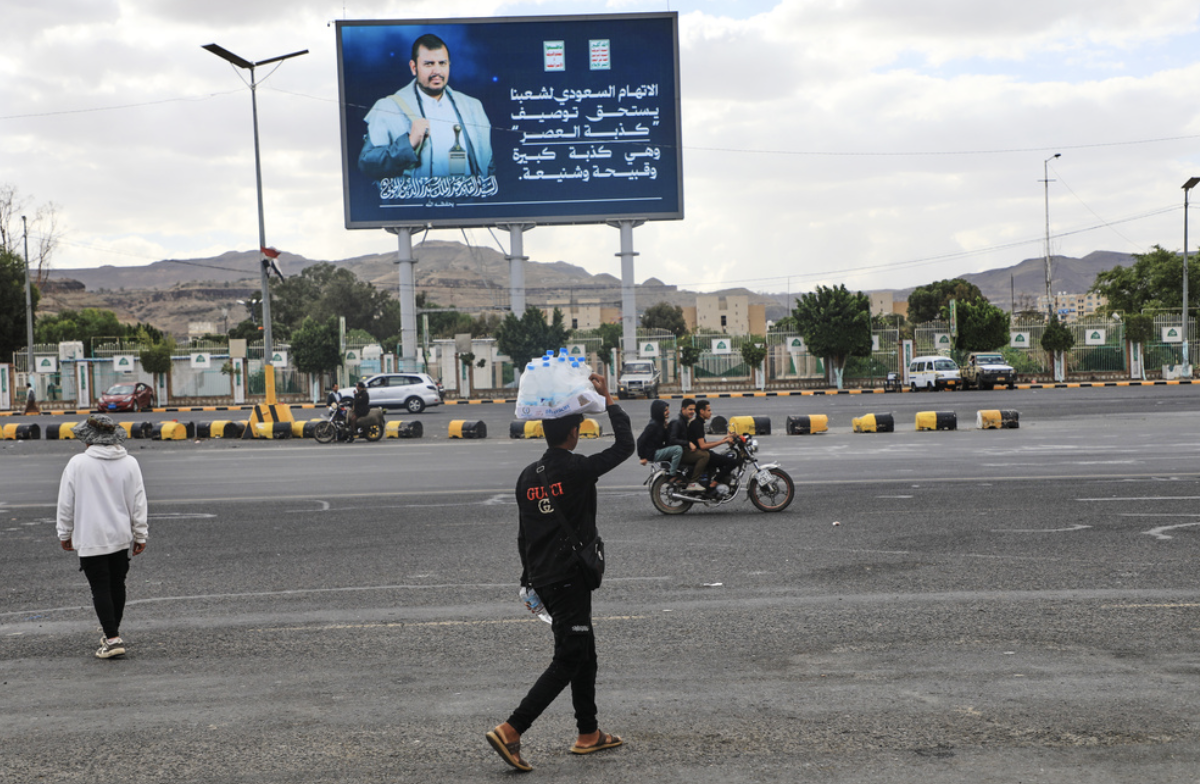
A vendor walks under a billboard of Houthi leader Abdul Malik al-Houthi reading, in Arabic, "The Saudi accusation against our people deserves to be described as the lie of the century," in Sanaa, Yemen, on Oct. 5, 2026. (AP Photo/Osamah Abdulrahman)
A Houthi missile struck Riyadh’s main airport on Oct. 10, killing 13 people, including an American, and injuring more than 300, officials said. A second Houthi strike the next day killed one more, and the airport remained closed on Oct. 12.
Saudi Arabia is back in the war it spent seven years prosecuting and the past four trying to get a clean exit from.
On Oct. 4, the chairman of Yemen’s internationally recognized, Saudi-backed Presidential Leadership Council (PLC) announced an offensive to retake all Houthi-held territory in the country, including the capital, Sanaa. By Oct. 5, the Saudi-led coalition, which first intervened against the Houthis in 2015, announced that 100 of its jet fighters had bombed 324 Houthi targets.
According to the PLC, the offensive’s first days have gone well along the coast, with forces claiming Dhubab and positions near the narrow Bab el-Mandeb Strait at the southern mouth of the Red Sea. The Yemeni Defense Ministry also announced that the port city of Mocha had been retaken, though four government sources told Reuters that its forces had reached only the city’s outskirts. On Oct. 9, Saudi Arabia’s ambassador to Yemen declared the strait “cleansed” of Houthi fighters, which a Houthi spokesman denied, and a day later fighting was still raging around both Mocha and Dhubab.
Inland, Yemeni government forces have fared much worse than they have in the coastal theater. In and around the area of Taiz, Yemen’s third-largest city, Houthi forces rushed through mountain passes, cut the main roads that connect the city south to Aden, the PLC’s temporary capital, and surrounded the PLC troops in the city.
Houthi missile and drone attacks have targeted Saudi airports, military bases, and oil facilities. There was even a close call near Mecca, Islam’s holiest city, where the Saudi-led coalition said it shot down a Houthi drone in September, but the Houthis deny having targeted it. According to the UN’s migration agency, more than 200,000 Yemenis have been displaced, nearly all of them since the beginning of September.
Since the Iran war began in February, traffic through the Strait of Hormuz has been heavily disrupted, and Saudi Arabia has been rerouting millions of barrels of oil a day from its east coast to its west. The oil travels from the Persian Gulf’s shore, through the 750-mile East-West Pipeline across the desert, to the Red Sea port of Yanbu, a route Saudi Arabia built in the 1980s in case Hormuz was ever closed. From there, however, tankers bound for Asia must still pass through the Bab el-Mandeb Strait. In September, the Houthis seized Mocha and Perim Island, which sit inside the strait; on Oct. 9, the PLC claimed to have retaken Perim.
The offensive is the latest phase of Yemen’s civil war, which began in September 2014, when the Houthis, a Zaydi Shiite religious movement from the country’s northern highlands, seized Sanaa, eventually forcing the government to flee south to Aden. In March 2015, Saudi Arabia assembled a military coalition of Arab states, including the United Arab Emirates, which also sent ground troops, and launched airstrikes to restore the Yemeni government’s authority. After 7 years of air and ground campaigns, the Houthis were still in control of Sanaa and northwestern Yemen. By late 2021, the UN estimated that 377,000 people had died since 2014, with hunger and disease being the most prominent causes.
In April 2022, a UN-brokered truce largely halted the ground war, and Saudi officials began negotiating with the Houthis directly. After the outbreak of fighting in Gaza in 2023, the Houthis started to attack merchant ships off Yemen’s Red Sea coast and withstood subsequent American, British, and Israeli bombing campaigns.
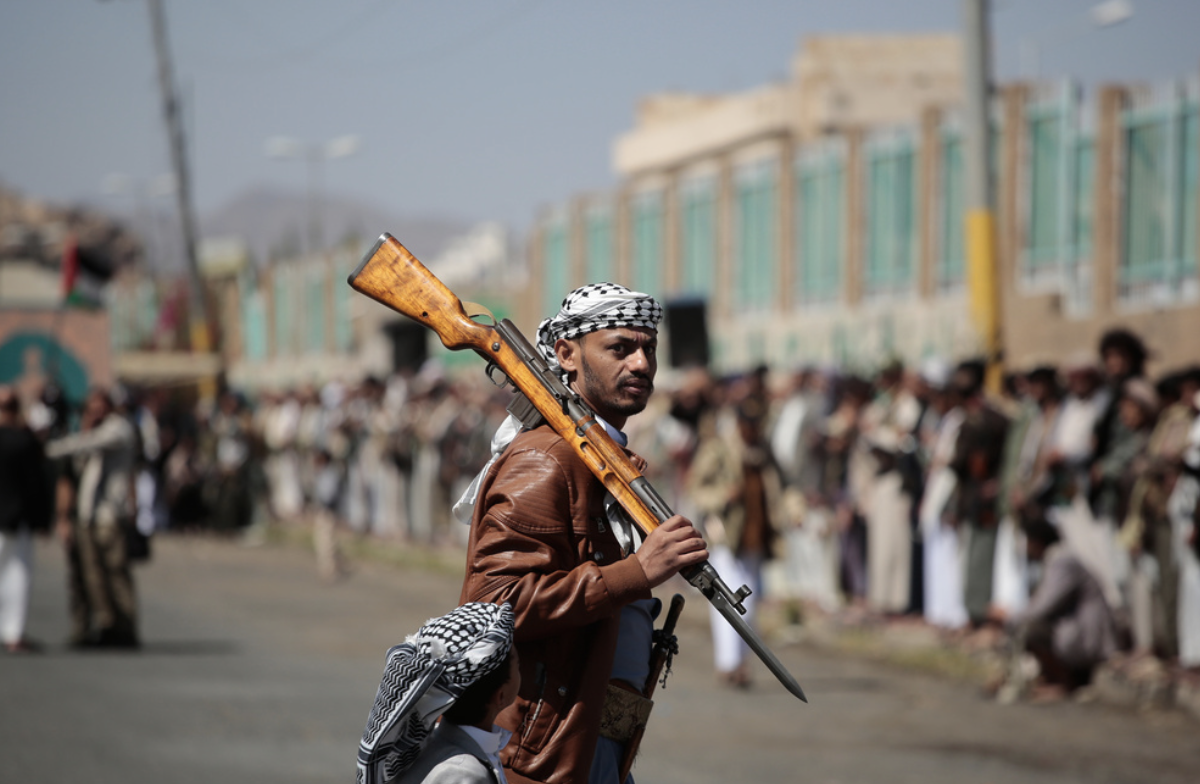
A Houthi supporter carries a rifle at an armed tribal rally in Sanaa, Yemen, on Oct. 7, 2026. (AP Photo/Osamah Abdulrahman)
For Saudi Arabia, the status quo since 2022 was shaky but relatively stable and manageable until last December, when the UAE-backed Southern Transitional Council (a separatist movement in the south that also opposed the Houthis) seized much of Hadramawt, a province bordering Saudi Arabia. Riyadh gave the Emiratis 24 hours to withdraw the last of the troops they had kept in Yemen since 2015, and in early January Saudi jets struck the separatists, leaving Saudi Arabia and the UAE, which entered the war together, at odds.
In July 2026, an Iranian plane carrying a Houthi delegation coming back from Ayatollah Ali Khamenei’s funeral was preparing to land in Sanaa when PLC forces bombed the airport’s runway. The Houthis responded by declaring a naval blockade of Saudi Arabia and firing projectiles at Saudi oil infrastructure.
Ahmed Nagi of the International Crisis Group called the offensive “a turning point in the trajectory of the conflict,” but added that the real test will come in the mountains, where the Houthis maintain their strongholds.
Since 2015, Saudi Arabia has dealt with the Houthis first through war, then through talks, and now through war again.