
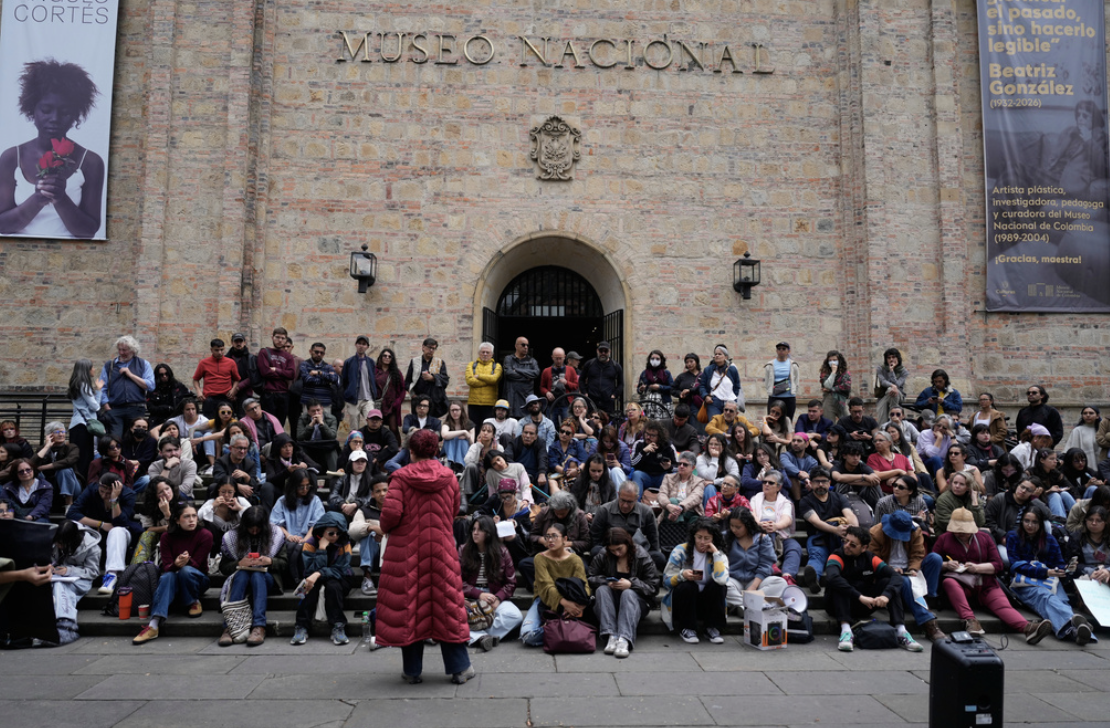
University students hold a class outdoors in front of the National Museum as part of a protest against the removal of some artworks from the museum in Bogota, Colombia, Wednesday, Oct. 21, 2026. (AP Photo/Fernando Vergara)
On Oct. 15, 2026, President Abelardo de la Espriella of Colombia removed over 30 pieces of artworks and historical objects from its Hacer Sociedad (Making Society) and Memoria y Nación (Memory and Nation) exhibits in the National Museum of Colombia. This follows with the revival of ties between Colombia and the United States as of Sept. 8, 2026, critics have compared the removals to President Donald Trump’s efforts to reshape how U.S. museums present history.
De la Espriella took office on Aug. 7, 2026, following leftist President Gustavo Petro, making a sharp turn to the right. The removal drew criticism from human rights organizations, cultural institutions, and political groups that accused the government of excluding marginalized communities from Colombia’s historical record. Espriella labeled the removal of these cultural artifacts as a “counterrevolution” to avoid cultural institutions from being taken over “atheist social communism.” He said, “This perversity of using culture to indoctrinate people is finished.”
Colombia’s path from repression and conflict was not an easy one. Its history is marked with the remnants of vital civil rights movements that include LGBTQ+ activists, feminist groups, and Indigenous communities. Officials also removed objects associated with the 2016 peace agreement between the Colombian government and the Revolutionary Armed Forces of Colombia (FARC), a former guerrilla organization. De la Espiriella has said Colombia’s museums should not promote “terrorism,” where he scrutinizes liberalist ideals.
The strengthening of U.S.-Colombia relations led to the U.S. directing $1 billion dollars in aid for Colombia to reinvest into their military and security networks. Espriella’s rightist approach similarly parallels Trump’s because according to White House reports, Executive Order 14319, targets “woke” Artificial Intelligence (AI) models that include Diversity, Equity, and Inclusion (DEI) ideologies, where he claims significant historical details have been distorted. Gimena Sanchez-Garzoli, director of the Andes on Latin America, reflects a broader trend of Colombia utilizing “U.S. political narratives and strategies” within their political frameworks. This has led to accusations of the Colombian government promoting a vision of Colombia as exclusively white, Catholic and Spanish-speaking, as Colombian independence leaders and conquistadors were removed from the galleries.
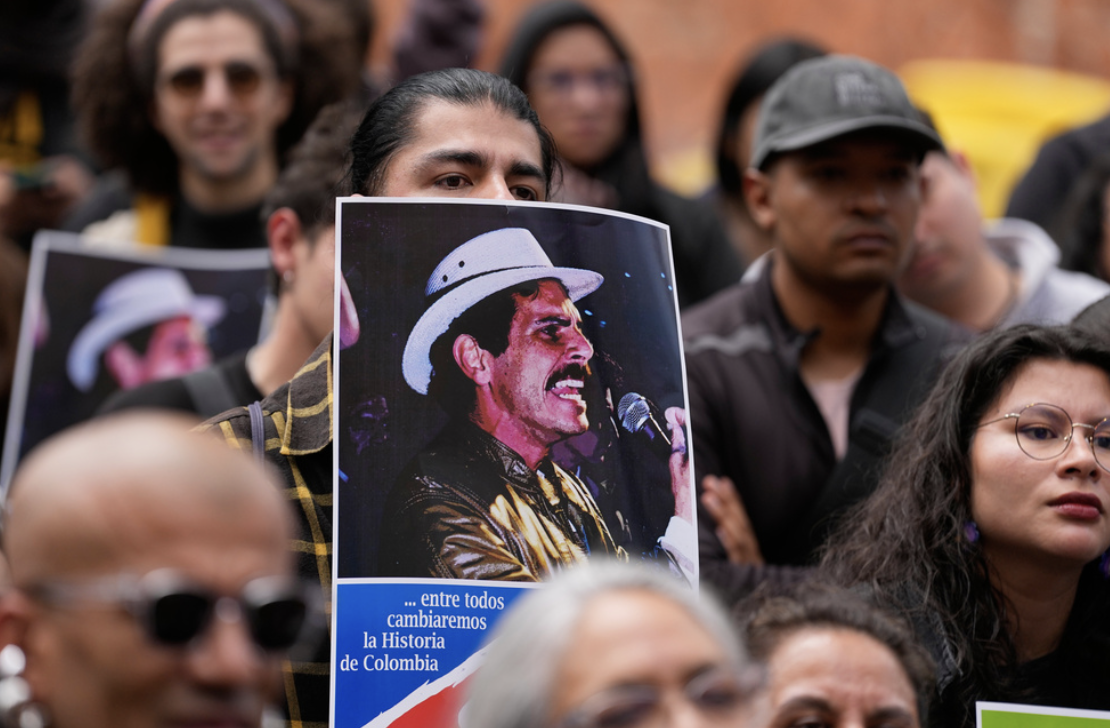
A demonstrator holds a poster of the late M-19 guerrilla commander Carlos Pizarro during a protest against President Abelardo de la Espriella's order to remove exhibits about political violence from the National Museum in Bogota, Colombia, Saturday, Oct. 17, 2026. (AP Photo/Fernando Vergara)
On Oct. 17, 2026, more than 500 people demonstrated outside of the National Museum in Bogotá, accusing de la Espriella’s administration of censoring Colombia’s history. Demonstrators carried signs reading: “Censorship is for cowards,” “Long live queer and trans art,” and “This is not a culture war, it is a war on culture.” The contentions against Espriella’s actions led to a series of riot police breaking up protests. Despite the police presence, university students and professors continued their protests by holding outdoor classes in front of the museum discussing creative freedom.
Former Liberal Party Senate candidate Maria Paz Gaviria questioned how one explains the story of citizenship conquest without acknowledging the ones that fought for it. Anthropologist Arturo Sanabria called the government’s approach a form of “neocolonial intervention.” This ties back to the anti-woke U.S. political narrative, where Trump is pushing for direct changes toward the Smithsonian Institution, to avoid funding “improper ideology.” According to National Public Radio (NPR), Epriella is deploying a “counterrevolution,” which remains a huge step to fighting “wokeism.”
Following the series of protests, on Oct. 19, 2026, Judge Cesar Enrique Osorio ruled the artifacts must be preserved and prevent them from being removed from the museum. However, there have been no actions yet on part of the government to return these missing artifacts to the National Museum.
The ties between the U.S. and Colombia will remain wielded, not only by U.S. aid, but also bilateral cooperation on combating transnational narcoterrorism to keep the two countries closely aligned. As Espriella is allowing the opportunity for U.S. investors to become more involved in the country, public concerns arise at the thought of Colombian history being viewed as a battleground for power.