
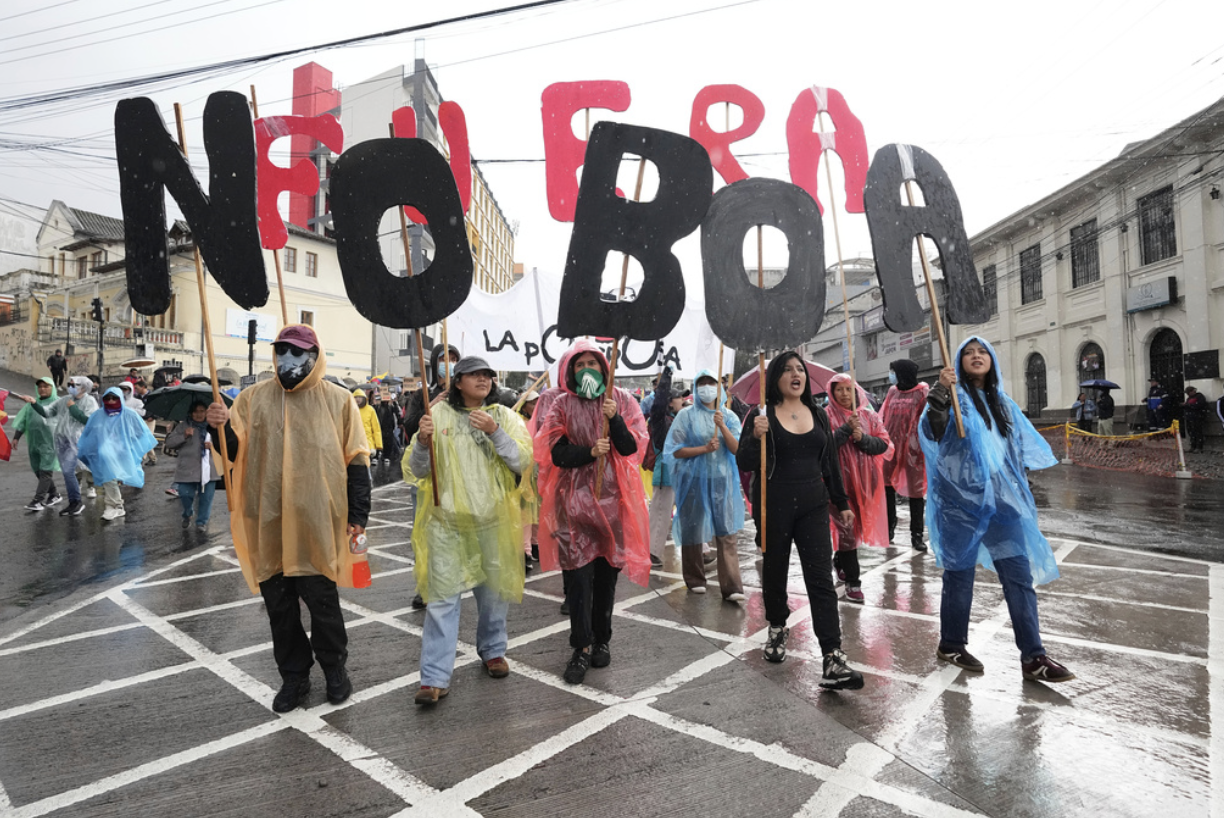
Protesters take part in an anti-government demonstration in Quito, Ecuador, Saturday, Nov. 7, 2026. (AP Photo/Dolores Ochoa)
Canadian mining operations have grown in recent years. Currently, around 60 percent of the world's mining companies have headquarters in Canada. In July 2026, the Canada-Ecuador FTA was signed by the two governments in order to boost both countries’ economies, remove tariffs, create new jobs, and support multinational businesses. Although the FTA has not yet taken effect, Indigenous and environmental organizations warn that the agreement could encourage mining investment in areas already affected by disputes over land rights and environmental protection.
Critics of the FTA hold that, through the Investor-State Dispute Settlement (ISDS), the agreement heavily favors Canadian mining companies and has aimed to safeguard their ventures in Ecuador by pressuring the state to meet their demands through threats of lawsuits or renegotiation of the FTA. The ISDS clause specifies Canadian corporations’ ability to sue Ecuador in cases where state restrictions hinder the profits and production of these multinational corporations. Both countries claim that these clauses, which heavily favor investors, are simply enforcement mechanisms to ensure both states’ compliance with the trade agreement.
Even before the FTA goes into effect, Canadian mining endeavors are not new to Ecuador. Mining operations have had severe effects on local communities, indigenous nations, the environment, and the rule of law for over a decade.
The Loma Larga mining project, owned by Canada-based Dundee Precious Metals Inc., is a large mining project located on indigenous land. The project is designed to mine for gold, silver, and copper within its almost 20,000-acre mine. The company has drafted extensive plans to extract more than 3,000 metric tons of metal-containing ore per day and more than 14 million tons over a 12-year project life.
The Solaris Warintza Project is another major Canadian mining operation located on the Ecuadorian border with Peru that intersects the Amazon and Andes, a region with high biodiversity. Although it is still in its exploration stage, Solaris aims to have the operation running by 2030, assuming construction begins as planned in 2027. The company recently stated in its project update that it expects to mine around 300,000 tons annually within the first five years of operation. The effects that this mine will have on local plant and animal life are unknown at this point, but researchers from Amazon Watch expect it to have far-reaching consequences for the region, specifically impacting biodiversity, natural resources, and Indigenous land.
The creation of these mines located within indigenous territories and communities has been carried out without legal approval from local indigenous communities. In 2021, a referendum was held, and 80 percent of inhabitants in the city of Cueca have voted against the creation of mines, citing that the creation of these mines violates the right to “free, prior, and informed consent” (FPIC) and the UN Declaration on the Rights of Indigenous Peoples, thus constituting a violation of human rights under the Escazú Agreement.
Additionally, Amnesty International reported in July, 2026 that if mining operations are allowed in this region, they would severely degrade the surrounding environment by polluting air, water, and soil, and destroying farmland, thus threatening the livelihoods, survival, and sovereignty of local indigenous nations.
In Feb. 2022, a provincial court judge ruled in favor of the community and required the Loma Larga Mine to stop operations and consult local groups and environmental organizations. In Aug. 2023, the Provincial Court of Azuay upheld the ruling. Despite this, because the ruling has not been enforced by the state, community members continue to report ongoing mining operations. Although Ecuador’s Ministry of the Environment reported conducting environmental consultation in Azuay and obtained community approval, many residents, aside from a few farmers in the highlands, deny ever giving land approval or receiving the environmental report.
Advocates of environmental organizations and local protestors have reported being attacked, threatened, and unjustly imprisoned due to being labeled as domestic terrorists. Reports of the use of excessive military force have become more common. In the case of the El Domo project, the company, Curimining SA, used the the Ecuadorian state to suppress dissent and criminalize peaceful protesters.
Ecuadorian President Daniel Noboa has further eroded the rule of law to stifle opposition against mining endeavors. To further aid Canadian mining endeavors in the country, Noboa has issued several presidential decrees that restrict mobility and the right to assembly. These decrees were intended to stifle dissent and criminalize those opposing mining operations, labeling them domestic terrorists.
To compound the issue, Ecuadorians and watchdog organizations alike have said an extreme conflict of interest exists between Noboa and Canadian mining operations. An investigative report by the Center for Economic and Policy Research (CEPR) has found that Noboa’s family holds a significant share of stock in various Canadian mining companies, leading Ecuadorians to question whether the FTA was ever intended to aid the economy and boost jobs.
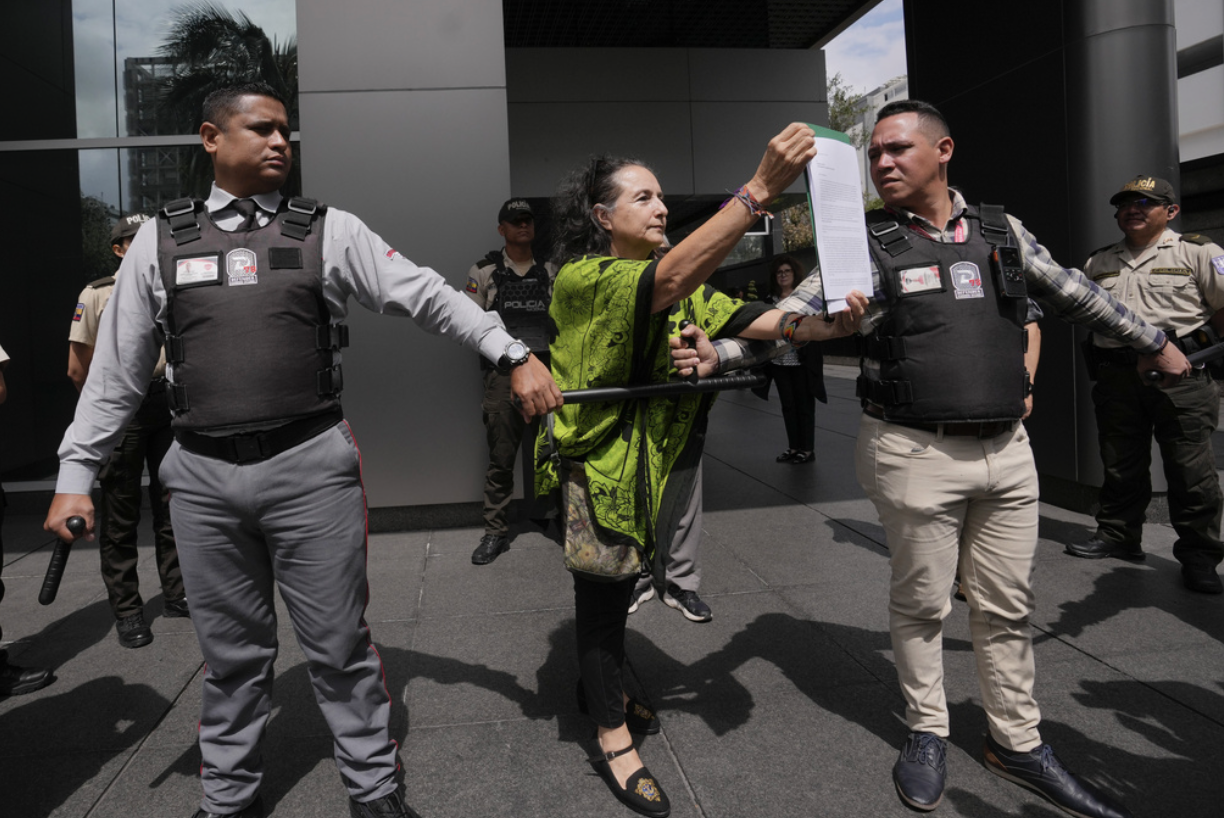
An environmental activist shows a letter for the Canadian ambassador against the Canadian government's interest in mining projects in Ecuador, after she was allowed to pass security officers guarding the Canadian embassy in Quito, Ecuador, Monday, March 4, 2024. (AP Photo/Dolores Ochoa)
In 2025, the Curipamba-El Domo mining project, associated with Canadian company Silvercorp Metals, faced protests over its planned development. Shortly after the protests began, six environmental defenders who were peacefully protesting were arrested and sentenced on March 21, 2024, by the Criminal Court of the province of Bolívar to three years of imprisonment and fines.
Human rights organizations, Indigenous nations, and community members have published reports, organized protests, and formed advocacy coalitions to oppose the mines' operation. Various groups such as the Shuar Nation, the “Working Group of Experts on People of African Descent,” and “The Defend Them All Foundation” have sent reports and letters to the headquarters of these companies to report the damage their communities are suffering.
In addition to encroaching on indigenous land, depleting natural resources that many depend on for survival, and receiving unrestricted access to the military and police to suppress dissent and criminalize protesters, these corporations are engaging in actions that have severely harmed the local environment. Mining is one of the leading causes of deforestation; a survey conducted in Brazil’s part of the Amazon found that around 10 percent of deforestation was attributed to mining operations in the region, largely due to nearby soil and water contamination. When deforestation occurs, carbon dioxide emissions rise, leading to biodiversity loss and more deforestation.
In addition to deforestation and heavy water use, mining operations can often contaminate air, soil, and water. Contamination from acid mine drainage, mercury, and arsenic often drains downstream into the clean drinking water communities use for drinking, farming, and bathing. Potential water contamination could threaten Shuar communities living downstream from the proposed Warintza project.
In many towns and cities downstream from mining operations, tens of thousands of people rely on these natural resources that these mines threaten to contaminate or deplete. Indigenous nations like the Kichwa and Shuar people rely on clean water, agricultural land, and the retention of their sovereignty and right to self-government.
In attempts to balance the effects of mining, Ecuador has taken up extremely strict environmental protections in addition to the protections of the rights of nature enshrined in the Ecuadorian constitution. In May of 2024, prior to the signing of the FTA, the Ecuadorian government signed Article 407 into law, aiming to protect Ecuadorians by prohibiting mining in urban areas and protected zones. Although it is vital to ensure protection for indigenous nations, there is a potential increase in mining that the country may face after fully adopting the FTA.