
Op-ed: Peru’s Politics of Instability
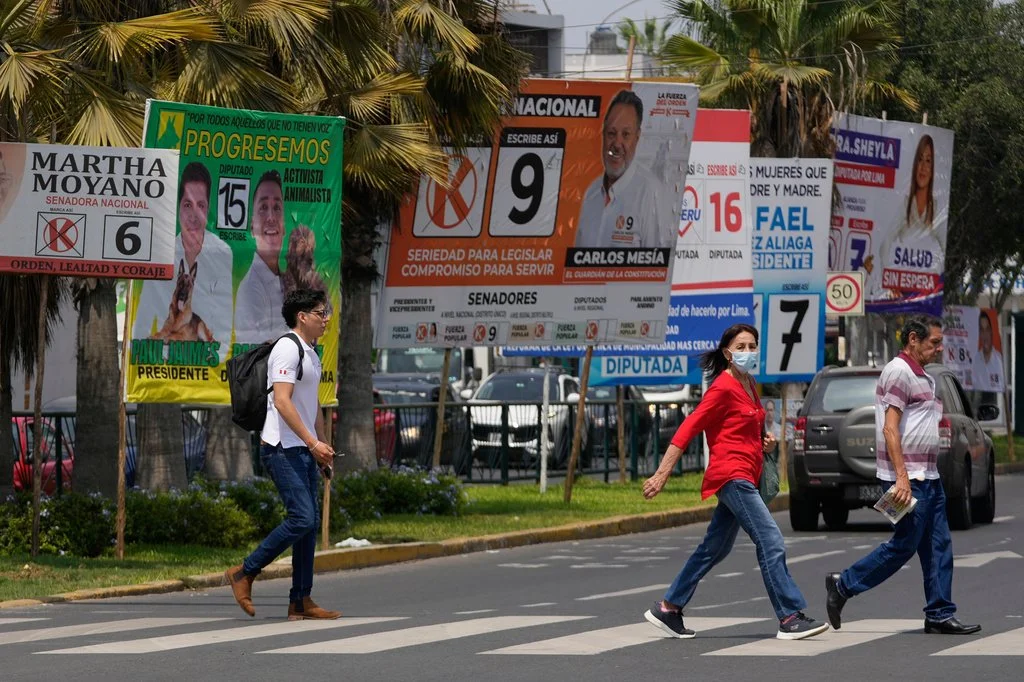
Pedestrians pass election campaign signs for presidential and congressional candidates, before the weekend's election in Lima, Peru, Friday, April 10, 2026. (AP Photo/Martin Mejia)
There was a time when the fall of a president would shake the country to its core. In Peru, the chaos has mostly just become the scenery. Presidents are removed, Congress clashes, protests happen constantly, and yet the country continues to move forward. As the country approaches another electoral cycle, the question is no longer how Peru will exit the crisis, but whether it remembers what political normalcy even looks like.
Over the past decade, Peru has experienced a staggering leadership turnover. Since 2016, the country has cycled through nine presidents, some impeached, others forced out, and a few arrested. The center of this pattern is a constitutional process of moral incapacity that allows for such impeachment. Originally meant to safeguard, it has increasingly been used as a political tool, enabling Congress to remove presidents with relative ease. What was meant to protect democratic accountability, in reality, led to a cycle of institutional conflict. But Peru’s instability cannot be blamed on politics alone. Beneath these repeated crises is a deeper and greater loss of trust. Corruption has played an immense role in this trajectory, with several former leaders in corruption scandals, most notably those tied to the Odebrecht case, which revealed a web of bribery across Latin America. Since the early 2000s, almost every president has been accused, investigated, or charged with something. This has made many Peruvians lose faith, not only in individual leaders, but also in the political system as a whole.
According to recent reporting by the Associated Press, Peru’s upcoming elections are already unfolding in a context shaped by insecurity, crime, and political fragmentation, with candidates positioning themselves as strong responses to disorder rather than representatives of coherent political programs.
At the same time, a separate Associated Press report highlights how Peru’s Congress continues to play a decisive, and often destabilizing, role in governance, including recent votes that underscore the persistent tension between legislative and executive branches. Rather than serving as a balancing institution, Congress has become an active participant in the cycle of instability, frequently accelerating political breakdown instead of containing it.
Polling data reported by The Guardian suggests that Peruvians themselves are aware of this dynamic. Public trust in institutions remains low, and voters approach elections with skepticism rather than hope. For many, elections are no longer moments of renewal, but temporary pauses in an ongoing crisis.
This raises a difficult but necessary question: what can elections actually fix?
Democracy assumes that elections provide legitimacy, stability, and representation. But in Peru, elections have increasingly failed to deliver these outcomes. The problem goes beyond the candidates to the structure within which they operate. Political parties are weak, fragmented, and often built around individuals rather than ideologies. Coalition-building is fragile, and governance becomes a matter of short-term survival rather than long-term planning.
In this context, elections risk reproducing the instability they are meant to resolve.
The consequences extend beyond domestic politics. Peru is one of the world’s largest producers of copper, a critical resource for global industries, including renewable energy and technology. Political instability introduces uncertainty into supply chains, affecting international markets and investor confidence. When governance is unpredictable, investment becomes cautious, and economic potential is constrained.
This is where Peru’s crisis becomes an international issue. It is not only a question of governance within a single country, but of how political instability in resource-rich states can ripple across global systems. For investors, policymakers, and international partners, Peru represents both opportunity and risk, a country with immense economic potential, but uncertain political foundations.
What makes Peru’s political instability particularly striking is not only its persistence, but its coexistence with a surprising degree of macroeconomic continuity. For years, Peru has maintained relative economic stability despite its political volatility, creating a paradox that complicates any straightforward narrative of crisis.
At the center of this continuity stands Julio Velarde, the long-serving president of Peru’s central bank, who has held his position since 2006 across multiple administrations, providing a sense of consistency in an otherwise shifting political landscape. Under his leadership, Peru has maintained controlled inflation, stable monetary policy, and a level of investor confidence that has helped buffer the economy from political shocks.
While macroeconomic indicators have remained relatively strong, their benefits have not been evenly distributed across society. Peru continues to face significant inequality, particularly between urban and rural areas, as well as persistent gaps in access to public services such as healthcare, education, and infrastructure. In this context, economic growth has not translated into broad-based social trust or political legitimacy.
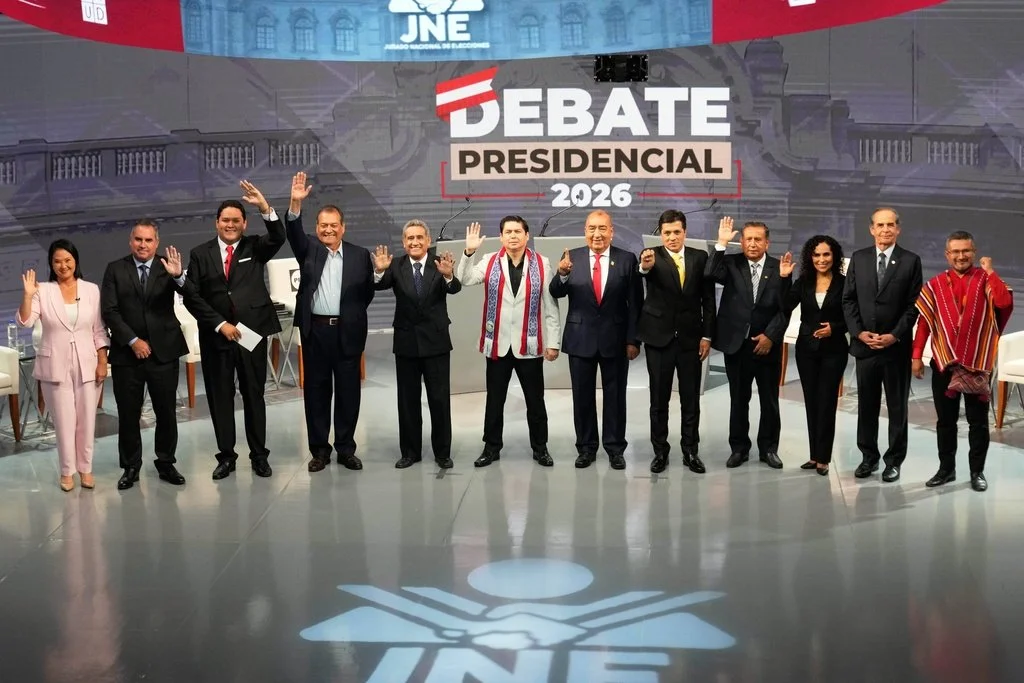
From left, presidential candidates Keiko Fujimori, Rafael Belaunde, Enrique Valderrama, Jorge Nieto, Mesias Guevara, Herbert Caller, Mario Vizcarra, Paul Jaimes, Antonio Ortiz, Rosario Fernandez, Roberto Chiabra and Ronald Atencio wave to reporters upon arriving at a presidential debate ahead of the April 12 election in Lima, Peru, Wednesday, March 25, 2026. (AP Photo/Martin Mejia)
The disconnect between economic performance and political stability reveals a deeper structural tension. On one hand, Peru has built a reputation as a reliable economic actor in global markets, particularly as a major exporter of copper. On the other hand, its internal governance remains fragile, with institutions that struggle to channel economic gains into effective public policy. This duality has allowed the country to function economically while stagnating politically.
Over time, political uncertainty can introduce fear that can eventually erode the economic foundations with which it has coexisted. Investor confidence, while historically robust, is not immune to prolonged governance crises. As Reuters and other financial reporting have noted, repeated political disruptions have begun to affect market perceptions, particularly in sectors tied to long-term investment such as mining and infrastructure. When governments lack continuity, regulatory predictability becomes uncertain, and investment decisions are delayed or reconsidered.
At the same time, the social consequences of instability accumulate. Frustration with corruption, inequality, and ineffective governance has fueled disapproval and deepened public disillusionment. Trust in institutions erodes gradually, though repeated experiences of disappointment.
Velarde’s presence at the central bank has, in many ways, insulated Peru from the immediate economic consequences of political turmoil. But such insulation has limits. Monetary policy can stabilize inflation and currency, but it cannot repair institutional fragmentation, nor can it restore public trust. Economic stability without political legitimacy risks becoming unsustainable. If the current cycle of crisis continues, the country may reach a point where its economic strengths can no longer compensate for its political weaknesses.
But focusing solely on institutions risks overlooking the human dimension of this crisis.
Because instability is not just a condition but a lived experience, it shapes how people understand authority, how they relate to the state, and how they imagine their future.
Nevertheless, people adapt. They lower their expectations. They learn not to rely too heavily on political promises. They adjust to a reality in which change is constant, and stability is uncertain. What emerges here is them, not disengagement, but a different form of acceptance.
There is a recognition that politics and governance will remain turbulent and incomplete. That crisis is not something that interrupts normal life, but instead is something that defines it. This normalization of the crisis may be Peru’s biggest change and also its greatest risk. If instability is expected, it does not need to be explained. Democracy, in this context, could become more about the process than the substance. Elections are still happening, and the government is still changing. But the basic conditions are still mostly the same.
As Peru approaches its next electoral moment, there will be renewed hope for change. Elections give the public a way to make changes, even if it's not perfect; they remain one of the few mechanisms through which citizens can shape political outcomes. But they can't fix a system that is unstable at its core on their own.For real change to happen, there needs to be deeper structural reform. This means making political parties stronger, changing how Congress and the presidency work together, and rebuilding trust in institutions. These are not quick fixes; they will take time to work.It is not about choosing new leaders, but rebuilding a political system in which leadership can endure. It is about rebuilding a political system in which leadership can endure. It is about making institutions stronger, rebuilding trust, and making it so that governance isn't always under attack.
Peru is standing at a point that feels, in a way, both familiar and new. There is no sudden change of direction or resolution, just a dawning realization that the country’s problems are not just temporal, but structural.
And maybe that awareness is where change begins.Because before a crisis can be resolved, it must be understood for what it really is: Not an interruption. Not an exception either. But a system that has learned to work in instability. The question now is whether Peru can learn to function differently.