
Inside El Salvador’s Largest Mass Trial
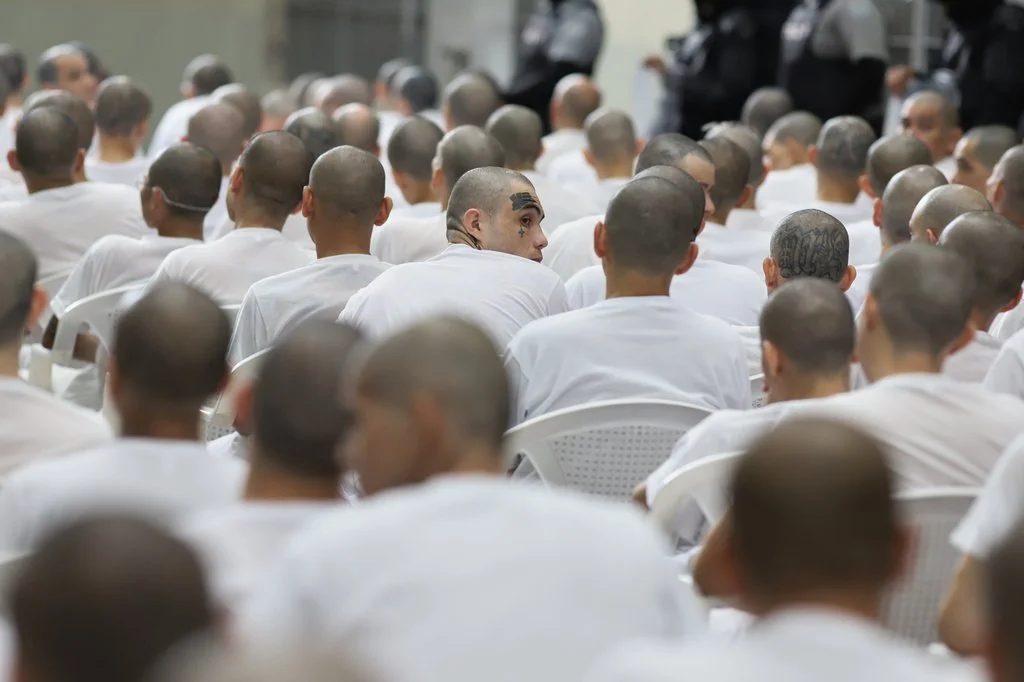
Alleged gang members take part in a mass trial at the Terrorism Confinement Center (CECOT) in Tecoluca, El Salvador, Thursday, April 23, 2026. (AP Photo/Salvador Melendez)
On April 21, El Salvador began its largest mass trial so far, for 486 inmates accused of being members of the Mara Salvatrucha gang (MS-13). The transnational criminal organization is allegedly responsible for more than 47,000 crimes, including 29,000 homicides, committed between 2012 and 2022 in El Salvador.
Prosecutors say the charges include homicide, femicide, extortion, enforced disappearances, and arms trafficking. They also accuse some of the defendants of ordering the killing of 87 people in one weekend in 2022, the wave of violence which led President Nayib Bukele to declare a state of emergency a few days later.
The trial is being held under El Salvador’s expanded organized crime laws, after Congress passed legislation allowing prosecutors to try large groups of alleged gang members collectively. The trial is taking place virtually, with most defendants appearing from maximum-security prisons, such as the Center for the Confinement of Terrorism (CECOT).
The trial is not only the largest prosecution since Bukele launched his ‘war on gangs’ in 2022, but also one of the clearest examples of how El Salvador’s justice system has changed under the country’s four-year state of emergency. First declared on March 27, 2022, the state of emergency has been renewed 49 times, most recently on March 26, 2026.
The trial comes as part of the extreme measures put in place under Bukele’s anti-gang campaign, which President Donald Trump has backed. These measures have included mass arrests, maximum-security detention, and expanded powers for prosecutors.
The extreme measures are rooted in decades of gang violence in the region. The Salvadoran government estimates that over 200,000 homicides have occurred at the hands of gangs, including Mara Salvatrucha and its most notorious rival, Barrio 18, over the past three decades.
Although this is the largest mass trial so far, it is not the first of its kind. The first was held in March 2025, when 52 members of the Barrio 18 gang were found guilty. One defendant received multiple charges that together added up to 245 years in prison. In another trial in November 2025, one individual received a 397-year prison sentence.
Since 2022, more than 91,500 individuals have been arrested under the crackdown, with around 8,000 later released after being wrongfully detained. Many detainees remain in maximum-security facilities built as part of the government’s prison expansion strategy.
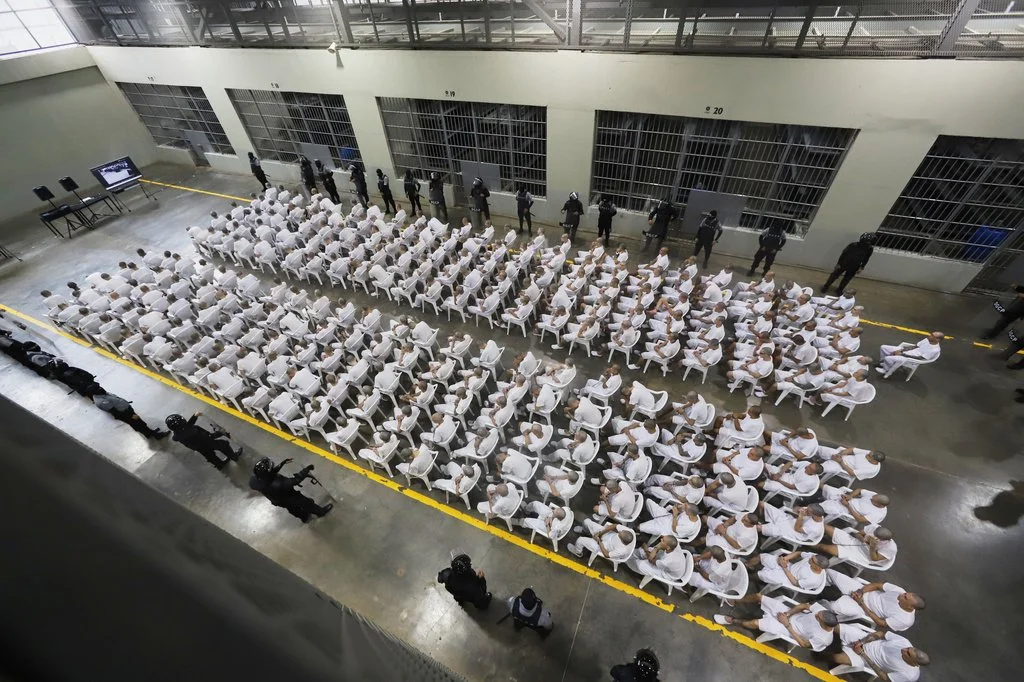
Alleged gang members take part in a mass trial at the Terrorism Confinement Center (CECOT) in Tecoluca, El Salvador, Thursday, April 23, 2026. (AP Photo/Salvador Melendez)
MS-13 and Barrio 18, El Salvador’s two most notorious gangs, were both formed in Los Angeles and have been linked to widespread violence in Central America since the 1990s, when US immigration reforms saw the mass deportation of thousands of gang members. For decades, the gangs controlled over 80% of El Salvador’s territory using “extortion, drug dealing, contract killings and arms trafficking.”
El Salvador used to be one of the most dangerous and deadly countries in Latin America. CECOT itself was built to hold gang members in the country with the highest murder rate in the world.
In 2015, the country recorded 6,656 homicides. By 2023, that number had fallen to 214. Since the start of Bukele’s presidency in 2019, El Salvador has become one of the safest countries in the region. Crime rates have absolutely plummeted, a feat that, according to The Times, “has made him the most popular elected head of state in the world,” with an approval rate of more than 90%.
Despite the country’s impressive progress in crime reduction, human rights organizations have raised concerns over potential rights violations. One of the main issues with these mass trials is the lack of due process, the legal principle that guarantees people accused of crimes are presumed innocent and have the right to a fair trial.
The concern is not only the size of the trials, but also how long the defendants can be held before they ever appear in court. The same legislation that allowed mass trials also removed El Salvador's 24-month maximum limit for criminal proceedings, meaning some detainees have now been held for four or more years without a trial.
The Human Rights Watch has also documented conditions inside El Salvador's prisons, describing allegations of physical torture, beatings, psychological suffering, denial of basic necessities, and severely restricted access to recreation or outside contact. These reports add to concerns that the government's security campaign is not only weakening due process but also exposing detainees, including some who may have been wrongfully arrested, to inhumane treatment.
One woman, whose husband was taken to prison without evidence of gang affiliation, told CBS News she now fears the government the way she once feared the gangs.
Critics, such as the Washington Office on Latin America, argue that trying hundreds of people at once makes it difficult to evaluate individual cases, increasing the risk of wrongful convictions. The concerns come as Bukele’s security policies have led to a sharp drop in homicides, while also drawing scrutiny from human rights organizations over mass arrests, prison conditions, and due process.