
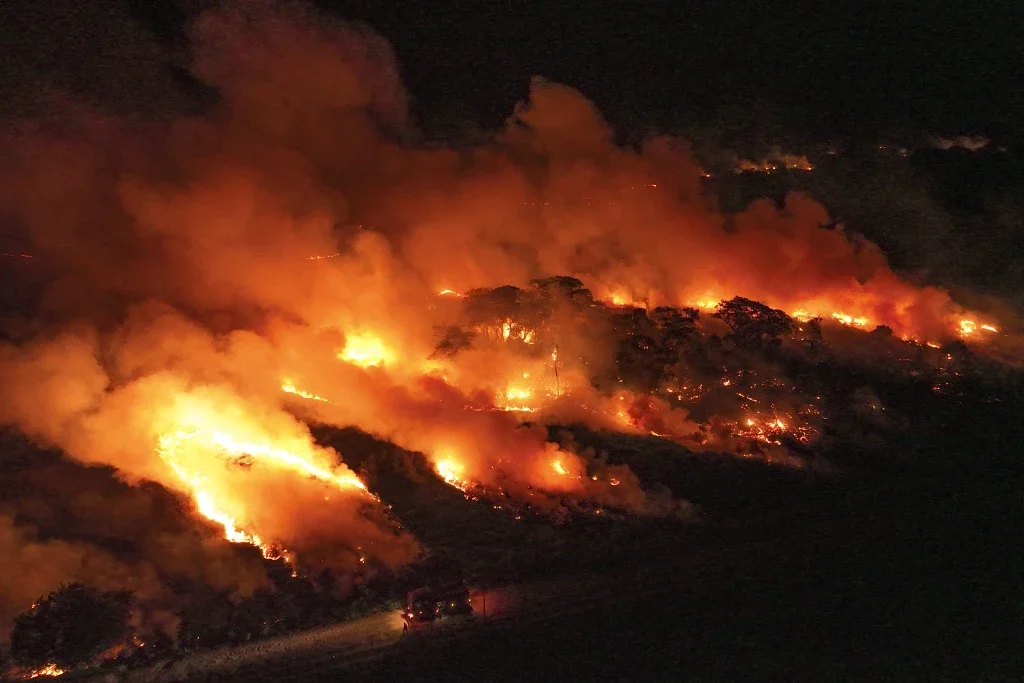
A wildfire consumes an area next to the Transpantaneira road in the Pantanal wetlands near Pocone, Mato Grosso state, Brazil, Nov. 15, 2023. (AP Photo/Andre Penner, File)
Forests once covered roughly 80% of Western Europe 6,000 years ago. Today, just one-third remains. By 1500 AD, the great forests of central and northern Europe had largely been demolished to grow grain, graze cattle, build ships, smelt iron, and heat homes. England cleared its woodlands over centuries of agricultural expansion. Germany’s forests became charcoal for forges and lumber for fortresses. Each of Horatio Nelson's warships at the Battle of Trafalgar required 6,000 mature oak trees. Europe built its civilization on its forests, and then ran out of them.
These same civilizations then crossed oceans to find more — more forests, more land, more peoples to dispossess.
Generations across the world were taught to admire explorers like Columbus and Magellan — their visionary quests to conquer uncharted lands, develop commerce to satisfy an acquisitive European population, and boost prosperity. But look past that mythology, and the fruits of this so-called advancement were felt by only some. On the surface, this progress is exciting to imagine: bold humans crossing unknown oceans, drawing maps, opening up worlds. But then one lifts the veil and sees the exploitation of virgin soil, the dispossession of Indigenous populations from their ancestral lands, and the deliberate imposition of a caste system designed to ensure that a permanent group of "have nots" keeps the "haves" having.
The conquistadors took extraordinary quantities of gold and silver from the Americas, transferring the wealth of entire civilizations into European treasuries for three centuries. They also imposed plantation systems — sugar, cotton, rubber, tobacco — that replaced Indigenous land management with monocultures optimized for export, clearing the land, breaking Indigenous governance systems, and making the Americas economically dependent on European markets. What began with swords and smallpox continues with trade agreements and debt. What continues today is the consumption: the beef, soy, the palm oil, the timber that flows from cleared tropical land into the supermarkets of the very nations now lecturing countries like Brazil about deforestation.
That system did not disappear. It evolved.
The same nations that built their wealth by extracting resources, clearing forests, and restructuring entire continents for profit now position themselves as global stewards of environmental morality. They arrive at climate summits to condemn deforestation — a practice their own civilizations perfected, and only "abandoned" once there was nothing left to cut. This is not environmental leadership, rather, it is historical amnesia dressed up as moral authority. And the people paying the price for that amnesia are not sitting in conference halls, they are dying in the forest.
This is not ancient history. Between 2019 and 2021, EU imports were associated with an average of 190,500 hectares of deforestation per year: roughly 15% of all deforestation linked to direct global trade. The European Union is the second-largest proponent of trade-linked tropical deforestation on Earth. Between colonial settlement and the 1870s, the United States cleared roughly half its northeastern forests to build its agricultural and industrial base. That process generated the capital that now funds the institutions of global environmental governance. Today, those institutions set the terms by which developing nations must manage their remaining trees.
Hypocritical: not because regulation is wrong — rather it is urgently right — but because the conversation is being led by the nations most responsible for the problem, who have never been asked to account for it.
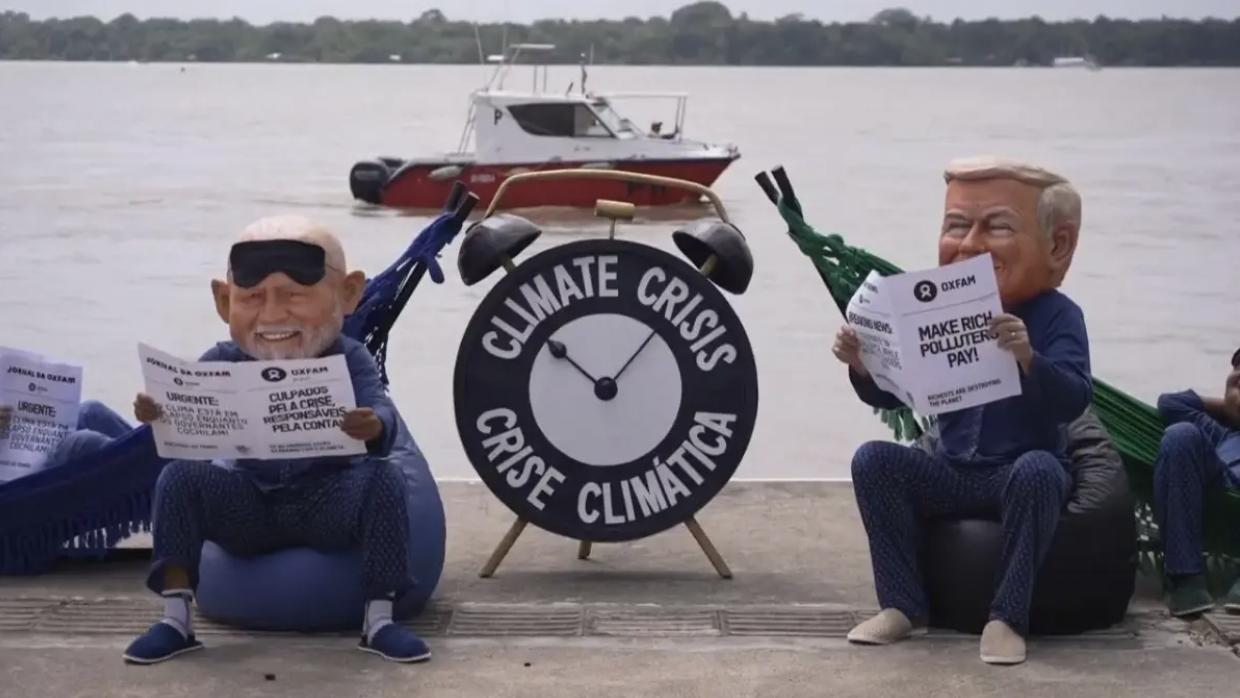
Activists from several organisations held protests on Wednesday in the Brazilian city of Belem where COP30 is taking place, calling for greater action to combat climate change. (AP/Lucas Dumphreys and Alan K. Guimaraes)
In November 2025, the world descended on Belém, Brasil — gateway to the Amazon — for COP30, the first UN climate summit held in Brazil since the Rio Earth Summit in 1992, and the first ever in the heart of the rainforest itself. Heads of state gave speeches. Promises were made. Activists marched through the streets carrying lights called porongas, traditional lamps used by Amazon rubber tappers, demanding that the world finally honor its commitments to the forest and the people who live inside.
No binding roadmap to halt deforestation was signed. The formal deforestation roadmap, backed by more than 80 nations, was quietly relegated to a voluntary initiative. The lights went out. The conference ended. And the Amazon keeps on burning.
This has become a ritual: the world convenes, the wealthiest nations follow by delivering moral proclamations about biodiversity, climate, and the rights of Indigenous peoples. Then they fly home, open their supermarkets, and buy the beef, the palm oil, soy, and timber: the very things that make deforestation profitable. And somewhere in the forest, another Indigenous land defender is found dead.
And yet, the people most targeted are also the last line of defense. There is a fact that gets consistently buried beneath the politics: the world's most effective forest protectors are not governments, not international NGOs, and certainly not the corporations that fund lobbying campaigns to delay the very regulations meant to hold them accountable. They are Indigenous communities.
Start not with policy, but with people.
According to Global Witness, at least 146 land and environmental defenders were killed or disappeared globally in 2024. Indigenous peoples, who make up roughly 5% of the population, accounted for nearly a third of all lethal attacks. 82% of those killings took place in Latin America, with Colombia alone recording 48 murders, a third of the global total, with 19 being from indigenous communities. In nearly every documented case the killers were acting in service of the same economic forces that wealthy nations’ consumers and corporate drive: illegal logging, industrial agriculture, and extractive mining.
These systematic murders, enabled by impunity, are done in the service of profits that flow overwhelmingly out of the Global South and into global supply chains. Human Rights Watch documents this pattern: forest defenders are "frequently threatened, attacked, and even killed by criminal networks and land-grabbers eager to convert the forest to land for industrial agriculture." Governments often take few effective steps to stop these killings, and corporations routinely evade supply chain accountability.
The forest is not an abstraction. The Yanomami of Brazil, the Kichwa of Ecuador, and the Saeto community of Peru — four of whose leaders were murdered by illegal loggers back in 2014 — gave this argument its most powerful legal foundation yet. The Inter-American Court of Human Rights declares climate destruction a human emergency, recognizes nature itself as a holder of rights for the first time in the history of international law, and elevated the obligation not to cause irreversible harm to ecosystems to the status of jus cogens: a norm of international law, non-derogable, binding on all states, in the same category as the prohibition against genocide. Knowingly destroying forests, the Court implies, is no longer a development choice. It is a legal violation.
Research by the World Resources Institute shows that in Colombia, the deforestation rate inside tenure-secure Indigenous lands was 0.04%, half the rate outside those lands. The cost of securing Indigenous land rights in the Amazonian countries amounts to less than 1% of the total environmental benefits those lands generate, estimated between $679 billion and $1.53 trillion over 20 years in Brazil, Bolivia, and Colombia alone. According to WRI, releasing the carbon stored on Indigenous and community lands would be equivalent to 33 times total global energy emissions — making their preservation one of the single most cost-effective climate interventions available.
There is also a straightforward economic argument for preservation: one that politicians and governments managing significant forest cover should be using as leverage, rather than charity. Brazil's Amazon Fund demonstrates the model: sovereign donors including Norway, Germany, and France have contributed billions precisely because a living Amazon generates more value — in climate regulation, rainfall generation, carbon sequestration, and biodiversity services — than any cleared pasture. The Amazon’s “flying rivers,” vast atmospheric currents of moisture generated by the forest itself, sustain rainfall across South America’s farmland. When large areas are cleared, those systems weaken, reducing agricultural productivity in the very regions that clear the forest to grow more agriculture. Destroying the Amazon to create cattle ranches, in long-run economic terms, is a self-defeating trade-off.
Preservation is smart, but it is only viable if the international rules are fair. The EU Deforestation Regulation, already delayed twice under corporate lobbying pressures, is now pushed to December 2026; it must be implemented with full traceability requirements and genuine human rights conditions. Voluntary pledges, as the COP30 in Belém proved, accomplished nothing. Every supermarket in Europe that sells beef raised on cleared Amazon land is a participant in deforestation. For effective change, the law must say so, enforce it, and impose real consequences.
Forest nations don't need lectures — they need binding import rules that hold corporations accountable, climate finance that actually transfers wealth, and Indigenous rights respected in every trade deal and supply chain audit. Days after COP30 ended in Belém, Brazil's own Congress weakened Amazon protections under agribusiness pressure. Nations that have extracted, cleared, and consumed the most bear the greatest obligation to act — and have the least standing to moralize.
The conquistadors changed their titles. They became trade ministers, corporate borders, and environmental delegations. The extraction never stopped. It just got a green label.
The lights of Belém are out, and the forest is waiting.