
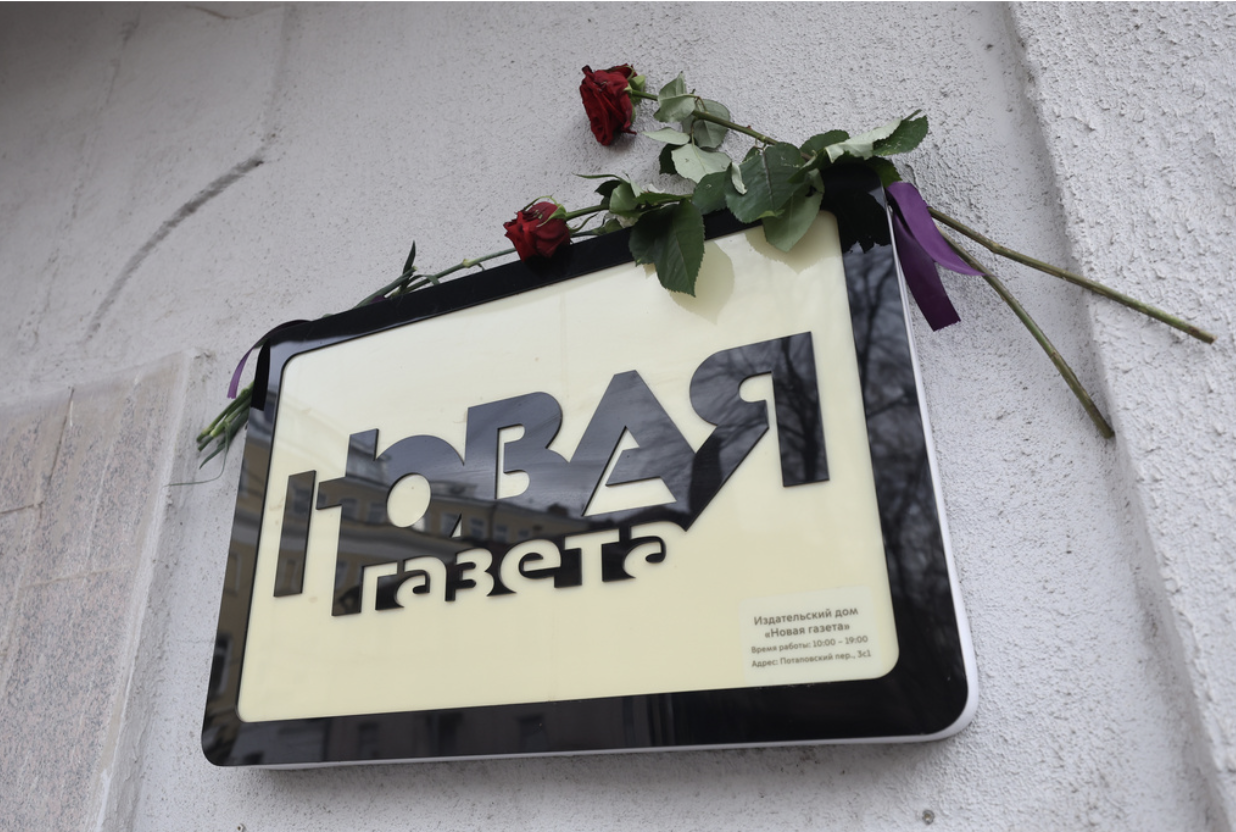
Flowers are attached to a nameplate of the Russia's top independent newspaper Novaya Gazeta during a ceremony of closing Novaya Gazeta's office in Moscow, Monday, Nov. 9, 2026. (AP Photo)
A court is only as strong as the people who can access it, and some governments have exploited that vulnerability. Rather than closing courts, these governments jail the lawyers who file petitions, shut down the newspapers that report abuses, and imprison the activists who bring cases to public attention. The judge remains on the bench, and the courtroom is still open, but no one can bring a case, so justice is gone in practice.
Removing legal defenders makes the justice system inaccessible to ordinary citizens. The international community’s tendency to condemn verdicts only after they are issued does little to prevent these abuses. Democracies and bar associations should treat how a government handles its lawyers and journalists as the earliest warning available, and send trial monitors to the first hearing rather than issuing statements after the verdict.
In little more than a week, a Pakistani court jailed two human rights lawyers for 10 years each, and Russia's prominent independent newspaper announced it would close down. Neither government needed to abolish a court to achieve this.
Pakistan provides a clear example of how a government can maintain its court system and make it harder for people to access it. An anti-terrorism court sentenced the human rights lawyers Imaan Mazari and Hadi Ali Chattha, who are married, to 10 years each after a trial held inside Adiala prison in Rawalpindi.
The case concerns an October 2024 incident in Islamabad. Prosecutors alleged that the couple removed barriers along a route set aside for the touring England cricket team and argued with police. The couple says they were on their way to court that day and never removed the barriers. The judgment found that the episode showed an intent to create terror. The judge treated a dispute over road barriers as terrorism without adequately explaining why.
The better explanation for the arrest of the couple lies in their work. Mazari, 32, has defended journalists facing defamation charges and individuals accused of "blasphemy". She has also worked on cases of enforced disappearances involving ethnic Baloch. Chattha has represented victims facing false blasphemy cases, sexual violence, and enforced disappearances. Their clients include families seeking to learn what happened to a missing relative and people accused of offenses that only a few lawyers will take on. These cases only reach a courtroom if a lawyer is willing to bring them, and the couple is among the few lawyers in Pakistan who consistently take on this work. Jailing them, therefore, ends their clients’ cases without a ruling, because few other lawyers are willing to take them on.
This marked the couple’s second conviction this year. In January, a court sentenced each to a total of 17 years in prison over social media posts, under a cybercrime law that critics say is used to suppress online dissent. The law, the Prevention of Electronic Crimes Act (PECA), was enacted in 2016 to address cybercrime. A 2025 amendment added a crime of spreading “fake or false” information, which Human Rights Watch says is vaguely and overbroadly defined. The Supreme Court later suspended those sentences, but police re-arrested the couple the same day in the cricket-route case.
The defense says the trial itself was compromised. Lawyers reported they could not meet their clients in jail, and the court ordered jail authorities to facilitate meetings. The trial was later shifted to the jail amid disputes over producing the accused and lawyers’ access. Chattha had told the court that lawyers and journalists should be allowed to attend any high-profile trial. Maxari’s mother, Shireen Mazari, a former human rights minister, called it a “sham trial without any due process.” Amnesty International said the verdict showed the judiciary had failed a test of fair-trade principles.
A government confident in their case would have let outside observers watch the trial, and Chattha asked for that, saying lawyers and journalists should be allowed to attend any trial held inside the jail. The international criticism, however, came only after the January conviction. In February, five UN experts said in February that “States must ensure lawyers are not subject to prosecution for any professional action,” and an EU spokesperson said the conviction went against the independence of lawyers.
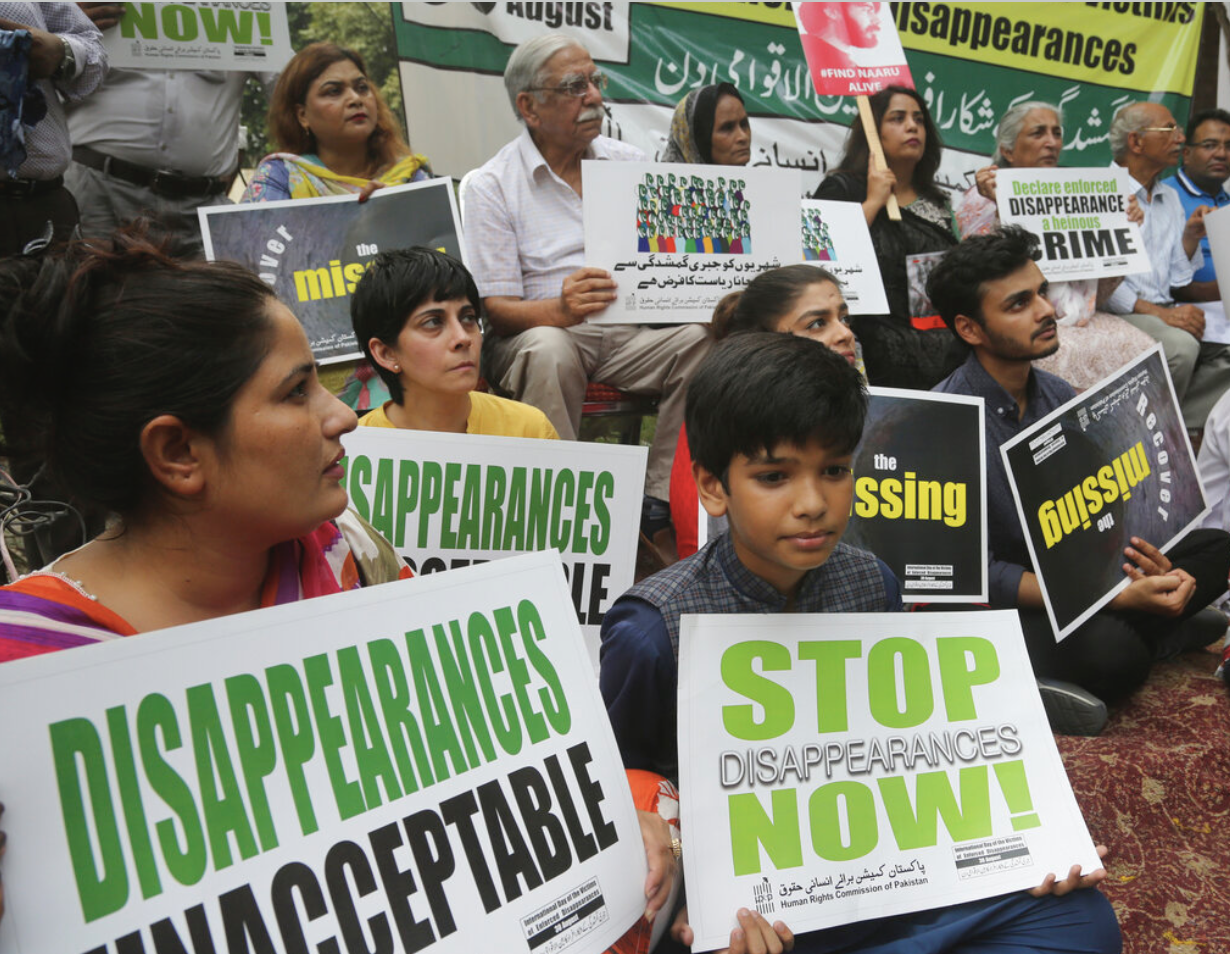
Pakistani human rights activists protest against enforced disappearances to mark the International Day of the Victims of Enforced Disappearances in Lahore, Pakistan, Friday, Aug. 30, 2019. (AP Photo/K.M. Chaudary)
Russia has employed similar methods of censorship on lawyers and newspapers. Novaya Gazeta, an independent investigative newspaper, announced it would stop operating on Nov. 9, after landlords told the newsroom to vacate its Moscow office. Sergei Sokolov, the paper’s editor in chief, said in a statement that “Novaya Gazeta has been killed.”
The Novaya Gazeta was an investigative paper that was known for its critical coverage of Russian corruption in its politics. The Committee to Protect Journalists counts five journalists who wrote for The Novaya Gazeta who were killed over its three decades of operation. The best known was Anna Politkovskaya, who reported abuses by Russian forces in Chechnya and was shot in her building’s elevator in 2006. A paper that kept publishing through five killings was finally ended because of an eviction notice and a cutoff of donations.
The paper said financial organizations stopped servicing it after its entire editorial team was designated a "foreign agent,” which cut off its donations. Investigators had searched the newsroom for 13 hours. Its entire editorial team was designated a “foreign agent”, and financial organizations stopped serving it. Amnesty noted that private actors carried out the eviction and the donation cutoff, but said the authorities’ role is not in question. Landlords and payment processors let the state avoid signing its own order.
Lawyers were targeted the same way. In January 2025, a court sentenced three lawyers who had represented Alexei Navalny to between 3.5 and 5.5 years for passing his messages from prison. One of them, Vadmin Kobzev, told the court: “We are on trial for passing Navalny’s thoughts to other people.”
In this case, both reporters and lawyers translated what Russia did politically and in courts into something an ordinary person can read and a judge can act on. A government that jails the messenger sets an example to every other lawyer, scaring them away from taking sensitive cases in fear of getting arrested.
That is why pressure has to come from the outside, from the democracies I named above. I use the word “democracies” carefully here, because neither government qualifies as one. Freedom House rates Pakistan as Partly Free, 32 out of 100, and Russia as 12 out of 100. The V-Dem Institute counts Pakistan among the electoral autocracies and lists Russia in the same group. Yet all three keep courts open, and the Freedom House found that media freedom, personal expression, and due process in both countries have deteriorated most over the past two decades. The courthouse is a poor test of a legal system. Whether people can access and understand the court system is a better question. By “democracies,” I mean countries that Freedom House rates as free, which are free to press other governments for change.
In most of these cases, condemnation arrives after the sentence. Amnesty’s statement on Mazari and Chattha came after the verdict. The U.N. experts’ public statement on the first case came 11 days after the January conviction. Unfortunately, by then, the government and courts have finished their work.
The warning signs came months earlier. Mazari and Chattha had been in custody since Jan. 23, nine months before the Oct. 29 verdict. Investigators searched Novaya Gazeta’s newsroom on April 9, more than six months before it closed. Navalny’s lawyers were arrested in October 2023 and sentenced 15 months later. In each case, there was a moment when a bar association or an embassy could have asked to watch what came next, or intervene.
The prosecution of a lawyer or journalist for work tied to a client or a story should be that warning sign. The U.N. Basic Principles on the Role of Lawyers say that governments must let lawyers work without intimidation, hindrance, harassment, or improper interference, and that lawyers “shall not be identified with their clients or their clients’ causes.” The principles are soft law, but they give bar associations a standard to cite from the day charges are filed. The point is to invoke it before.
The tools to go about doing this exist. TrialWatch trains monitors with a course approved by the U.N. human rights office. It has monitored 24 cases in Lahore’s courts over six months, observing 252 hearings, so watching Pakistani trials is not new. Diplomats can attend too: observers from at least 10 consulates say in on the opening of Lai’s trial. Governments and bar associations should make this routine, request access in writing before the first hearing, and publish the response. A government confident in the integrity of its courts should be willing to allow independent monitoring of its proceedings.
Trial monitoring alone will not secure anyone’s release. But the defense in Pakistan plans to petition the Supreme Court, and an independent record of how the trial ran, including the weeks it was moved inside a prison, would be their first exhibit. Monitoring is better than condemnation because condemnation says what a government did, but a minister can record it while it happens. A court is only as strong as the people who can reach it, and Pakistan and Russia show how a government can empty one without closing it. In both countries, the courthouses are open, but the lawyers, reporters, and activists who bring cases to them are jailed or shut down. Democracies and bar associations should treat the way a government handles its lawyers and journalists as an early warning.