
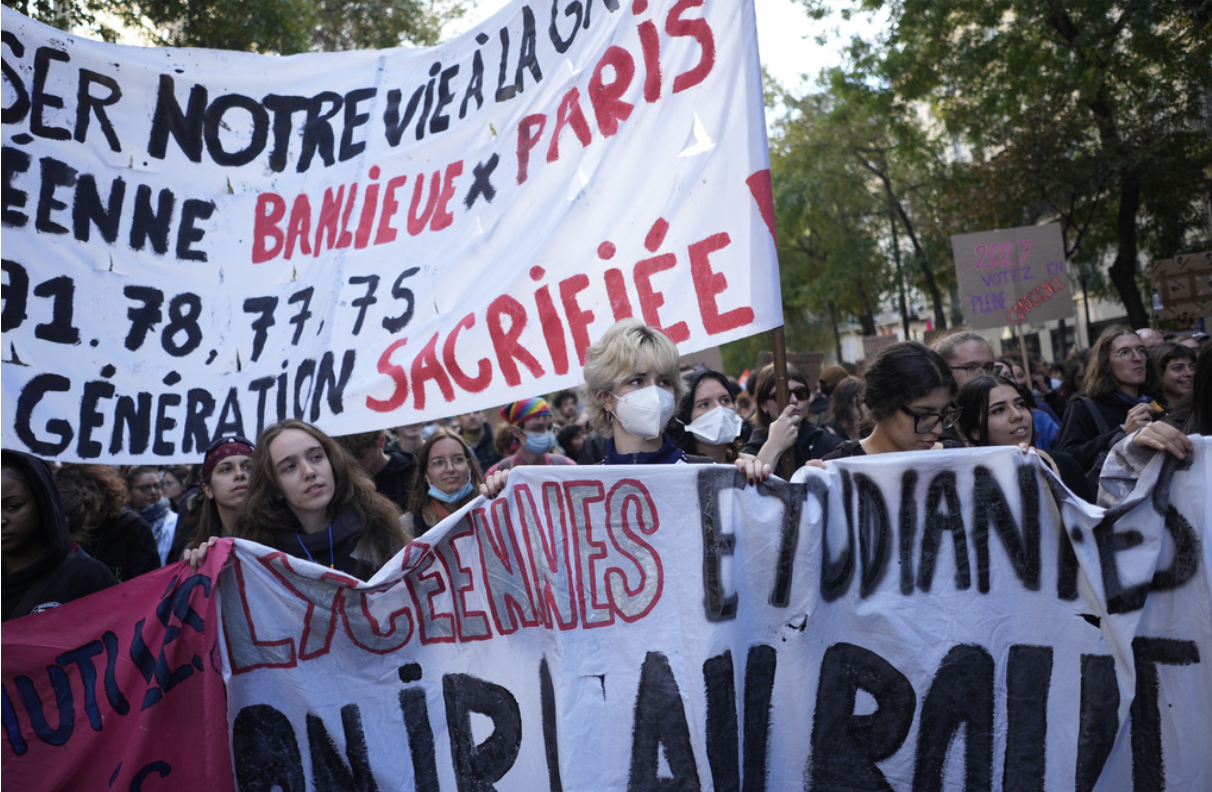
Students march during a demonstration against under-resourced schools, in Paris, Saturday, Oct. 17, 2026. (AP Photo/Thibault Camus)
As youth protests have intensified over the past week in France, so has police involvement and use of excessive force in these movements. Despite civil unrest for such actions, which have been scrutinized as unlawful and violent, the French government lacks observable effort to enforce any restrictions on law enforcement.
On Sept. 21, 2026, a protest by high school students broke out in the Paris suburb of Créteil, France. This protest, the first of many, stemmed from frustration with the French government’s long-standing underinvestment in youth education systems, which has resulted in a shortage of teachers, overcrowded classes, and inadequate school infrastructure. Since September, protests have multiplied, spreading across the country to Bordeaux, Lyon, Marseille, and other major cities. Not only have these efforts expanded geographically and attracted more participation, but more individuals, such as parents and teachers, have joined the movement.
Although most of these protests have been peaceful, with a few violent exceptions, there have been growing concerns about the ways in which members of French law enforcement have intervened. Police response has included the use of explosive stun grenades and tear gas canisters. As a result of this weaponry, many children have faced severe injuries, such as a 15-year-old boy who reported losing his hand, similar to a 14-year-old boy whose jaw was shattered by a stun grenade canister fired in proximity. However, physical injury has not been the only reported instance of unlawful police force.
Since protests began, police have detained more than 6,800 people, 86 percent of whom are individuals under the age of 18. Several of these individuals have alleged that they experienced physical and verbal harassment during their arrests. Nathalie Tehio, a lawyer and president of the French Human Rights League, received “several accounts of racist comments made,” noting that other “[l]awyers have told us that their clients have been humiliated or treated violently or pushed.” Additionally, Prisca Ancion, a lawyer with the left-wing lawyers’ group Collectif d’Action Judiciaire, reported that “[t]here have been racist insults during arrests, as well as homophobic, sexist comments or sexual touching,” encouraging families to file complaints.
While many detained children and their families are actively seeking justice, few have been met with satisfactory legal proceedings for their claims. Out of the approximately 6,000 children detained, roughly 2,000 are facing legal action; 2,000 were handed an alternative option to legal action, such as a citizenship course, without conviction or their cases being heard at trial, for more than 1,000 children. No charges were brought against law enforcement officers at all.
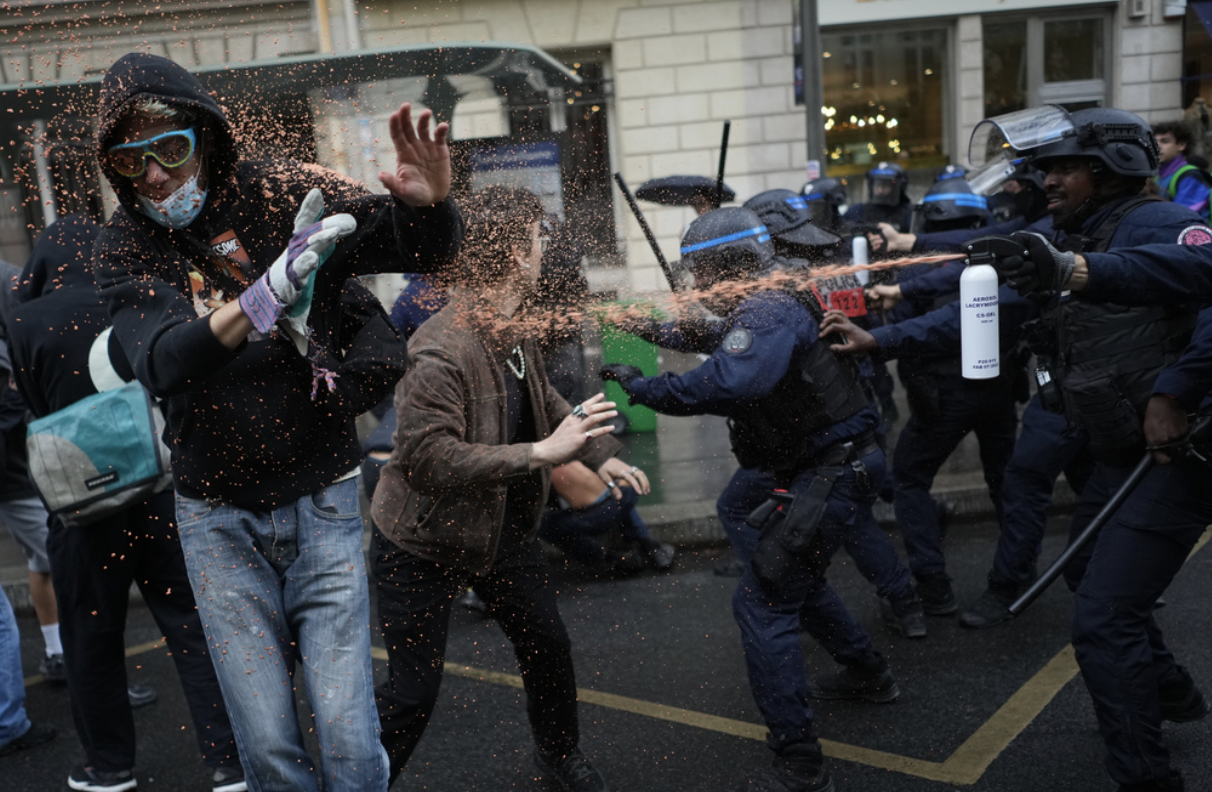
Police officers spray students with pepper spray near Sciences Po University as they protest against under-resourced schools, in Paris, Wednesday, Oct. 7, 2026. (AP Photo/Thibault Camus)
Rather than investing efforts to address the persistent complaints of police brutality in peaceful protest settings, the French government has instead sought to strengthen law enforcement’s right to use force in their detention strategies. A bill that proposes to grant officers the “presumption of legality” in contexts of using force during arrests has been under consideration since the beginning of 2026. Human rights groups have warned of the risk of lowering the threshold for officers to employ potentially harmful methods such as explosive weaponry and firearms, simultaneously shielding them from legal scrutiny if this bill is to come into effect.
The questionable use of police de-escalation tactics is not a new subject of debate in France. Over the past decade, peaceful protests have been met with allegations of unwarranted violence and excessive force by law enforcement on multiple occasions.
The use of questionable police de-escalation tactics is not a new subject of debate in France. Over the past decade, peaceful protests and civil resistance in the country have been met with violence by law enforcement on multiple occasions.
An example from 2018 was the Yellow Vest Movement, a grassroots movement sparked by regressive increases in diesel and petrol fuel taxes introduced by President Emmanuel Macron’s administration. Protests by citizens in this case were similarly met with crowd control weapons such as rubber projectiles and stun grenades, causing permanent injuries such as lost limbs and eyes. Under the same administration in 2023, France’s pension reform, with protests that aimed to increase the retirement age by two years, again faced allegations of excessive force by police officers who made “preventative arrests that could amount to the arbitrary deprivation of liberty.”
Overall, police brutality in France is a trend that civil populations continue to take issue with, especially in the context of peaceful organization. While the issue has undoubtedly been brought into the political limelight and organizations have made efforts to bring justice to civil populations, the country’s official government has made no overt signs of intended intervention or mitigation.