
Who’s Actually Enforcing Human Rights in Venezuela’s 'Blood Gold' Trade?
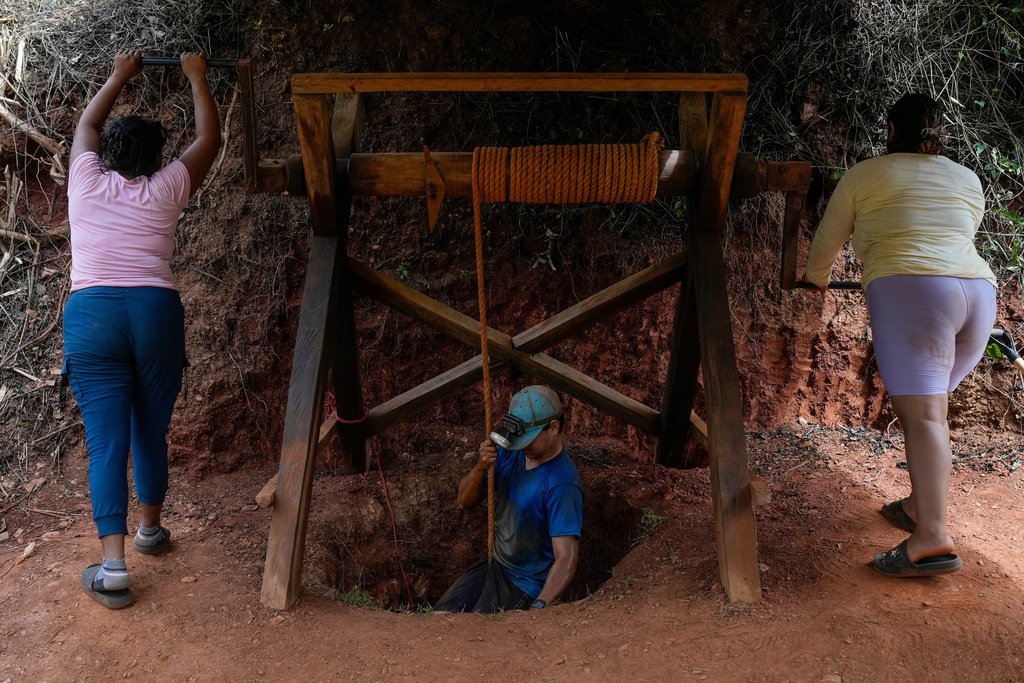
Women lower a miner into a gold mine pit in El Callao, Venezuela, Tuesday, Jan. 22, 2026. (AP Photo/Matias Delacroix)
Six months after President Donald Trump's administration brokered a deal to bring Venezuelan gold into the United States, hundreds of millions of dollars' worth of it has been sitting untouched in warehouses. No refiner will process it: not because of politics, but because what processing will mean for the refiner’s own exposure to the human rights abuses embedded in how that gold was extracted.
The gold arrived after a chain of events that began in January, when US forces removed Venezuelan leader Nicolás Maduro from power and installed his former vice president, Delcy Rodríguez, as interim president. Within weeks, the administration turned its attention from Venezuela’s oil reserves to its gold, one of the largest untapped deposits in the world. In March, the global trading house Trafigura signed a yearlong deal with Venezuela’s state mining company, Minerven, to buy and export gold from the country’s industrial mines.
Getting the gold into the country was shown to be easier than getting anyone to buy it. Under international sourcing rules, refiners must certify that gold mining has not funded armed groups, environmental destruction, or forced labor before they can process it. Venezuela’s gold industry struggles to meet all those expectations. At London Mining Week, one refining executive was asked whether his company would be the first to publicly accept Venezuelan gold. He answered the question with one of his own, asking the room whether any refiner wanted to go first. The hesitation from all the refiners showed that publicly accepting the gold would mean publicly vouching for a supply chain that regulators and auditors can’t yet certify as clean. Months later, no refiner has stepped forward.
The hesitation from the refiners is not new, and it echoes a position Trump himself once held. Years before this deal, his administration blocked Venezuelan gold from the U.S. market, citing its ties to environmental destruction and to what he called “corrupt military officials.”" That assessment was not far off from what United Nations investigators had already concluded. A UN report on Venezuela’s Orinoco Mining Arc (which is where the country’s gold industry is centered around) found that buying gold from the area could be equated with buying “blood gold,” citing documented forced labor and trafficking, and warned that a US license allowing Minerven to export gold “perpetuates ecocide and launders criminal wealth.”"
These conditions have not disappeared. In the mining town of El Callao, New York Times reporters found children working in gold-processing plants in violation of Venezuelan child labor protections, using mercury that has been banned nationwide since a 2016 presidential decree, one which is ignored, and whose runoff continues to poison local water supplies. Nearly every mining operation in the area (including some inside of the perimeter of Minerven’s own facilities) pays a cut of its gold to Tren de Guayana, the gang that locals say functions as the area’s real government. Workers call the practice “el sistema,” or “the system” in English. Even Minerven’s own underground miners, who work as deep as 1,000 feet underground without life or disability insurance after the state broke up their union years ago, are not spared: three died in separate accidents in the past year alone.
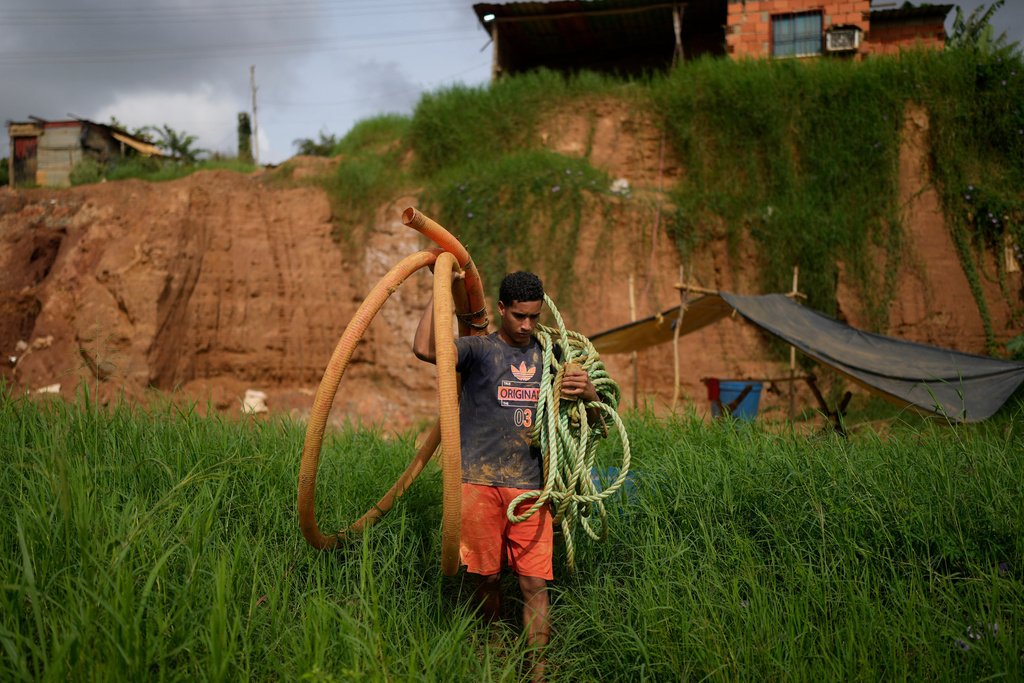
A miner carries a hose to a pit at a gold mine in El Callao, Venezuela, Tuesday, Jan. 22, 2026. (AP Photo/Matias Delacroix)
Julia Yansura, program director at the Washington-based FACT Coalition, offered a blunt estimate of the scale of the program: roughly 90 percent of Venezuela's gold is criminally produced, she told the the Times, making the hunt for clean supply “like searching for a needle in a haystack.”"
What has emerged is an unusual split, where the branch of the government that negotiated the deal wants the gold moving, while the private companies responsible for refining it are refusing to move it until they can prove, under industry and international standards, not US government mandates, that it is clean.
That is a striking reversal for a deal the White House once framed as a rights-driven cleanup of a “stolen” industry, arguing that Western investment would displace gangs and corrupt officials. Six months in, the industry is signaling that it does not believe that argument, and residents of El Callao say they have yet to see any change in their town. The mayor, Coromoto Lugo, said the town’s monthly allotment from federal authorities, less than 1 cent a day per resident, has not changed since the gold started flowing into the United States.
This is what happens when a government can’t, or rather won’t, enforce their own standards. The Venezuelan gold standoff points to a broader problem for US human rights policy. When a resource deal is valuable enough, sanctions and diplomatic pressure get waived or loosened long before the conditions they were meant to address actually improve. Now, the only thing left to hold up human rights standards are private due diligence rules that the government has no hand in writing and no authority to enforce. This arrangement is fragile, because compliance standards are already applied unevenly across the industry, and can collapse the moment one refiner breaks it to get a competitive edge, and carry none of the legal consequences that come with violating a government sanction. If corporate caution is the only real check left on a supply chain the UN has called tainted by forced labor and trafficking, that raises an uncomfortable question. What happens the next time a strategically important country’s resource sector needs cleaning up, and the private sector decides that it simply isn’t worth the risk?