
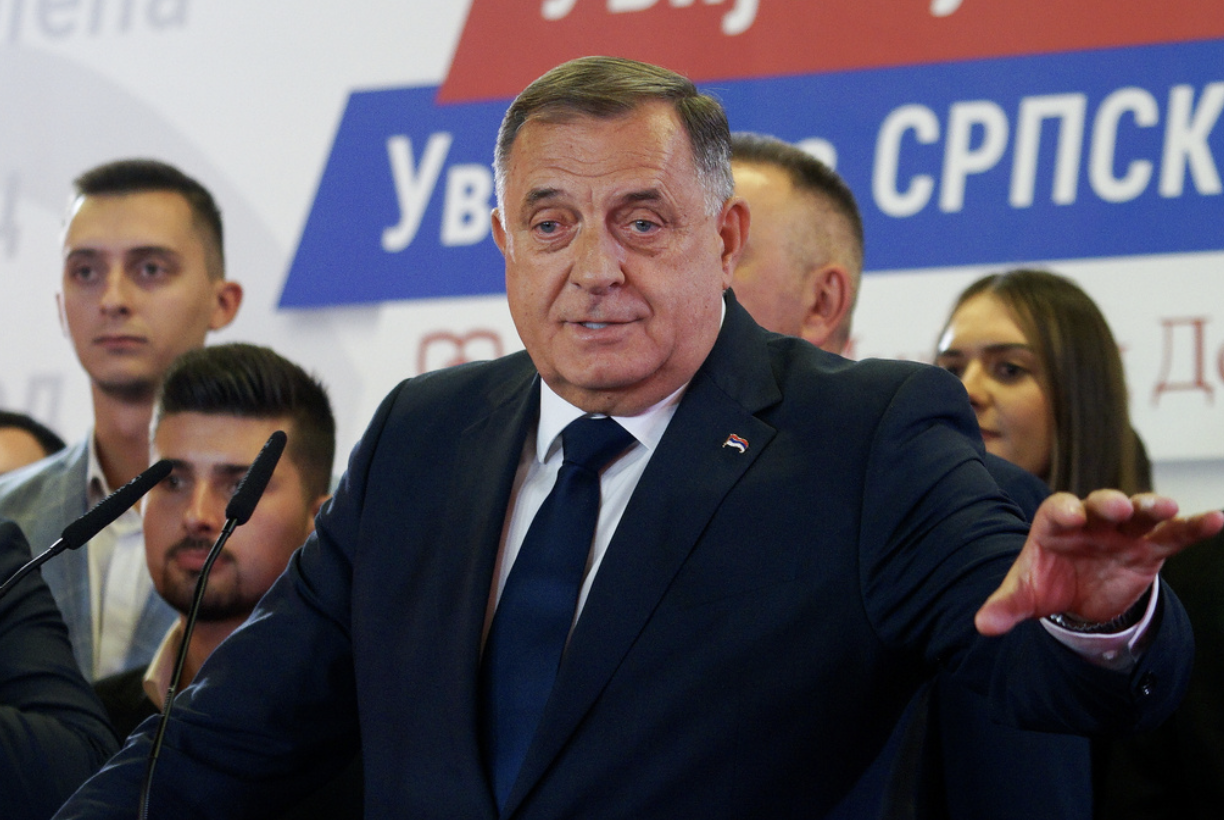
Leader of the Alliance of Independent Social Democrats (SNSD), Milorad Dodik, speaks during a news conference following the publication of general election results, in Banja Luka, Bosnia, Sunday, Oct. 4, 2026. (AP Photo/Radivoje Pavicic)
On Sunday, October 4, Bosnia-Herzegovina held its national elections amid the backdrop of economic pressures, historic ethnic tensions, and increased talks of the country joining the European Union. Progress, however, has been blocked by ethnic and political divisions despite the bloc’s encouragement for Bosnia’s leaders to work together on reform. The election saw a 42 percent turnout from the electorate, which marked an eight percent decline from the 2022 national election, a remarkably low turnout for the country.
In the Federation of Bosnia-Herzegovina, voters elected Darijana Filipovic, candidate of the Croatian Democratic Union of Bosnia-Herzegovina, deposing the incumbent Zeljko Komsic of the Democratic Front, who held the seat for 8 years. Incumbent Bosnian member of the presidency Denis Bećirović of the Social Democratic Party led his opponent by three percentage points as of Sunday night. In Republika Srpska, the Bosnian-Serb nationalist candidate Milorad Dodik declared victory for his party.
Dodik, despite not appearing on the ballot, dominated the campaign and inflamed ethnic divisions in the country with his use of separatist rhetoric, sparking fears of renewed instability and ethnic conflict in Bosnia. Formerly the president of Republika Srpska, a part of the country that holds the majority of the Serb population, Dodik was banned from holding public office last year after being convicted of defying decisions by the international envoy who oversees the 1995 Peace Agreement that ended the violent Bosnian War. He openly defies the national government in Sarajevo, making moves for Republika Srpska to separate from the country. At his final election rally Friday night in Banja Luka, Republika Srpska’s administrative capital, Dodik told supporters that Bosnia “is dead.”
Bosnia’s complex governing institutions were created by a US-brokered peace agreement in 1995 to moderate and keep at bay deep ethnic divisions within the country. The Presidency consists of three presidents, representing the three constituent peoples - Bosniaks, Croats, and Serbs. As most of the Bosnian-Serb population lives in the region of Republika Srpska, the Serb member is elected from there, while the Bosniak and Croat members are elected from the Federation of Bosnia and Herzegovina to reflect that region’s ethnic makeup.
Combined, Republika Srpska and the Federation of Bosnia and Herzegovina make up the state of Bosnia-Herzegovina. According to the constitution, the state of Bosnia-Herzegovina is in charge of its own foreign affairs, trade, customs, and currency, as well as migration issues, international law enforcement, and telecommunications. The two regions have their own sovereign capabilities. Republika Srpska, Dodik’s region, was declared the independent “Republic of the Serb People of Bosnia and Herzegovina” by the Bosnian-Serb assembly on January 9, 1992, an announcement considered one of the causes of the Bosnian war and rooting the region in Serb identity.
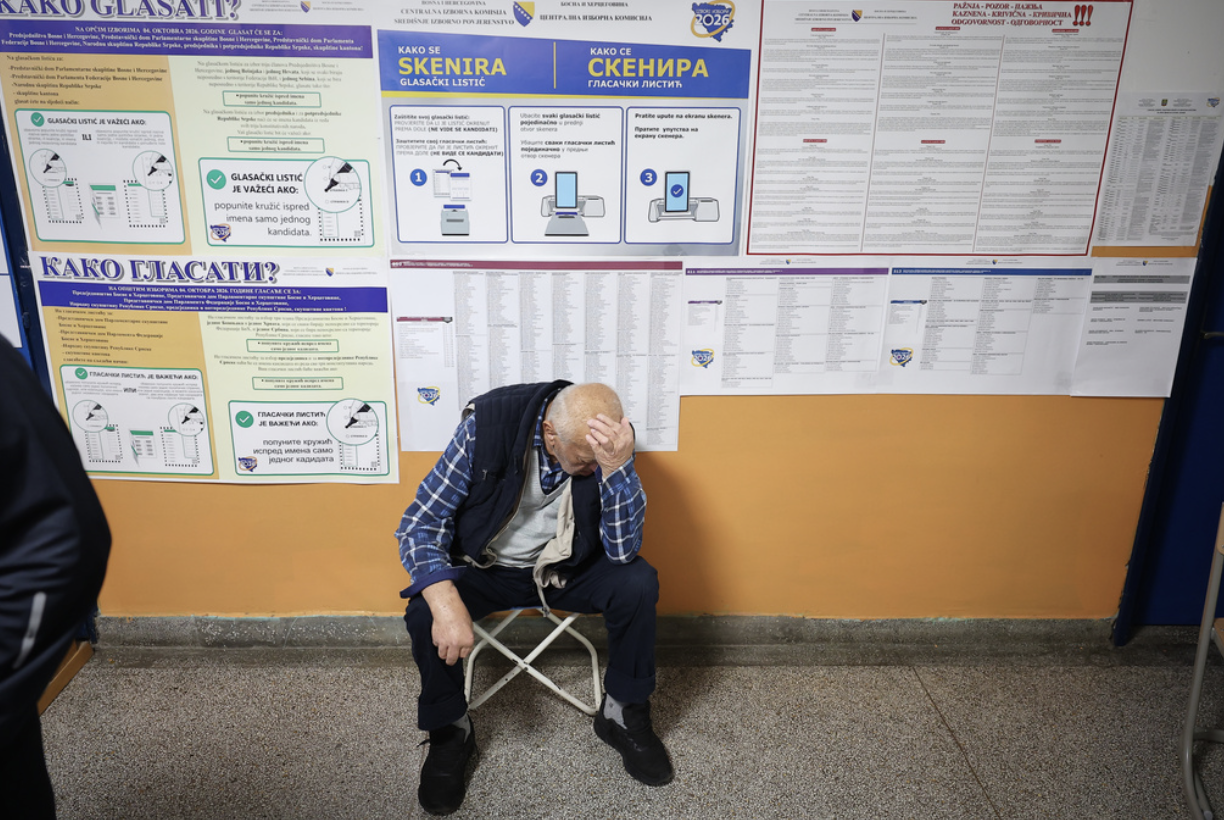
An elderly man waits, backdropped by posters with voting instructions, to cast his ballot during the general election in Sarajevo, Bosnia, Sunday, Oct. 4, 2026. (AP Photo/Armin Durgut)
The Bosnian War began officially after an independence referendum held in February 1992, following the declaration of independence by Croatia and Slovenia from Yugoslavia, where 99.7 percent of voters voted “yes.” Bosnian Serb leadership boycotted the referendum to prevent independence from Yugoslavia, but it was formally declared on March 1, 1992. Between 1992 and 1995, Bosnian-Serb forces targeted Bosniak Muslims and non-Serbs across the country. Over 7,000 Bosniak Muslim prisoners captured in the siege of Srebrenica were summarily executed from July 13 to July 19 of 1995. Over the duration of the Bosnian War and genocide, nearly 100,000 civilians died, 2 million were displaced, and between 20,000 and 50,000 women were systematically raped.
Dodik’s party continues to exacerbate ethnic tensions between Muslim Bosniaks, Orthodox Serbs, and Catholic Croats through its intense national rhetoric. His win, despite being withheld from the ballot, indicates the prevalence of these tensions among the people of Bosnia-Herzegovina as well. According to Sacir Filandra, a professor of political science at the University of Sarajevo, results were in line with the broader pattern of strengthening conservative forces in an uncertain political climate marked by “rising walls” and fear. Across the world, nationalist and conservative parties have gained footing by feeding off of the anxieties and uncertainties of the electorate. At a news conference late Sunday, Dodik declared that his party would hold a “vast majority” in Republika Srpska’s assembly, and asserted that “no one should ask us to change our politics … we will not give up, but continue for our people.” His victory sparks fears of renewed instability and ethnic conflict in Bosnia, as well as of the rise of right-wing nationalism in Europe.