
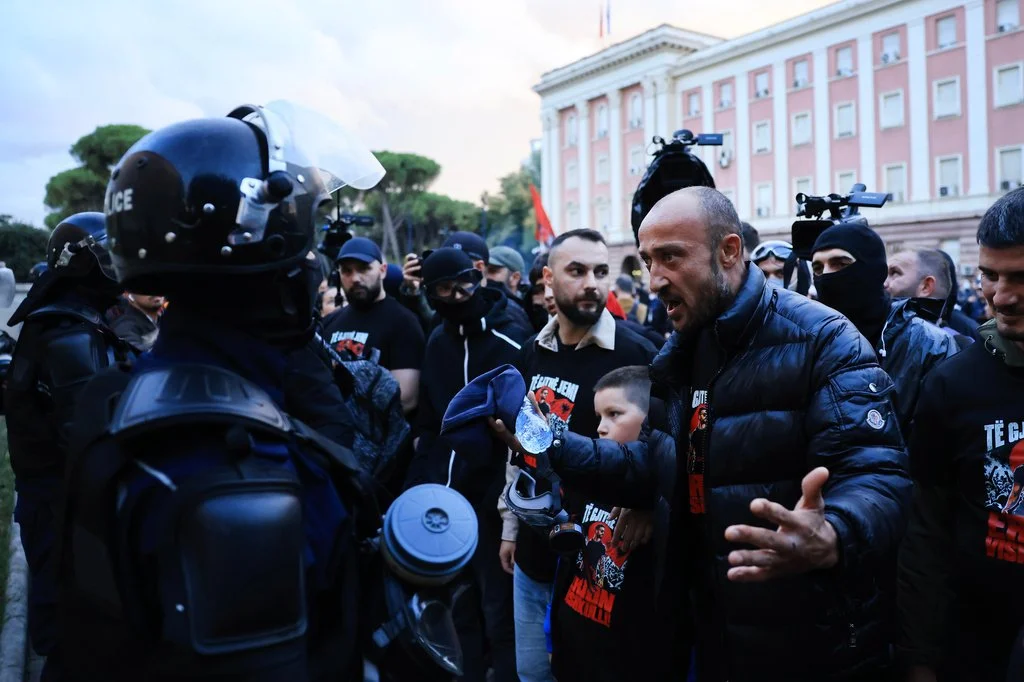
Protesters argue with police officers during an anti-government rally, in Tirana, Albania, Sunday, Oct. 25, 2026. (AP Photo/Hameraldi Agolli)
Student demonstrations over tuition costs and limited job prospects have grown into a nationwide challenge to Prime Minister Edi Rama, who has led Albania since 2013. The protests have persisted since October 13, with students rejecting the government’s offers of dialogue and demanding Rama’s resignation. Police said 388 people had been charged with criminal offenses by October 18.
The protestors are motivated by multiple grievances. Students have complained for months about the cost of education and employment prospects after graduation, according to Al Jazeera. Meanwhile, Reuters linked the unrest to the broader factors of governmental corruption and a stagnant job market. The student protests also follow a movement that began in May over luxury development projects in protected coastal areas, including a planned resort linked to Jared Kushner, however,Rama’s government denies corruption allegations.
Nevertheless, the driving force behind the protests remains disputed. Rama has blamed unspecified foreign interests for the unrest and for what he called an attempted drone attack on his office. He has also accused the opposition of trying to derail EU accession, and the police chief claimed out of those arrested, “only very few were students.” Experts told Al Jazeera that opposition groups are trying to capitalize on the moment, while young people are the ones demanding systemic change. Protesters have also expressed dissatisfaction with Albania’s traditional opposition parties, public broadcaster RTSH reported.
The movement has since expanded. University lecturers joined on Oct. 20, and a union leader announced a class boycott at all universities starting the next day. On Oct. 23, health care workers called for Rama’s resignation and a transitional technocratic government. That same day, ruling-party and opposition lawmakers scuffled in parliament after leadership rejected an opposition demand to debate the protests.
Rama says he is willing to talk with students but cannot resign, arguing that voters gave him a mandate to complete EU membership negotiations. Students have rejected the government’s proposed format for dialogue, viewing his resignation as the only solution. On Oct. 25, protesters burned chairs he had placed outside his office as an invitation to talks. The next day, he replaced them with a stone table, sharing images on Facebook that showed written invitations to dialogue laid out on its surface
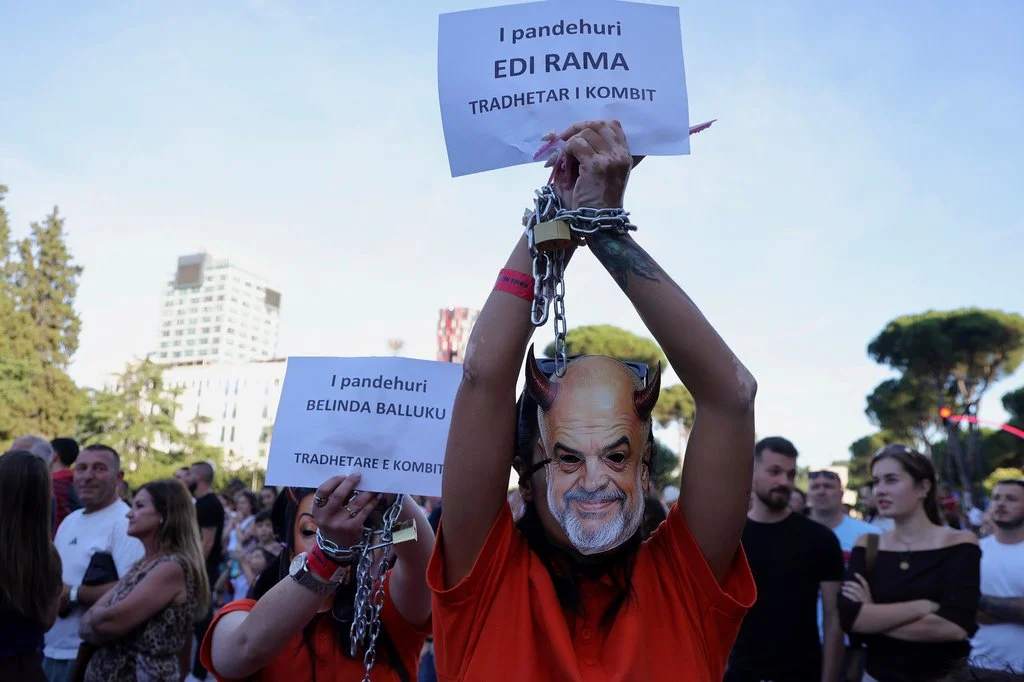
Protesters take part in a rally in Tirana, Saturday, June 13, 2026, against the construction of a massive coastal development project linked to Jared Kushner and Ivanka Trump at Narta lagoon area, western Albania. The banner reads: "Defendant Edi Rama is nation's traitor.” (AP Photo/Hameraldi Agolli)
Large-scale student unrest isn’t new to Albania. Protests in December 2018 over rising education costs forced Rama to dismiss eight ministers and announce a package known as the “Pact for the University,” though some demands went unmet.
The current unrest coincides with student and youth protests elsewhere in Europe. In France, secondary school students have blockaded schools for weeks to demand more teachers and better facilities. In Serbia, a student-led movement that began after a 2024 railway station collapse killed 16 people recently entered electoral politics, running a “Student List” in an Oct. 25snap parliamentary election that defeated longtime Serbian leader Alexander Vučić. Albania’s protesters, by contrast, have so far centered their demands on Rama’s resignation, rather than on contesting elections.
The stakes also include Albania’s bid for EU membership. Albania had opened all 33 negotiating chapters by November 2025, and in July it closed its first three, including one on education and culture. A fourth, on enterprise and industrial policy, was closed on Oct. 14, the second day of the protests. The government aims to conclude talks next year and join the bloc by 2030, though the agreement on any chapter is not considered final until all are complete.
Rama has argued that the protests threaten Albania’s EU progress rather than his government. Meanwhile, Brussels urged that grievances in a candidate country be handled peacefully and through dialogue. European Enlargement Commissioner Marta Kos said in July that environmental protection is part of the membership criteria, in reference to Kushner’s Zvërnec resort project, which sparked protests over the summer.
With students and the government still divided over the question of Rama’s resignation, the protests show no immediate sign of settlement. How Tirana handles them may shape how Brussels reads its progress on the democratic and rule-of-law benchmarks that accession depends on.