
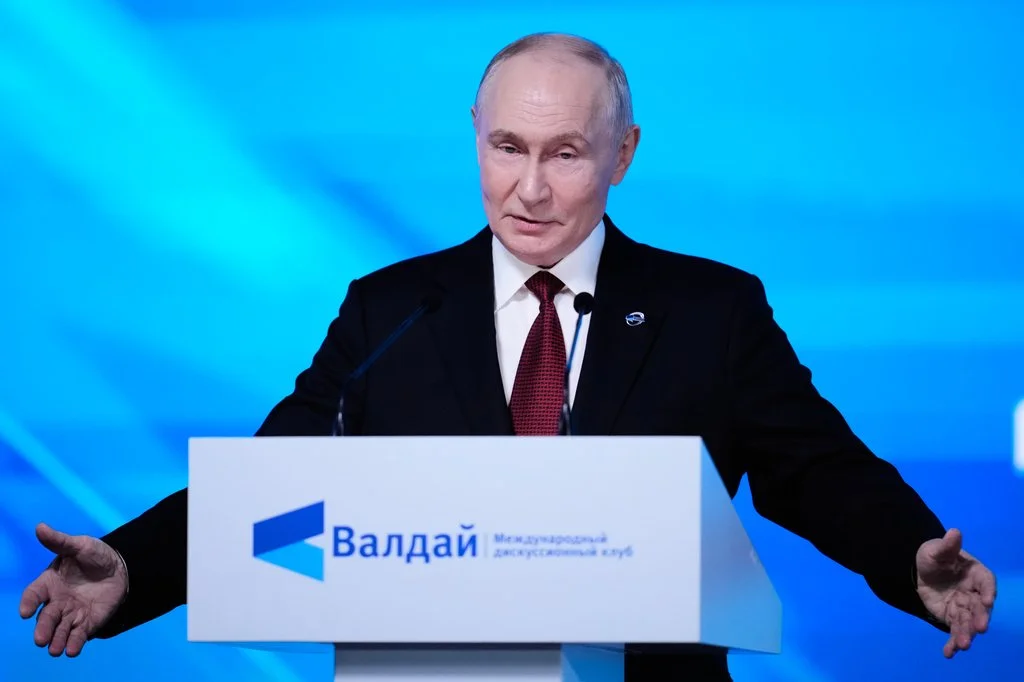
Russian President Vladimir Putin gestures speaking at the session of the Valdai Discussion Club in Moscow, Thursday, Oct. 1, 2026. (AP Photo/Pavel Bednyakov)
President Donald Trump may be a more measured foreign policy strategist than his critics realize. Or perhaps his advisers have spotted something the rest of us haven't. Either way, his latest agreement with Russian President Vladimir Putin raises some uncomfortable questions.
Washington has eased restrictions on Russian diesel exports, opening the door for Moscow to earn more money and claim a diplomatic win while its invasion of Ukraine continues. At the same time, Trump has criticized Ukrainian President Volodymyr Zelenskyy and pressed Kyiv to stop attacking Russian refineries, holding out the promise of cheaper fuel for American voters ahead of the midterm elections.
After years of trying to squeeze Russia economically, Washington now appears to be giving the aggressor a break while putting pressure on the country defending itself. Putin has good reason to welcome the deal. But he may be getting ahead of himself.
I have always supported Ukraine, its democratic aspirations, and its intrinsic right to defend its peaceful people against uncalled Russian aggression. What follows, therefore, is a somewhat unconventional thought experiment, but not an allegation that Washington and Kyiv are secretly working together. There is no public evidence of such an arrangement.
The argument is simpler: Trump's agreement may have given Ukraine yet another, stronger reason to keep targeting Russian refineries. Kyiv had plenty of military and economic reasons to do so before the deal, but now they have more.
As a result, those same attacks could also eat into the benefits Putin hopes to gain from an agreement with Ukraine's most powerful ally.
A big announcement, but how much does it deliver?
On Oct. 9, Trump announced on Truth Social that Russia would immediately supply more than 300,000 tons of diesel to American and international markets. Another 500,000 tons would follow in November, with 1 million tons more expected shortly afterward. Washington subsequently eased restrictions on Russian diesel exports, which had been intended to limit Moscow's ability to profit from international energy markets and finance its war of aggression against Ukraine.
The political appeal is easy to understand. Diesel keeps trucks moving, powers agricultural machinery, and supports much of the global economy. When diesel prices rise, transportation and production become more expensive, and those costs eventually show up in the prices consumers pay.
According to the Council on Foreign Relations, U.S. diesel averaged $6.18 per gallon on Oct. 12, up from $3.48 at the start of 2026. With congressional elections approaching on Nov. 3, Trump had an obvious incentive to show voters he could bring fuel prices down. Putin, meanwhile, appeared ready to help.
But the headline numbers tell a less impressive story.
Russia's initial commitment of 300,000 tons amounts to roughly 2.25 million barrels of diesel, less than a day's worth of U.S. consumption, according to the Council on Foreign Relations.
The Carnegie Endowment for International Peace puts global diesel consumption at around 120 million tons a month. By that measure, Russia's initial shipment represents just 0.25 percent of monthly global demand.
Additional supplies could help ease prices at the margins. But Russia has continued exporting to countries outside the Western sanctions coalition even under existing restrictions. Relaxing those restrictions could, therefore, make Russian exports more profitable without adding much new fuel to the global market.
For Ukraine, the political cost is harder to ignore. Moscow gets new commercial opportunities and a measure of diplomatic recognition without making concessions toward ending its invasion. The question is whether the economic benefits will be anywhere near as significant as Putin hopes.
Putin has the oil. Ukraine is attacking the refineries.
Russia has vast reserves of crude oil. But crude alone cannot meet demand for diesel. It has to be processed, and that requires functioning refineries. For months, Ukraine has been targeting those facilities to disrupt Russian military logistics and cut into the country's energy revenues.
The campaign appears to have taken a significant toll.
According to Carnegie, Russia's monthly surplus of diesel available for export fell from roughly 3 million tons in April to 325,000 tons in September. Ukrainian attacks played a role, alongside domestic demand and seasonal factors.
That's a drop of nearly 90 percent. The International Energy Agency has also pointed to limited operational refining capacity as a constraint on Russia's ability to expand diesel exports substantially.
There is an important detail in Trump's original announcement, too. Beyond the initial shipments, he promised another 3 million tons, provided Russian refineries remained capable of producing the fuel.
That condition exposes a weakness at the heart of the deal. Washington can ease export restrictions, and Moscow can promise millions of tons of diesel. Neither, however, can guarantee that Russian refineries will remain safe from Ukrainian drone strikes.
Carnegie suggests Russia probably has enough existing export capacity to meet its initial commitments. But fulfilling those commitments is one thing; significantly increasing production is another, especially while attacks on refineries continue.
This is where the deal could create an unexpected strategic turn for Putin.
Ukraine was already attacking Russian refineries for military and economic reasons. Trump's decision hasn't changed that basic calculation. What it has changed is the potential payoff.
Every refinery Ukraine damages could make it harder for Russia to capitalize on the sanctions relief it has just secured. The attacks are still aimed at weakening Moscow's war economy, but they could now also undermine the commercial value of an agreement that Kyiv has little reason to welcome.
In other words, instead of Trump giving Ukraine a new source of leverage, he may have made the leverage it already has more consequential.
Trump's criticism of Ukraine leaves a bigger question.
If Ukrainian attacks can limit the benefits Russia gets from the deal, an obvious question follows: Why is Trump publicly opposing them?
On Oct. 16, Trump criticized Ukrainian strikes, arguing that they were driving up global diesel prices. He returned to the issue in a Truth Social post on Oct. 18, taking aim at Zelenskyy while defending his reluctance to impose further sanctions on Moscow.
The simplest explanation is that Trump wants lower fuel prices and sees Ukrainian attacks as an obstacle. But there is another possibility worth considering: Washington may understand that Ukraine is likely to continue targeting Russian energy infrastructure, regardless of American objections.
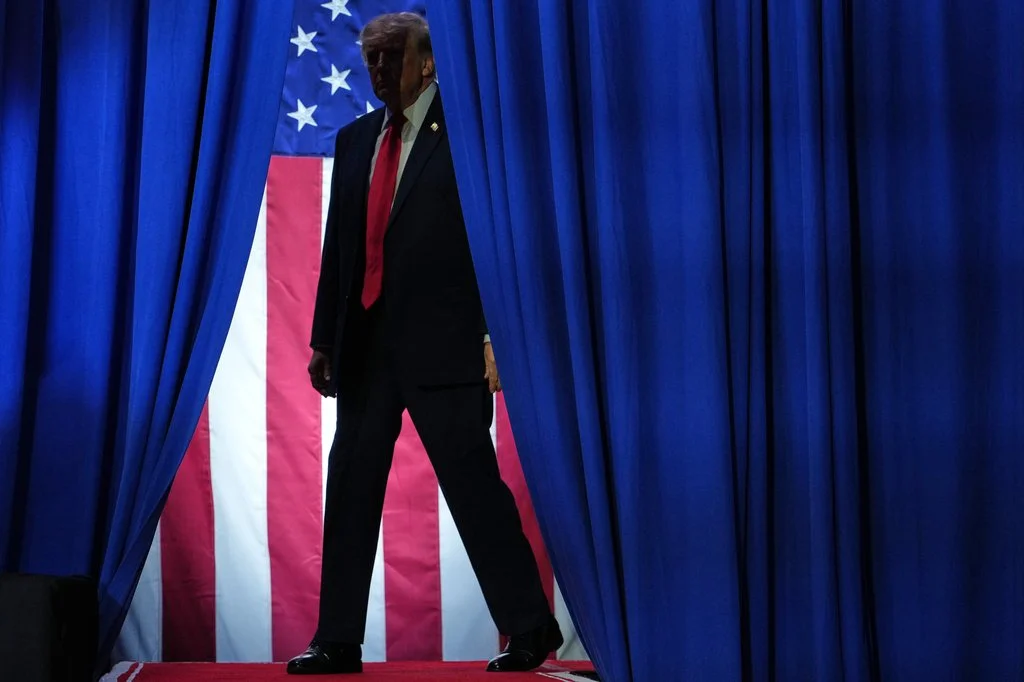
President Donald Trump arrives at a campaign rally at Sioux Gateway Airport, Thursday, Oct. 22, 2026, in Sioux City, Iowa. (AP Photo/Alex Brandon)
Under that scenario, Trump's public criticism could help preserve goodwill with Moscow while allowing Washington to distance itself from Ukrainian operations. Putin would see an American president who appears willing to accommodate him, even as Ukraine continues to damage the infrastructure Russia needs to expand its diesel exports.
There is no evidence that Washington and Kyiv are coordinating in this way. Genuine disagreement between the two governments remains the more straightforward explanation. Still, Ukraine's ability to pursue its own military objectives complicates Moscow's assumptions. An agreement between Trump and Putin does not guarantee that Ukraine will hold back.
Trump's calculations may also reach beyond the war itself.
The conflict involving Iran has disrupted energy production and shipping across the Middle East, particularly around the Strait of Hormuz, a vital route for international oil trade. Those disruptions have tightened energy markets and added to the pressure on Washington to bring prices down. Trump explicitly linked Russian diesel exports to developments around the strait when announcing the deal.
He later defended delaying additional sanctions on Moscow, partly arguing that Russia was providing little assistance to Iran. That suggests Washington may see limited concessions to Putin as a worthwhile price to pay if they help keep negotiations over Ukraine alive and discourage deeper Russian involvement alongside Tehran.
But that calculation carries risks for Kyiv. Russia's established ties with Iran make it far from certain that sanctions relief will change Moscow's behavior. And if Washington is offering concessions to advance its interests elsewhere, it could end up weakening pressure on Russia without securing anything meaningful for Ukraine in return.
The limits of the “thought experiment.”
There are also good reasons to doubt that Trump's policy reflects some carefully calculated strategy that ultimately benefits Ukraine.
In October, Ukrainian officials reported disruptions to Starshield, the military satellite communications service developed by Elon Musk's SpaceX. The interruptions affected Ukrainian battlefield communications and drone operations before service was restored on Oct. 24.
Trump denied responsibility, but the episode highlighted a basic vulnerability: Ukraine still depends heavily on American-controlled technology. Zelenskyy has also criticized restrictions affecting military assistance and intelligence sharing. He offered to suspend refinery attacks for 30 days if Washington provided additional Patriot air defense interceptors.
These are not trivial disagreements that can be brushed aside as diplomatic theater. A policy that weakens Ukraine's defenses while expanding Russia's commercial opportunities is not necessarily helping Kyiv, whatever unintended consequences it might produce for Moscow.
Putin also stands to gain more than export revenue. Sanctions relief gives him a chance to weaken Western unity and cast doubt on the West's willingness to sustain economic pressure. European governments have spent years reducing their dependence on Russian energy. Washington's willingness to ease restrictions now raises fresh questions about how durable that effort will be.
It's entirely possible, then, that Putin has secured the better bargain.
Even so, one contradiction remains. Washington has opened new commercial opportunities for Russia without removing the vulnerability Ukraine has exposed in its refining infrastructure.
Putin can negotiate sanctions relief and promise millions of tons of diesel. What he cannot do is guarantee that Ukrainian attacks will stop. As long as those strikes continue, Russia may struggle to turn its diplomatic win into the economic gains it expects.
Trump's agreement may, therefore, give Kyiv another incentive to keep up the pressure, if not level it up, even as Washington criticizes the very campaign that makes Moscow's gains less certain.
Did Trump's advisers anticipate this possibility, or did they underestimate the consequences of easing restrictions? There is no way to know from the available evidence. What is clear is that concessions to Moscow deserve closer scrutiny when they come without meaningful gains for Ukraine.
The deal may look like a victory for Putin. But signing an agreement and reaping its full benefits are two very different things.