
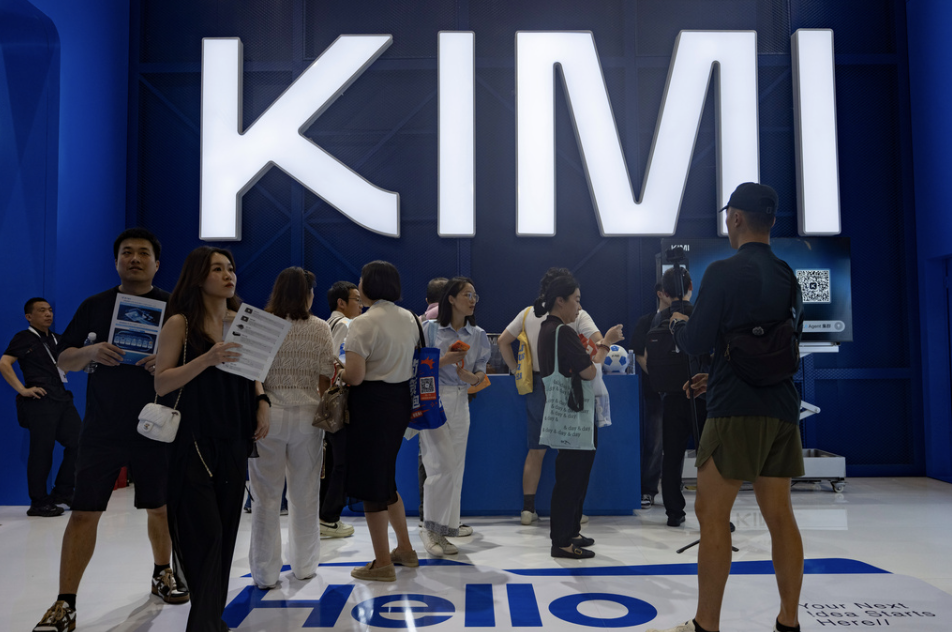
Attendees visit the booth for Chinese AI startup Moonshot's Kimi K3 during the World AI Conference in Shanghai, July 17, 2026. (AP Photo/Ng Han Guan)
The US currently aims to stay ahead of China and lead the global AI ecosystem. President Donald Trump has stated in response to calls for a slowdown that “what they wanna do is stop our progress, because we’re leading China by a lot. And we’re going to keep it that way.” This reflects the broader stance of the US on AI, which emphasizes consistent innovation of closed, frontier AI models. America’s effort seems to be paying off - it has been leading the technological gap between the two countries in recent years, though that gap is rapidly narrowing. In fact, some industry experts accuse Chinese developers of distilling American models to replicate capabilities at lower training costs. Beyond innovation, a core component in the AI race is access to high-end hardware. The US possesses cutting-edge AI chips from companies like Nvidia and AMD, while also banning their exports to China. Despite China’s chipmakers racing to catch up, it continues to lag behind the US in supplying cutting-edge models.
The trend in China, however, demonstrates an emphasis on integrating AI into various facets of the economy. China’s Five-Year Plan states its aim to actively use AI to promote growth. For one, Chinese models are open-weight models that allow widespread downloading and modification. The proliferation of open models prioritizes the deployment of AI and data collection, gathering specialized industrial data from various industries to improve AI in a reiterative cycle. The Chinese government’s supply-and-demand subsidies also help lower AI model costs, encouraging widespread deployment of open models. This benefits manufacturing across industries. Huawei and Xiaomi, two multinational technology companies from China, are adopting AI to increase their smartphone and EV supply chain efficiencies. Their steel and pharmaceutical sectors are likewise exploring ways to accelerate innovation with AI. Greater efficiency and lower production costs could further potentially translate into benefits for consumers.
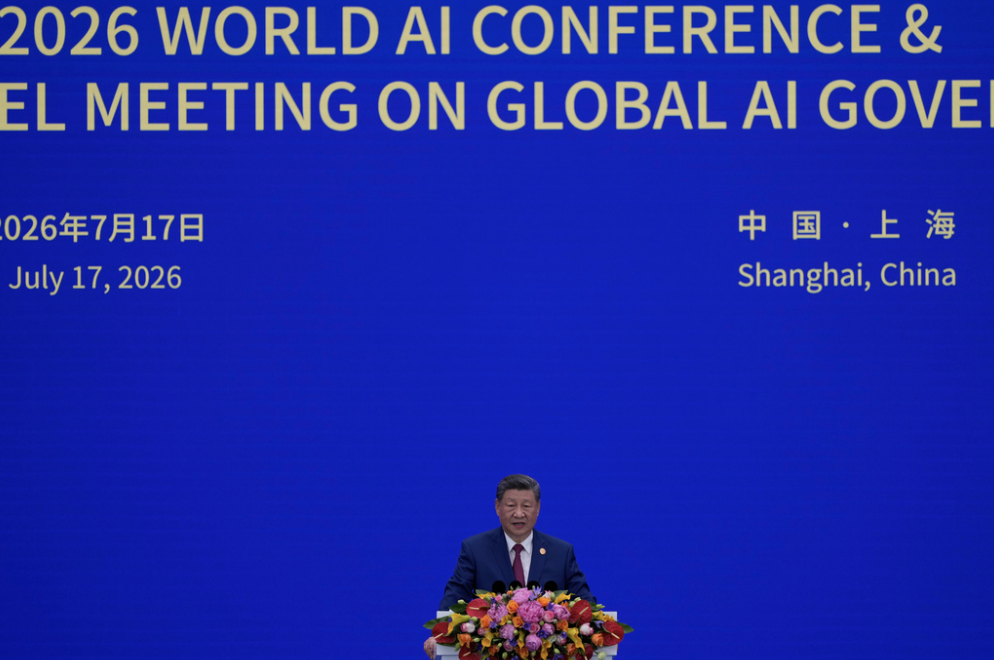
Chinese President Xi Jinping speaks during a meeting on global AI governance held on the sidelines of the World AI Conference in Shanghai, China on July 17, 2026. (AP Photo/Ng Han Guan)
While China continues to face challenges competing with the US in frontier AI development, it is using its renewable energy surplus to complement AI infrastructure and boost businesses in its green tech sector. The US’ current spending on coal and gas power is forecasted to outstrip China’s for the first time in decades, while the current administration has eliminated more environmental reviews in order to speed up construction. In contrast, China has an advantage in building power plants quickly and at scale, allowing for faster generation of energy capacity to the point where it currently has much more renewable power than it can use. It is therefore planning to power AI data infrastructure with its green energy supply. Recently, Chinese green energy company Envision Group began operating a renewably powered data center that it claims could become the world’s largest standalone AI data center. China’s AI industry growth is therefore helping it leverage its other prominent sector, renewable energy, which has recently been challenged by overcapacity, with companies seeing declining profit margins and making workforce cuts.
In the long run, it is important not to focus solely on technological innovation through continuous model scaling and capacity expansion, but also to plan the strategic adoption of AI to shape long-term economic growth. To do so, countries can focus on seeing how AI can be integrated into their existing economic and industrial advantages, which would further create a complementary relationship between AI improvement and strengthening other parts of the economy.