
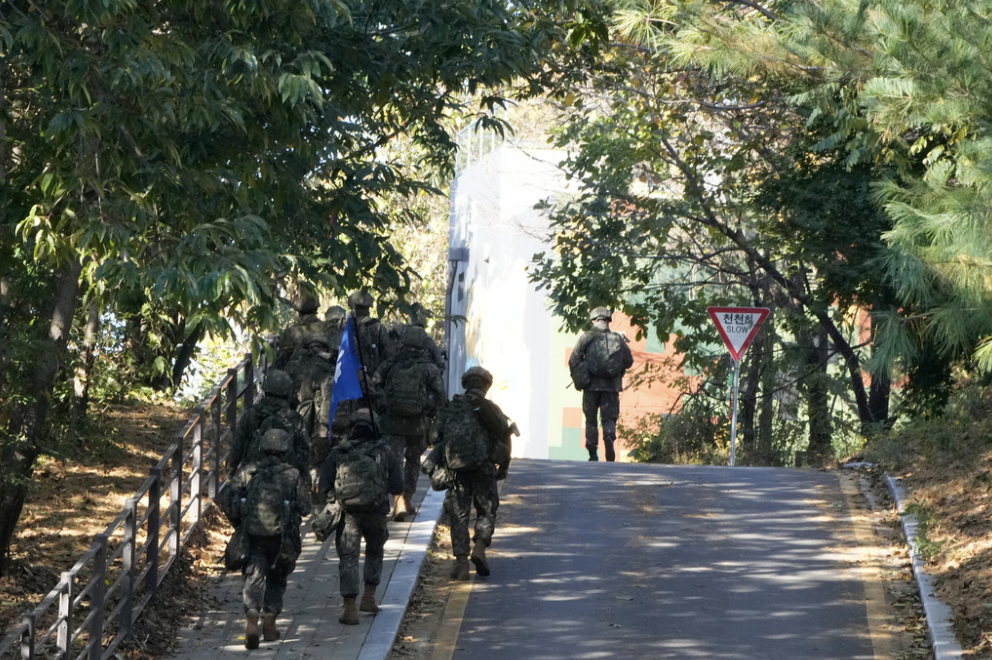
South Korean army soldiers walk near the border with North Korea, in Paju, South Korea, Thursday, Oct. 22, 2026. (AP Photo /Ahn Young-joon)
On Sep. 21, 2026, three South Korean soldiers were injured at the western section of the Demilitarized Zone (DMZ). The incident raised tensions along the inter-Korean border over military activities and the location of the Military Demarcation Line (MDL). On Oct. 23, South Korea officially proposed military talks with North Korea to clarify the MDL’s precise location and restore military communication. The proposal faces broader challenges in managing border incidents between the two countries.
The DMZ and the MDL were established under the 1953 Korean Armistice Agreement, separating North and South Korea. The incident happened inside the heavily armed Demilitarized Zone separating the Koreas. South Korean military officials said they suspected that North Korea was responsible for the mine explosion. South Korea said it would take appropriate measures and hold North Korea responsible, while Kim Yo-jong, the sister of North Korean leader Kim Jong-un, denied North Korea’s responsibility and rejected South Korea’s demand for an apology. In recent years, North Korea has strengthened its border security, including barbed wire fences and anti-tank barriers. Kim Yo Jong also threatened a military response if the South Koreans fire on North Korean troops working near the border.
Although the 1953 Korean Armistice Agreement established the Military Demarcation Line (MDL), identifying its precise location has become more difficult as physical markers have disappeared over time. The agreement, signed by representatives from the UN Command, North Korea, and China, established the details of the Demilitarized Zone (DMZ) and separated the two sides. Physical markers were placed along the line to help identify its location, but many disappeared over time. The line runs through the DMZ, and disagreements over its location has contributed to different opinions about border incidents. South Korea has reported repeated incidents in which North Korean troops crossed the MDL, prompting South Korean forces to fire warning shots. North Korea disputes South Korea’s accusations of rising border tensions.
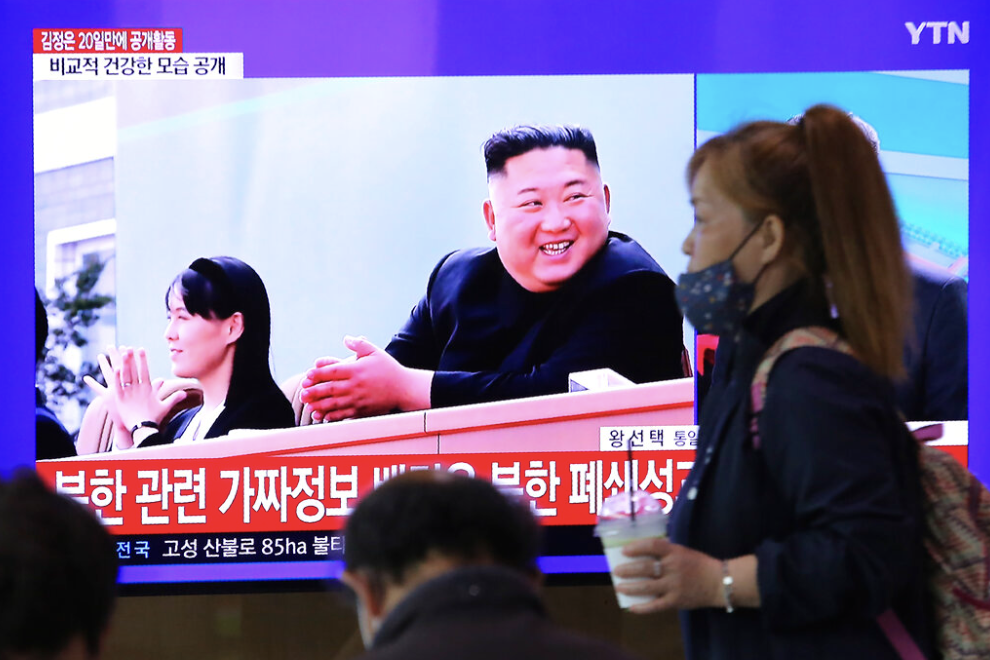
A woman passes by a TV screen showing an image of North Korean leader Kim Jong Un and his sister Kim Yo Jong during a news program at the Seoul Railway Station in Seoul, South Korea, Saturday, May 2, 2020. Kim made his first public appearance in 20 days as he celebrated the completion of a fertilizer factory near Pyongyang, state media said Saturday, ending an absence that had triggered global rumors that he was seriously ill. (AP Photo /Ahn Young-joon)
On Oct. 23, 2026, South Korea officially proposed holding military talks with North Korean authorities to jointly confirm the location of the ground-based MDL and restore military communication channels, with a meeting including the UN Command also possible. Direct communication could help clarify military movements and prevent the possibility of accidental clashes. The proposal’s prospects remain uncertain. According to South Korean officials, South Korea made a similar offer in November 2025, but North Korea didn’t respond.
Any escalation on the Korean Peninsula could have wider risks for regional security, including that of the United States and its regional allies. The UN Command, which upholds the Korean Armistice Agreement, could play a role in communications and in addressing border incidents.
However, talks focused on the MDL would not resolve the broader political disagreements between the two Koreas. Their potential contribution would be more limited to clarifying military movements and reducing the risk of miscalculation.
The outcome of South Korea’s proposal remains uncertain, especially given North Korea’s lack of response to the previous offer. Clarifying the location of the MDL and restoring military communication could manage border incidents, but progress would depend on North Korea agreeing to participate.