
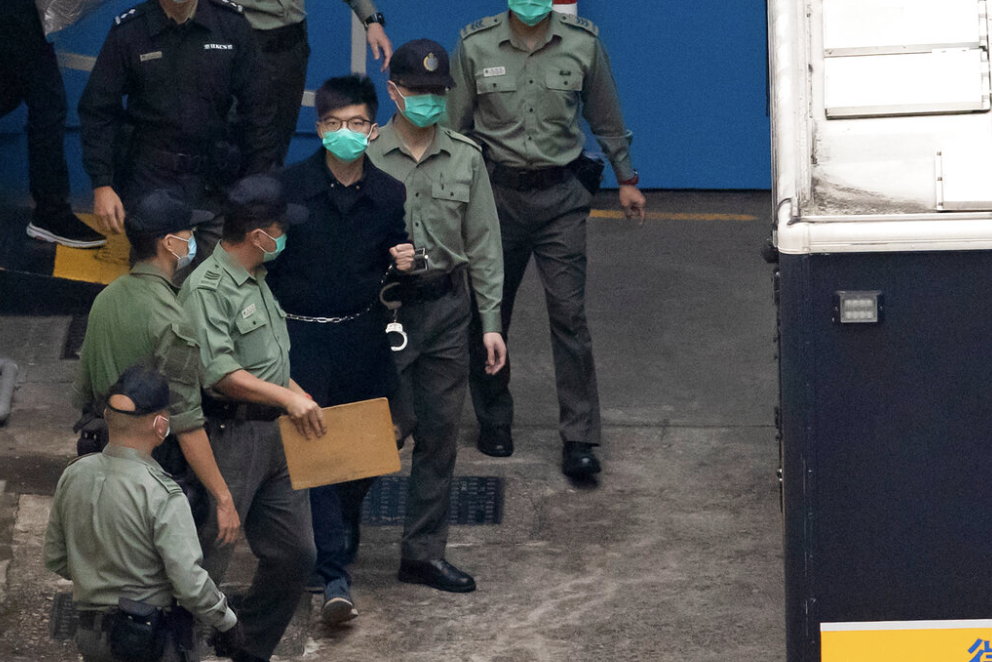
Hong Kong activist Joshua Wong, center, one of the 47 pro-democracy activists is escorted by Correctional Services officers to a prison van in Hong Kong, Thursday, March 4, 2021. A marathon court hearing for 47 pro-democracy activists in Hong Kong charged with conspiracy to commit subversion enters its fourth day on Thursday, as the court deliberates over whether the defendants will be granted bail. (AP Photo/Kin Cheung)
Hong Kong has a responsibility to protect national security, but enforcement of the National Security Law has increasingly blurred the distinction between genuine threats to national security and peaceful political expression. The imprisonment of pro-democracy activists, restrictions on political organizations, and prosecution of individuals involved in political movements demonstrate the consequences of this expanding enforcement. National security should not become a justification for suppressing political opposition, and the government must establish clear boundaries to protect fundamental freedoms.
Why did Hong Kong introduce National Security Laws?
The controversy surrounding Hong Kong’s National Security Law can be traced back to the 2019 anti-extradition protest, a bill that allows certain criminal suspects in Hong Kong to be transferred to mainland China for trial. Many Hong Kong citizens opposed the proposal, fearing it would weaken the city’s judicial independence. This bill eventually developed into a pro-democracy movement with over two million people protesting on the street. Hong Kong was returned to the Chinese government by the United Kingdom in 1997 under the principle of ‘One Country, Two Systems’. The Basic Law serves as Hong Kong’s constitutional framework and guarantees certain freedoms and a high degree of autonomy. Article 27 specifically protects freedom of speech, press, publication, association, and assembly.
In June 2020, the Chinese government enforced the National Security Law in Hong Kong. The legislation criminalizes four types of activities: secession, subversion, terrorist activities, and collusion with foreign forces. The Beijing government argued that the law was necessary to restore stability after the 2019 protests and protect national security. The introduction of the law also created a debate over the relationship between national security and civil liberties. Although governments have a responsibility to prevent threats against their sovereignty and stability, the interpretation and enforcement of national security offenses determine how much room remains for political opposition and public criticism.
Joshua Wong’s 10-year sentence:
Hong Kong Pro-democracy activist Joshua Wong was sentenced to 10 years in prison after pleading guilty to colluding with external forces under the National Security Law. The sentence followed allegations that Wong and other activists sought international support for sanctions against Hong Kong and Chinese officials. His latest conviction adds to an existing four-year and eight-month sentence imposed in the Hong Kong 47 case. Joshua Wong became a famous figure in the Hong Kong democracy movement as a teenager. He gained public attention when he led student protests against the government-imposed national education curriculum. He became internationally recognized through his involvement in the 2014 Umbrella Movement for electoral reform and the 2019 anti-extradition protests.
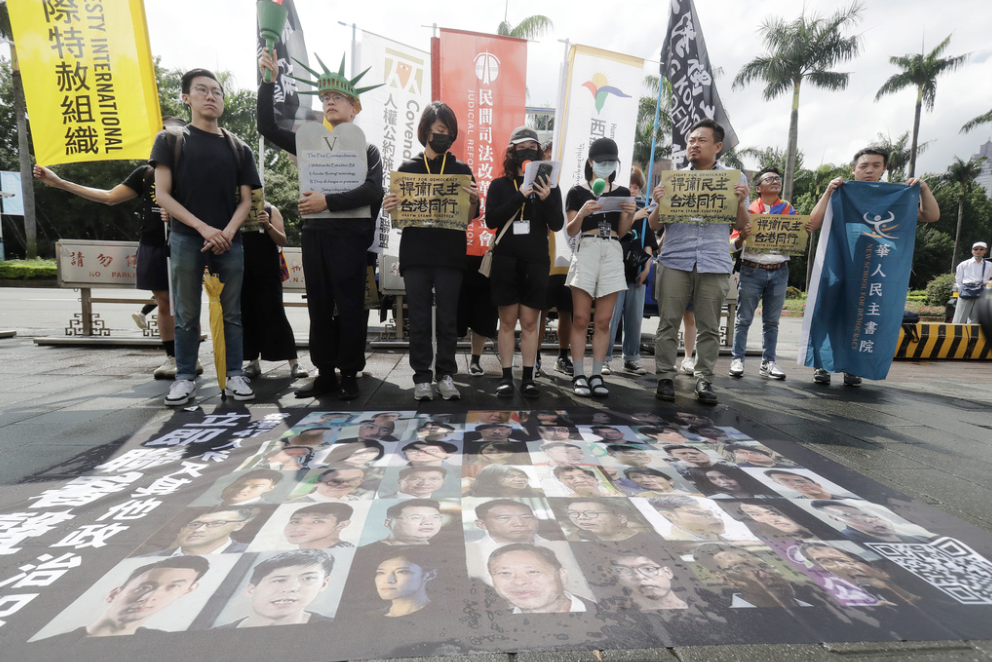
Hong Kong activists and supporters in Taiwan hold a protest commemorating the 10th anniversary of the 2014 umbrella movement and the fifth anniversary of the anti-extradition law amendment bill movement in Taipei, Taiwan, Sunday, June 9, 2024. A black huge banner on the ground reads " Unite now in solidarity with the Hong Kong 47 and other political prisoners. (AP Photo/Chiang Ying-ying)
Imprisonment - The consequences for pro-democracy activists (Hong Kong 47 and Jimmy Lai):
The Hong Kong 47 case sets an example of how the National Security Law has shaped political opposition in the city. In 2021, 47 pro-democracy politicians and activists were charged with committing subversion over their participation in an official primary election held in 2020. The government argued that they intended to secure a majority in the Legislative Council and use their legislative powers to veto government budgets, pressuring the chief executive to resign.
In November 2024, 45 people were convicted and sentenced to prison terms ranging from four to 10 years. Benny Tai, a former University of Hong Kong law professor, received a maximum 10-year sentence. The case raises questions about the boundaries of political participation. Organizing an election primary and coordinating opposition candidates are common in electoral politics in many democratic systems. However, the Hong Kong government viewed it as an attempt to undermine state power. The disagreement over political activities illustrates the shrinking space for political opposition under the National Security Law.
Beyond political activists, the enforcement of national security legislation has also affected Hong Kong’s independent media. Jimmy Lai, the founder of pro-democracy newspaper Apple Daily, was sentenced to 20 years in prison, with convictions involving foreign collusion and sedition. His sentence is the longest imposed under the National Security Law to date.
Apple Daily, which frequently criticized the Hong Kong and Chinese governments, was forced to close in 2021 after authorities froze its assets and arrested senior executives. Jimmy Lai’s imprisonment and Apple Daily’s closure raise concerns about whether independent media can continue to operate without facing the risk of national security prosecutions.
Restrictions on freedom of political expression:
The impact of national security enforcement extends beyond the imprisonment of activists. The closure of Apple Daily demonstrated the consequences that national security investigations can have for independent journalism.
Pro-democracy parties faced increasing pressure and were forced to be dismissed due to the government targeting them and the establishment of the National Security Law. These actions have weakened opposition groups’ ability to organize and challenge government decisions. When journalists, activists, and political groups face uncertainty over whether their activities could be interpreted as threats to national security, it weakens the role of independent media and political opposition in holding the government accountable.
Agnes Chow, a pro-democracy activist, mentioned she was permitted to visit mainland China before she continued her studies in Canada. She later fled to Canada to study at a university and skipped bail, saying she will never go back to Hong Kong again in my lifetime, citing her personal safety and political situation. Hong Kong police issued an arrest warrant after she failed to return as required. Her experience illustrates how national security enforcement can continue to affect activists even after they leave Hong Kong.
International reaction:
The imprisonment of Joshua Wong attracted international criticism. On Nov. 6th, the governments of the US, Australia, Canada, France, Germany, Italy, Japan, the Netherlands, New Zealand, and the United Kingdom issued a joint statement criticizing the imprisonment of Joshua Wong. The government argued that the National Security Law was being used to target individuals for political expression and participation. It urged the Chinese government to honor the rights and freedoms guaranteed to the people of Hong Kong under the Sino-British Joint Declaration (1984).
The Hong Kong government responded that it has always been clear that they support peaceful protest, but any violence and vandalism from protests is unacceptable. The current social and economic systems in Hong Kong remain unchanged, including the right to freedom of expression. Officials maintained that the court followed established legal procedures and that protecting national security was a constitutional responsibility. The disagreement highlights the uncertainty over Hong Kong’s political future.
National Security and the Limits of Government Power:
The Chinese government defended the legislation, arguing that the central government has a fundamental responsibility for national security matters concerning Hong Kong, and that the legislative purpose of the National Security Law is to implement the policy of ‘One Country, Two Systems’. These concerns should not be dismissed. However, protecting national security doesn’t eliminate a government’s responsibility to protect individual freedoms. The challenge is determining where national security enforcement ends, and restrictions on peaceful political expression begin. When opposition activities and independent reporting risk being interpreted as threats to national security, the boundaries between criminal conduct and legitimate dissent become important. Without clear legal standards and appropriate punishments, national security legislation weakens the freedoms it is supposed to protect.
Where should Hong Kong draw the line between protecting national security and freedom of expression?
Hong Kong’s experience under the National Security Law proves how national security legislation can reshape an entire political environment. The imprisonment of Joshua Wong, Benny Tai, and Jimmy Lai, the closure of independent media organizations, and Agnes Chow’s departure from Hong Kong illustrate how enforcement affects political participation and individuals’ freedoms.
National Security should not become a justification for treating peaceful political criticism as a threat to the government. The government must establish clear legal boundaries between activities that endanger national security and those legitimate political expressions. It must ensure fair judicial proceedings and punishment proportionate to the offenses committed. Ultimately, the strength of a government should not be measured only by its ability to maintain order, but also by protecting the rights of those people who disagree with it. Hong Kong’s challenge is not only to preserve national security, but to prove that protecting national security and fundamental freedoms can exist together. A stable society should not require its citizens to remain silent.