
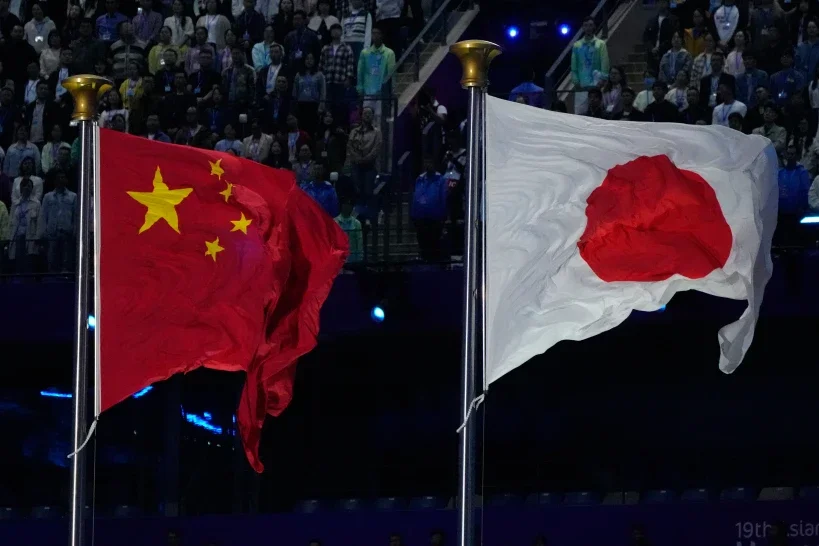
The flags of China and Japan are flown at the during the handover ceremony from China to Japan the next host of the Asian Games at the closing ceremony of the 19th Asian Games in Hangzhou, China, Sunday, Oct. 8, 2023. (AP Photo/Eugene Hoshiko, File)
In November 2025, tensions between China and Japan escalated after Japan’s prime minister, Sanae Takaichi, suggested that Japan could intervene in the event of a crisis involving Taiwan. The remarks triggered strong reactions from Beijing and quickly affected not only diplomatic relations but also people-to-people exchanges between the two countries.
Shortly after the statement, the Chinese Embassy in Japan warned Chinese citizens to pay close attention to their safety when visiting Japan. The embassy advised travelers to remain aware of local security conditions and exercise caution. Chinese officials argued that the Japanese leader’s comments about Taiwan had significantly worsened the atmosphere of bilateral exchanges and could pose risks to the safety of Chinese nationals in Japan.
The political tensions soon spilled over into the tourism sector. Following the Chinese government’s advisory discouraging travel to Japan, the number of Chinese visitors dropped sharply. In January, Chinese tourist arrivals to Japan fell by more than 60% compared with the same period a year earlier. According to data from the Japan National Tourism Organization, around 385,000 Chinese travelers visited Japan that month, representing a significant decline from the previous year.
The overall number of international visitors to Japan also fell slightly, marking the first year-on-year decline since the recovery from the COVID-19 pandemic. Analysts noted that the decrease was partly influenced by seasonal factors such as the timing of the Lunar New Year holiday, but many observers pointed to the diplomatic dispute as a key reason for the sharp drop in Chinese tourists.
Airlines in China also responded to the situation. Several major Chinese state-owned carriers announced that passengers traveling to Japan would be allowed to cancel or change their tickets without penalties. The decision reflected growing uncertainty surrounding travel between the two countries as the political dispute continued.
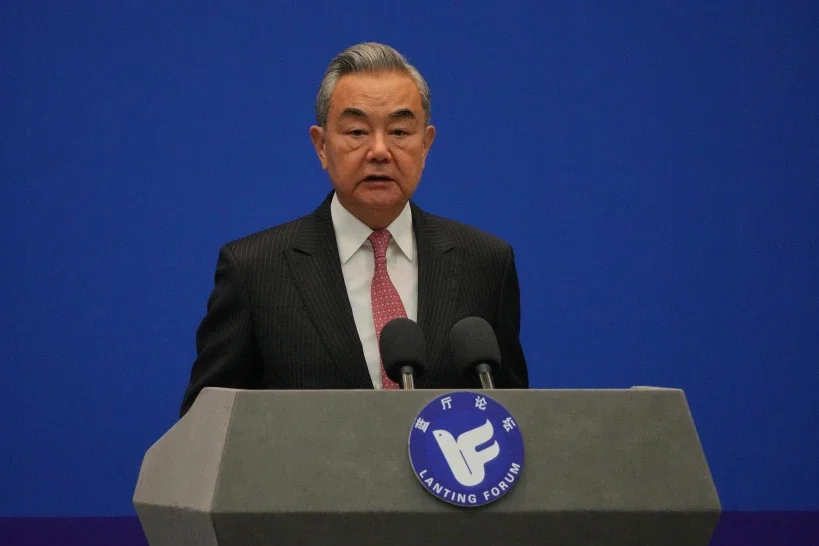
Chinese Foreign Minister Wang Yi delivers his opening remarks at the Lanting Forum on Improving Global Governance to Build a Community with a Shared Future for Humanity, at the Ministry of Foreign Affairs office, in Beijing, Monday, Oct. 27, 2025. (AP Photo/Andy Wong)
At the center of the controversy were Prime Minister Takaichi’s comments in Japan’s parliament, where she stated that a scenario such as a blockade around Taiwan could become a “crisis of national survival” for Japan if military force were involved. In Japan’s security framework, such a situation could justify the use of collective self-defense. The statement marked the first time a Japanese leader publicly suggested the possibility of intervention in a Taiwan-related conflict, prompting strong criticism from China, which described the remarks as interference in its internal affairs.