
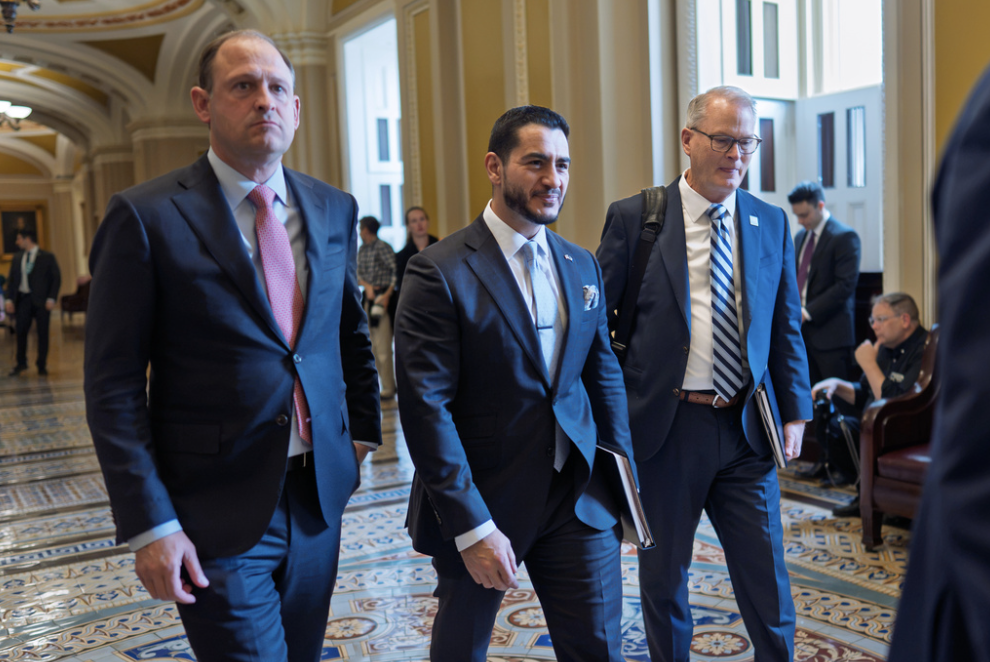
Sen.-elect Abdul El-Sayed, D-Mich., center, is flanked by Sen.-elect Andy Barr, R-Ky., left, and Sen.-elect Adam Hamilton, D-Kan., as newly-elected senators arrive for orientation following the sweeping victory by Democrats in the midterm elections, at the Capitol in Washington, Monday, Nov. 9, 2026. (AP Photo/J. Scott Applewhite)
The midterm elections were watched with bated breath by America’s Asian allies. While Asian leaders may be cautiously optimistic about the results, the uncertainty regarding “reciprocal tariffs” remains far from resolved. The Democratic Party has cemented control of both chambers of Congress, which represents a significant setback for Trump, whose administration has made tariffs a central instrument of its economic policy. For countries across Asia, the election results offer the prospect of greater congressional oversight, and “more stability” in trade relations. However, any major shifts in US trade policy will only be clear after the 2028 presidential election.
The US president had taken the global markets aback when, in 2025, he had imposed “reciprocal” tariffs ranging from 10 to 50 percent on trading partners, in order to shrink the US trade deficit. However, on February 20, 2026, the Supreme Court ruled that the International Emergency Economic Powers Act (IEEPA) did not grant the President the authority to unilaterally impose tariffs. However, as a significant legal blow to the administration's key trade policies, alternative legal mechanisms were adopted. On July 24, 2026, it imposed levies of 10 to 12.5 percent under Section 301 of the Trade Act of 1974 on goods from 60 trading partners, accusing them of failing to stop imports produced with forced labor. The affected countries and economies included China, Hong Kong, Japan, South Korea, and Taiwan.
For these countries and countries across Asia, the distinction between the legal defeat of Trump’s reciprocal tariffs and the continuation of the broader protectionist agenda is particularly important. The midterms offer greater scrutiny of trade policy, but do not signal an immediate return to predictable trade relations. The question is whether America’s Asian allies can continue to rely on Washington as a dependable economic partner when its trade policies remain subject to political and legal uncertainty.
Japan and South Korea have been the most exposed to the administration’s transactional approach to trade. Both countries attempted to negotiate favorable arrangements with Washington through substantial investment commitments, hoping to secure lower tariffs and protect their export-dependent economies. Their economic circumstances and negotiating positions are not completely identical.
Japan pledged $500 billion in investments in US Strategic sectors in exchange for a baseline 15 percent tariff rate on Japanese imports. As a major US ally and an important investor in the American economy, Japan has sought to preserve its access to the US market while maintaining a stable economic and security relationship with Washington. Its investment commitment reflects an attempt to accommodate American demands without allowing trade tensions to undermine a broader strategic partnership.
Meanwhile, South Korea and the US signed a formal memorandum of understanding (MoU) involving $350 billion in strategic investment to avoid higher US tariffs. However, implementing the agreement has raised additional concerns in Seoul, particularly regarding the financing and financial implications of certain projects. South Korea’s position is complicated by the need to balance its economic dependence on the American market with domestic concerns about committing substantial financial resources abroad. Consequently, while both countries have sought to secure favorable trade arrangements, South Korea faces particular pressure over how it will implement its investment commitments.
There is also a gap between the announced commitments and actual investment. Japan, South Korea, and Taiwan have collectively made available only $37.5 billion, approximately 2.7 percent of the total $1.4 trillion pledged under their respective trade arrangements. While the figures represent investment and financing commitments rather than money already transferred, the limited mobilization raises questions about the feasibility of the agreements and the willingness of Asian governments to continue making substantial concessions.
The election results could provide these governments with greater negotiating leverage. This does not imply that they can withdraw their commitments. With Democrats controlling both chambers, congressional committees could intensify investigations into the economic consequences of the administration's trade arrangements, question the financial terms of investment agreements, and demand greater transparency over their implementation. Lawmakers could also use hearings and legislative proposals to highlight the costs of tariffs for American businesses and consumers. Such scrutiny could increase the political costs of imposing additional tariffs and encourage the administration to reconsider how aggressively it uses trade restrictions in negotiations.
For Japan and South Korea, this could create greater room to seek clarity over investment timelines, financing arrangements and the conditions attached to their agreements. However, congressional oversight would not automatically translate into direct negotiating power for either government. The president retains considerable authority under existing trade legislation, and the administration can continue to use alternative statutory mechanisms to impose tariffs. Furthermore, the President can vet legislation passed by Congress, making major policy reversals difficult. The midterms may therefore increase institutional resistance to the administration’s trade agenda, but they do not guarantee that existing tariffs or investment arrangements will be reversed.
The Democratic Party’s control of both chambers of Congress also reflects wider concerns within the US about the economic consequences of the administration’s approach. Tariffs can increase production costs for American businesses, disrupt supply chains, and create uncertainty for companies dependent on international trade. These consequences may strengthen congressional opposition to the continued use of tariffs as a negotiating instrument. At the same time, it is important to recognize that American tariff policies are not driven solely by political bargaining. Support for domestic manufacturing, reducing dependence on foreign supply chains, and protecting strategically important industries has existed across both parties. From Washington’s perspective, tariffs can also serve as instruments of economic and national security, particularly amid growing competition with China. This broader political consensus makes it unlikely that a change in congressional control alone will produce a complete reversal of America trade policy.
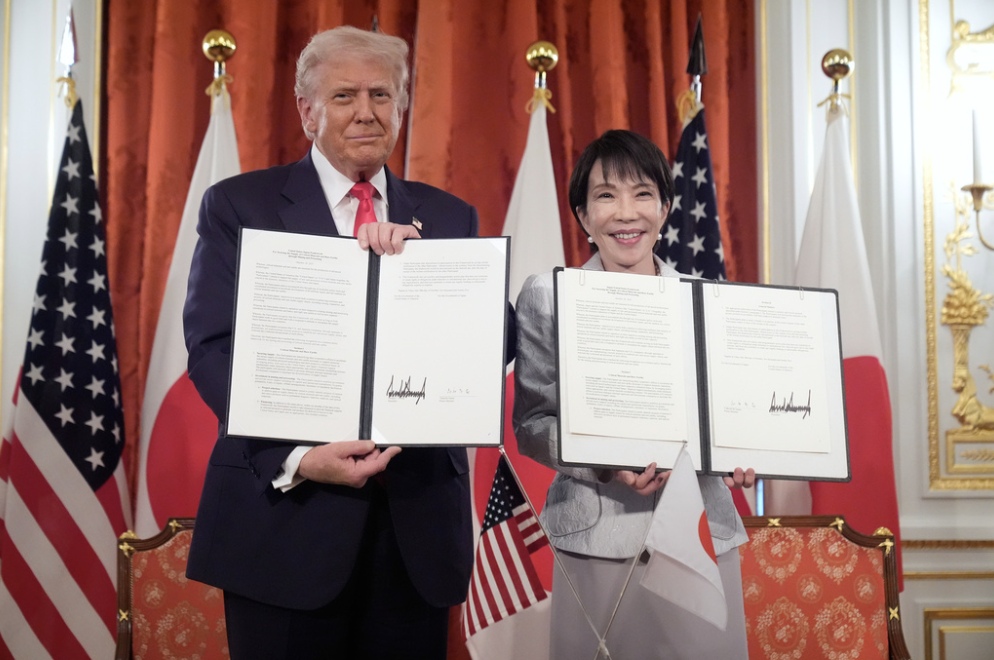
President Donald Trump, left, and Japan's Prime Minister Sanae Takaichi pose with their documents during a signing ceremony at Akasaka Palace in Tokyo, Japan, Tuesday, Oct. 28, 2025. (AP Photo/Mark Schiefelbein)
The larger geopolitical consequences of this uncertainty extend beyond trade. Japan and South Korea are not simply commercial partners of the United States but are central to its security framework in the Indo-Pacific. Japan hosts major American military facilities, while the US-South Korea alliance is crucial to deterring North Korean aggression. These two countries are also important partners in the broader efforts to maintain regional stability and counter China’s growing influence.
This creates a contradiction in American foreign policy. While cooperation is expected on behalf of the Asian allies on defense, intelligence sharing, technological competition, and regional security, Washington’s economic policies expose them to uncertainty. When countries are pressured into making enormous investment commitments but continue to face additional tariffs, the relationship risks becoming transactional. The concern is not simply that these countries may lose money, but that repeated economic disputes could gradually weaken their confidence in the United States as a long-term strategic partner.
China also stands to benefit from any weakening of confidence in American economic leadership. As Washington continues to use tariffs and investment demands to pressure its trading partners, Asian economies may look at diversifying their trade relationships. This does not mean abandoning security alliances with the United States or immediately moving closer to Beijing. Greater regional cooperation and alternative trade arrangements could consequently become more appealing to reduce exposure to American policy uncertainty. Such diversification would not immediately transform the regional balance of power, but it could gradually reduce Washington’s economic influence.
Despite the opportunities presented by the “blue wave” of midterm elections, it would be premature to make huge predictions. Support for domestic manufacturing, supply-chain security and competition with China extends across party lines. Even a future Democratic administration may retain elements of the protectionist economic approach that has characterized recent American trade policy. While the Democratic Party does believe in multilateralism, diplomacy as a primary tool, and strengthening international alliances, there is still a shift towards economic nationalism in American domestic politics.
Furthermore, a politically weakened President is not necessarily equal to a more predictable one. The reduced political standing could make him more aggressive in pursuing his existing policies, particularly since tariffs had been viewed as a way to demonstrate continued control over the country’s economic direction and the huge ripple effect of US economic decisions. Asian governments must therefore avoid assuming that this change will automatically translate into more favorable trade arrangements or will provide immediate economic relief.
Ultimately, the midterm elections have provided America’s Asian allies with an opportunity to breathe, not a guarantee of lasting relief. There is also the consideration that a lot of voters pivoted their political stance because of disappointments in the government action. Their ability to deliver on promises of greater economic stability and congressional oversight will be closely scrutinized ahead of the 2028 presidential election. If the party fails to translate their congressional majority into meaningful improvements in trade relations and domestic economic conditions, Republicans could regain the presidency. This possibility adds another layer of uncertainty to the long-term outlook for America's trading partners.
Japan and South Korea’s experiences demonstrate that even substantial economic concessions cannot entirely eliminate uncertainty when trade policy is increasingly driven by political negotiations rather than discussions, agreements, and predictable rules. The new Congress may introduce greater resistance to the decisions that will be taken, but restoring confidence in American leadership amongst the allies will require more than an electoral setback for the Republican Party.
For Washington, the stakes extend well beyond tariff revenues and investment announcements. Its influence in the Indo-Pacific depends not only on military strength but also on the confidence its partners place in its own commitments. If the US continues to treat the alliance as a bargaining chip, it risks them seeking alternatives and weakening the very regional partnerships it hopes to preserve. The midterms may have offered Asia a reason for cautious hope, but whether that hope translates into a more dependable American partnership will ultimately depend on Washington's willingness to align its economic policies with its broader strategic commitments.