
Protests in South Korea Over Trump’s Request For Aid in the Middle East
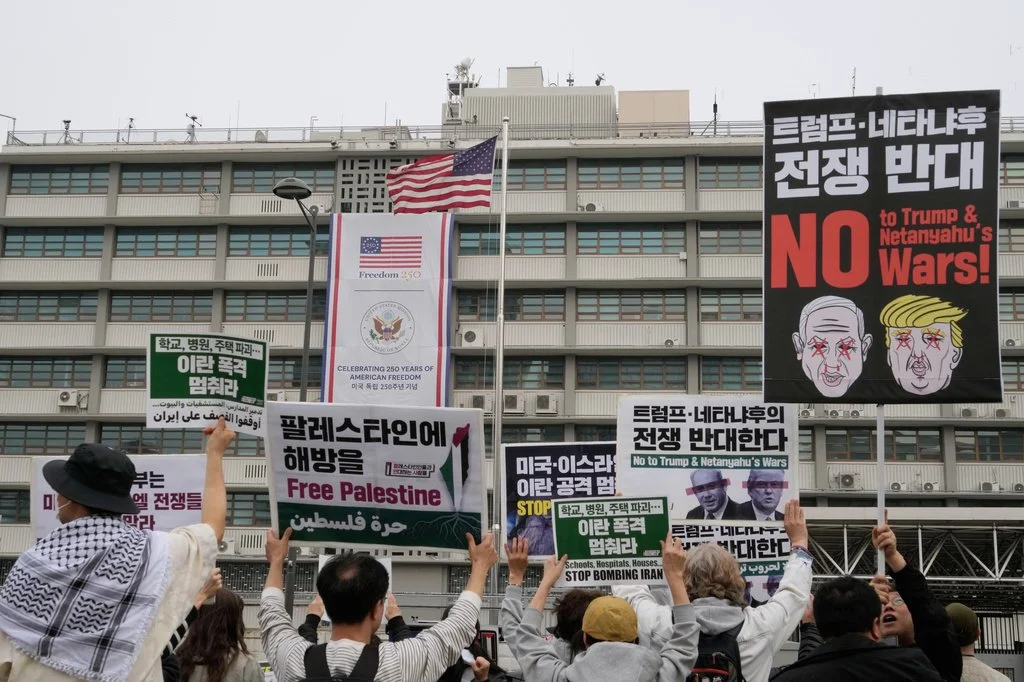
Protesters hold up their banners during a rally against the U.S. and Israel attacks on Iran near the U.S. Embassy in Seoul, South Korea, Sunday, March 29, 2026. (AP Photo/Ahn Young-joon)
South Korean activists are taking to the streets of Seoul, protesting Trump’s call for aid in sending military vessels to the Strait of Hormuz.
Following the US-Israel-Iran war, the Strait of Hormuz, an essential global trade route that transports oil from the Middle East to Asia, was shut down by the Iranian government. President Donald Trump has openly threatened Iran on this front, giving Iran a deadline which he has since extended twice. As tensions have escalated, President Donald Trump issued a request to NATO allies to send reinforcements to Iran, with resounding refusals in return.
South Korea and Japan were also named in Trump’s request. Shortly following the news, many in Seoul made their voices heard by holding a series of protests outside the US Embassy. The protests were triggered by the joint military exercises held annually by South Korea and the United States. Like many other NATO members, South Koreans believe that the war in the Middle East is not their fight, and their troops should not have to interfere.
“I was outraged to hear that [Trump] had asked his allies, specifically singling out South Korea, to send troops to Iran, and I could no longer remain silent,” said Jeong-Young Lee, a South Korean activist. Many of the protesters involved are office workers, taking time off of their lives to have their voices heard. Yet others are part of progressive and liberal organizations within South Korea. On March 15, People’s Solidarity for Participatory Democracy issued a statement on the matter: “Sending a naval vessel there would likely be interpreted as joining US-led military activity and could make South Korea a target of Iran,”
This is a general sentiment shared amongst South Koreans as well as the members of NATO that have been called upon to assist with the war. Many European countries have openly refused Trump’s statements, reluctant to escalate matters further in an issue that does not concern them.
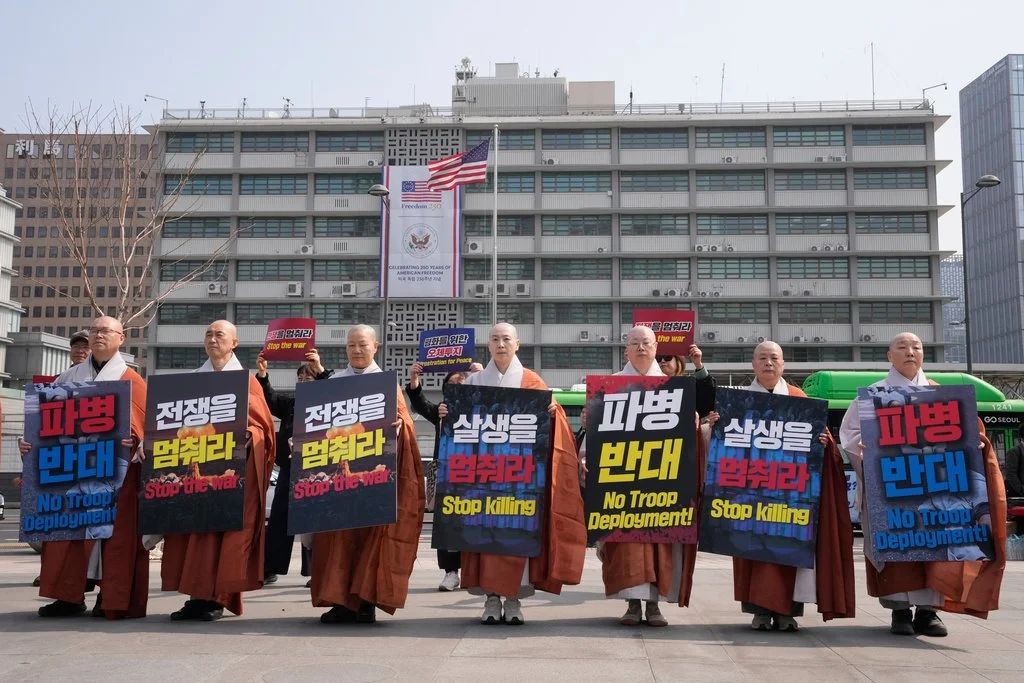
South Korean Buddhist monks protest against President Donald Trump asking multiple countries to send warships to reopen the Strait of Hormuz, at Gwanghwamun Square near the U.S. Embassy in Seoul, South Korea, Thursday, March 26, 2026. (AP Photo/Ahn Young-joon)
Among the protesters in South Korea were dozens of Buddhist monks carrying signs that read “stop killing” and “no troop deployment”. They marched towards the US embassy in Jongno-gu, Seoul, South Korea, representing the Jogye Order of Korean Buddhism, the largest sect of Zen Buddhism in South Korea. Additionally, 26 of the monks performed full-body prostrations as they crossed the 3-kilometer distance.
As of now, South Korea has refused to send any warships to the Strait of Hormuz in assistance to the US. On April 2, Trump voiced his dissatisfaction with this news, claiming that “Let South Korea, who was not helpful to us, by the way…Let South Korea do it.” Since the majority of oil traveling through the Strait of Hormuz directly benefits Asian countries, Trump has named South Korea, Japan, and China as responsible for dealing with the Strait of Hormuz’s closure.