

A photographer waits for the sunrise above the city skyline in Kuala Lumpur, Malaysia, Tuesday, Feb. 28, 2023. Malaysia Prime Minister Anwar Ibrahim unveiled a 386.1 billion ringgit ($87 billion) national budget on Friday that focuses on tackling the rising cost of living amid an economic slowdown. (AP Photo/Vincent Thian)
This week, the US announced new restrictions on Southeast (SE) Asian countries: Indonesia, Malaysia, Singapore, Thailand, and others must now receive a license from the US Department of Commerce to buy advanced AI chips from American companies like Nvidia or AMD. The new rule also requires a similar license if the countries provide “significant volumes” of computing power to companies whose headquarters are located in China.
This follows a long-running suspicion in Washington that Chinese AI companies have outsourced their data center processing to neighboring countries, or have smuggled chips illegally from SE Asian countries that have purchased billions of dollars worth of high-end chips, despite the ban on China since 2022 on importing American advanced chips in the midst of tense US-China AI competition. The suspicion climaxed with the recent spotlight on Nvidia’s co-founder and CEO, Jensen Huang. His suspected ties to Megaspeed raised suspicions that the Singaporean cloud-computing firm funneled advanced chip shipments into China through regional subsidiaries. Many SE Asian countries, including Singapore and Thailand, have been quick to make clear statements on their non-involvement in the conflict.
The AI boom has fuelled the region’s economic growth in recent years. Malaysia, for example, has approved $95 billion in data center-related investments since 2021; Thailand has $23 billion in investment as of February, and Indonesia’s data center market valuation stands at $2.8 billion in 2025. Singapore’s forecasted growth rate this year has also cited the AI boom. Chinese investment has supported data center expansion in SE Asia given its geographic proximity, relatively low political friction, and growing demand. Many data centers also rely on Chinese demand for remote access to chips, helping drive the region’s data center boom.
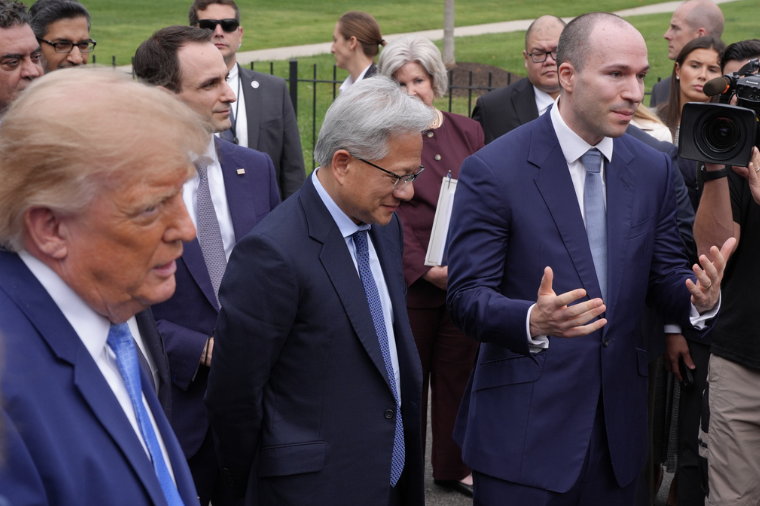
President Donald Trump and NVIDIA CEO Jensen Huang listen as Open AI president Greg Brockman speaks to reporters at the White House in Washington, Tuesday Sept. 29, 2026, after meeting with top executives of AI firms. (AP Photo/Jacquelyn Martin, File)
Moving forward, however, greater scrutiny from the US could potentially slow growth for some countries in the region. For one, restricted provision of advanced computing power to Chinese AI developers is likely to discourage Chinese commercial incentives to expand investment in the region. Chinese companies have begun looking for alternative suppliers outside of the regulated region. In Malaysia, for example, slower investment could slow down forecasted GDP growth by 0.2%, on top of an anticipated cooling in global AI exports. On top of declining investments, compliance-related costs could also slow down data center expansion. Because the AI sector in Malaysia depends on Chinese demand, the country is likely to take a greater hit from the new regulations.
Moreover, tighter regulatory oversight is likely to ensue as Democrats regain control of Congress next year and are motivated by the recent Nvidia scandal. The Trump administration has been criticized for allowing Nvidia chip shipments directly to China and being lax on chip exports. The administration has said that supplies can discourage Chinese development in advanced chip design, thereby supporting America’s lead in AI innovation.
SE Asian countries have sought to remain ‘neutral’ amid US-China tensions and have welcomed investment from both countries. Countries with a “mix of US hyperscaler, sovereign and enterprise clients” are likely to be relatively more insulated given strong demand from the US. In the meantime, however, many SE Asian countries have begun assessing or setting up compliant frameworks to the new regulations. In consideration of maintaining their reputation as a trusted hub for future AI growth and investment, as well as ensuring continued access to advanced US chip supply, SE Asian countries are formally acknowledging the US’ stance. “If you want to be in the game, you have to follow US regulations,” said Malaysia’s investment, trade and industry minister, Johari Abdul Ghani.