
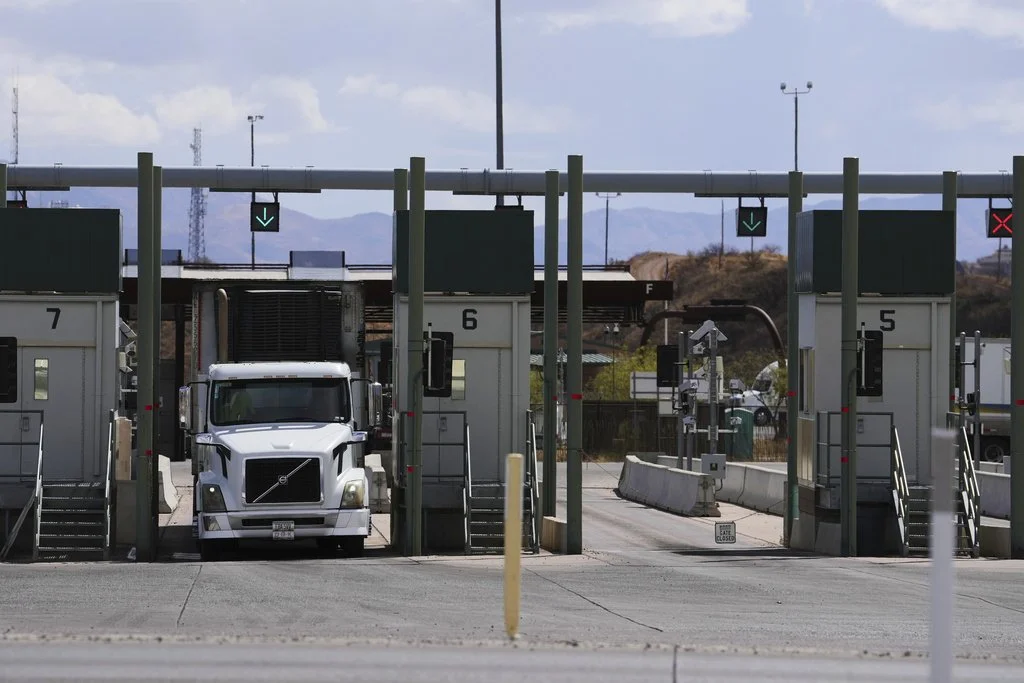
A truck pauses at the exit of the commercial port of entry from the Mexico side of the US-Mexico border Friday, April 4, 2025, in Nogales, Ariz. (AP Photo/Ross D. Franklin)
US-Mexico tariff relief negotiations hit a renewed impasse on Thursday due to objections from Commerce Secretary Howard Lutnick. This comes a week after Mexico’s Institute for National Statistics and Geography (INEGI) reported an 11.9% plunge in light-vehicle exports year-on-year, alongside an even steeper slash in nationwide production, in excess of 15% over the same period— 53,000 autos less than were produced in September of last year. Mexican trade experts largely identify the downturns as the ramifications of President Trump’s steep tariffs on auto imports in early 2025.
The past month’s decline is starker in context: before September, year-to-date exports had remained almost equal to the year before, falling by just 0.06% in the wake of Trump’s March 2025 announcement of an additional 25% tariff on auto imports. INEGI’s ‘light-vehicle’ category includes all passenger cars, SUVs, pickups and vans.
The US share of Mexican auto exports fell from 84.2% in the first two months of 2025, prior to the tariff announcement, to 75.7% over the same period this year. In comparison with January-September 2024, 133,000 fewer cars arrived stateside this year-to-date, a Mexican earnings blow, the most up-to-date US Census Bureau figures for 2024 and 2026 reveal, of $9.5 billion in gross export value.
The losses follow the United States’ 25% additional duty on the value of imported automobiles worldwide, which took effect on April 3, 2025. However, the proclamation specified that vehicles qualifying under the United States-Mexico-Canada Agreement (USMCA) can have the tariff applied only to their non-US components. Mexico’s Economy Secretary Marcelo Ebrard described the exemption as “a very big advantage” over competing auto exporters, estimating the average effective tariff at 15%.
Mexico has sought to offset its declining exports to the US by diversifying its auto export markets, forming a “Comprehensive Strategic Partnership” with Canada in 2025, working to tighten bilateral trade in “sectors of interest”, to coordinate trade policy, and to collaborate on strengthening its maritime corridors. Mexican auto exports to Canada grew by 98,000 over the same period, a 45.6% increase from 2024. From a Canadian perspective, 70% of the value increase in auto imports is accounted for by Mexican manufacturing, from April 2025 to February 2026 compared to the same period a year prior. Canada’s April 2025 retaliatory 25% auto tariffs toward the US handed Mexican vehicles a competitive advantage in the Canadian market. Southbound exports to Brazil also rose by 16,000 vehicles.

Mexican President Claudia Sheinbaum, right, meets with U.S. Secretary of State Marco Rubio at the National Palace in Mexico City, Wednesday, Sept. 3, 2025. (AP Photo/Jacquelyn Martin, Pool)
The shifting trade incentives have prompted vehicle manufacturers, including major US car companies, to revise their production strategies in North America. Following last year’s announcement of a $4 billion investment into US manufacturing plants in Michigan, Kansas, and Tennessee, General Motors on October 2 ceased production of the gas-powered Chevy Blazer at its Ramos Arizpe. Furthermore, INEGI’s report revealed Mercedes-Benz produced zero vehicles in Mexico last month, for the first time since opening shop in 2018.
But it appears there is no single dominant strategy, with Kia, BMW and Mazda increasing exports from Mexico in September year-on-year, with Mazda’s figures more than doubling.
Despite current terms of trade previously reaching the verge of change, carmakers’ best path forward in the long term remains no less clear this quarter than the last. At its July 2026 review, the White House refused to renew the USMCA as it currently exists, demanding tighter rules of origin— currently, 75% of a vehicle’s content must be North American to comply. Although the agreement remains in force for another decade, annual reviews are scheduled from 2027 onward, presenting opportunities for the three signatories to negotiate revised terms and concessions.
Despite increased market diversification efforts, the US continues to receive the lion’s share of Mexican auto exports, rendering the industry intensely exposed to Trump’s trade policy. Trade analysts at Atradius hence identified Mexico reestablishing reliable US market access as a central sticking point of USMCA negotiations. The analysts further claim that business confidence and capital investment in Mexico’s auto industry are consequently waning, which follows on from weakened investment more broadly in Mexican manufacturing.