
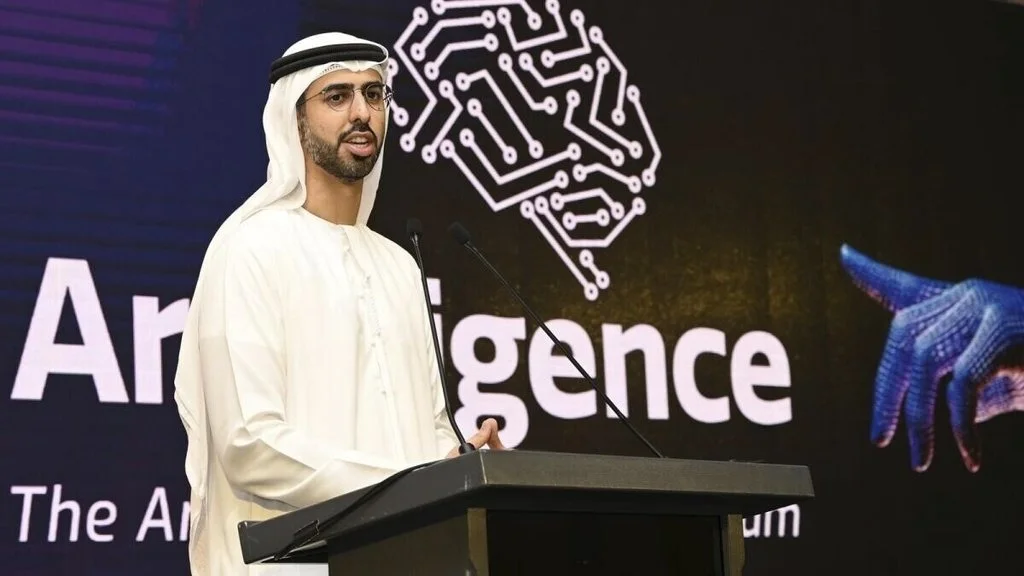
UAE Dubai First World Metropolis for Artificial Intelligence, June. 14, 2025 (AP Photo)
The limits of technological independence, even among the industry leaders, are being exposed via the computing power shortage, pushing AI rivals into partnerships. The Wall Street Journal reported an unlikely emerging partnership between Anthropic and xAI in the face of an AI compute shortage. This arrangement illustrates how compute access is reshaping relationships between companies, including rivals, to build frontier AI systems. This dependence raises a central question for governments pursuing AI sovereignty: Does sovereignty require technological independence, or can it be achieved by reducing dependence and securing reliable access to technology?
The UAE offers a case in point. Washington and Abu Dhabi announced the US-UAE AI Acceleration Partnership in May 2025, intended to place some of the world’s most advanced computing infrastructure on Emirati soil. This agreement includes a 5-gigawatt AI Campus built and operated with leading US technology companies, which will provide a platform through which US hyperscalars can offer services to nearly half the global population living within 3,200 km of the UAE. Although this expands UAE’s domestic computing capacity, the US retains authority over which Emirati companies qualify for license-free shipments. This distinction brings out a limit to AI sovereignty: housing infrastructure does not give a country authority over the technology required to control and upgrade it.
On paper, this move strengthens Emirati control in the global AI landscape, gaining direct access to the highly coveted AI infrastructure and large-scale compute capacity, with the facilities being directly located in the UAE. Advanced chip access remains in the hands of American firms, with chip access directly controlled by US export policies.
The US Bureau of Industry and Security eased export control for the UAE in July 2026, with select approved companies and the UAE government becoming eligible for license-free access to cover advanced computing items, including AI chips and servers. Although this eases the restrictions considerably, the eligibility is still defined by the US rules.
The US itself is placed in a unique position. Although it is governing advanced-chip exports and leading in several aspects of the AI compute scale and frontier model performance, its leading position does not guarantee self-sufficiency in AI manufacturing. It is still vulnerable to the strong global integration of the AI supply chain.
This dependence is visible in the commercial scramble for AI compute. According to a Wall Street Journal report in October, unlikely alliances were being formed between rivals across Silicon Valley to secure scarce computing resources, with competitors being forced to cooperate over access to the infrastructure. The most striking reported deal was between Anthropic and xAI, an arrangement through which Anthropic would lease over 300 megawatts of computing capacity through a deal worth approximately $45 billion.
Anthropic AI Image, Feb. 26 2026, (AP Photo/Patrick Sison)
Anthropic and xAI compete in frontier AI, with an unusually public rivalry. Elon Musk had publicly criticized Anthropic merely a few days before this reported partnership, alleging that Anthropic’s AI was biased against select demographic groups, describing its behaviour as “misanthropic and evil”. Despite public disagreements between these companies, the reported agreement suggests that infrastructure needs can outweigh public rivalry between competitors. The deep international integration of the AI supply chain reveals that no country is exempt from technological interdependence. This international dependence becomes clearer up the supply chain, with US technology relying on European, Japanese, and South Korean suppliers for components such as semiconductor materials and high-bandwidth memory, while these countries also depend on American processors, cloud services, and models. These overlapping dependencies illustrate the difficulty in achieving technological self-sufficiency.
China represents another example of an AI superpower which, despite its globally dominant position, is exposed to the deep-rooted global integration of AI. China has been particularly adamant in pushing towards self-reliance in terms of AI capacity manufacturing. Facing export controls from the US, Beijing pushed for the development of domestic alternatives, with Huawei expanding its shipments of Ascend AI accelerators and unveiling next-generation computing systems and chips. However, despite this strong step towards self-reliance, Huawei has been subjected to AI computing product demand exceeding its supply, with Chinese chipmakers facing shortages in high-bandwidth memory. Despite its government support, strong industrial capacity, and large domestic market, it is still unable to override the global reliance and integration of the AI supply chain.
These comparisons reveal different stages of countries pushing for AI sovereignty: the UAE, while significantly expanding its domestic capacity, remains entirely reliant on the US for technology and access; the US retains its position of global dominance while still being vulnerable to international supply chains, to the extent that scarcity leads to market restructuring around access to compute, forging alliances between rivals; China, although at the top of the food chain, faces supply constraints while fuelling its agenda for self-reliance. These developments suggest that AI sovereignty is now more about managing dependence than eliminating it. The next tests of sovereignty will be the ability of middle players to gain greater control over how their infrastructure is operated. Domestic chipmaking and supplier diversification will help indicate whether newer investments will reduce strategic independence or merely expand the existing capacity within foreign partnerships.