
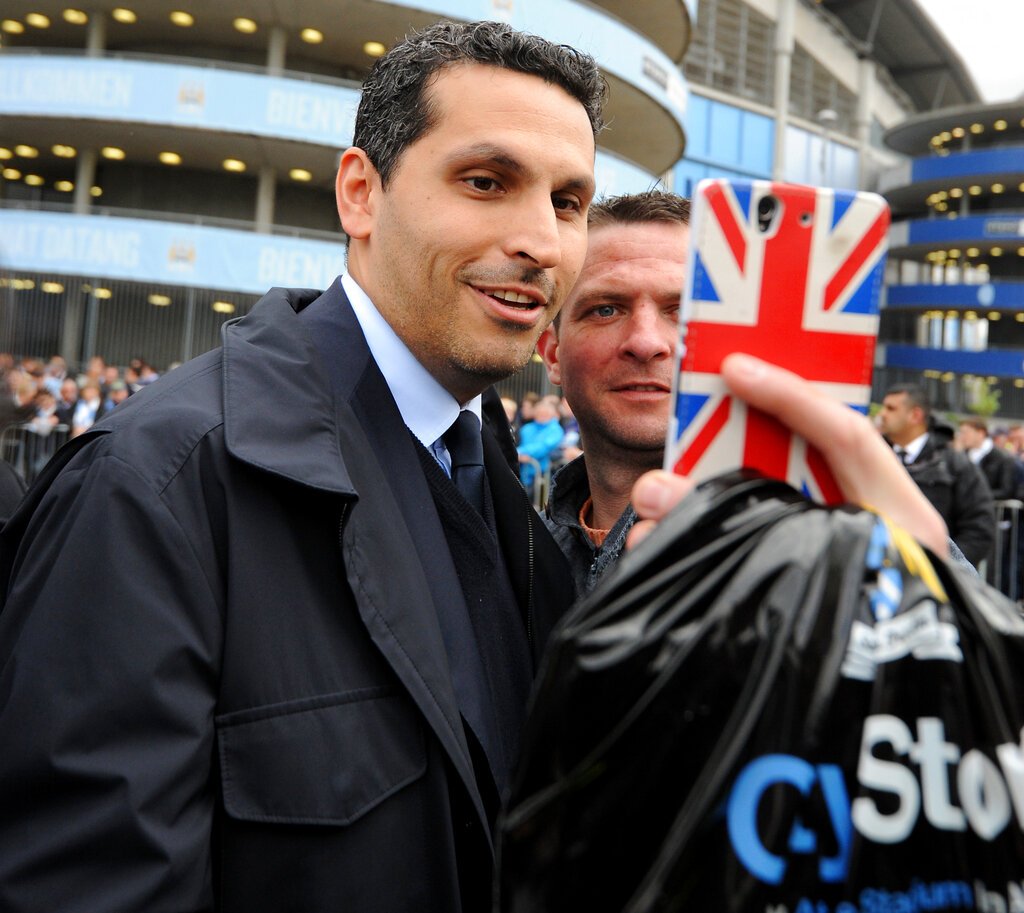
Manchester City chairman Khaldoon Khalifa Al Mubarak poses for a selfie with a supporter as he arrives at the Etihad stadium for the English Premier League soccer match between Manchester City and West Ham United at the Etihad Stadium, Manchester, England, Sunday, May 11, 2014. (AP Photo/Rui Vieira)
In the days following an independent sporting commission’s damning September 2026 verdict that Manchester City Football Club is guilty of 114 of 115 charges, including serious breaches of the Premier League’s financial rules, Emirati officials warned the ruling would “have an influence on the bilateral state relationship” between the UAE and Britain. Among the threats was the possible withdrawal of a multibillion-pound investment for a Silicon Valley-type Oxbridge tech hub. Manchester City has appealed the decision, vehemently denying wrongdoing. The appeal hearing is reportedly slated for mid-December, and a final ruling is expected early next year, with a massive points deduction leading to relegation under consideration.
For those in football, and perhaps more so for the international community, the UAE’s threats should be harrowing. Their jeopardy is twofold; a foreign government has undermined Britain’s sporting integrity, and a footballing institution is being used for political purposes. Britain should use this watershed moment as an opportunity to ban foreign states and state-controlled consortiums from owning or in any way controlling its football clubs.
In Europe, football is the social heartbeat—it brings people together every weekend, and a bad game can ruin someone’s month. Team loyalty is often inherited through family trees, and fans will wear their allegiances for life. When someone buys a football team, they purchase a place within a ready-made community that cares deeply about what happens to it. When an owner’s investment converts to on-field success, they turn into a cult hero. In sport, unlike other industries governed by finance, morals and law, victory is the ultimate kicker. As long as their team is winning, fans will happily stand by their club and its owners through controversy. That goodwill was on display the day Manchester City won their second Premier League title in 2014. An Associated Press photographer captured a fan taking a selfie with chairman Khaldoon Al Mubarak, his phone encased in the Union Jack.
Football’s loyalty therefore carries tremendous political value. When an owner can deliver lifelong memories in the form of trophies and championships, they buy a good reputation. And when that owner is closely associated with a foreign government, that goodwill can extend to the government. This presents an opportunity for sportswashing. Investing in a football club in this light is an enticing foreign policy strategy, as a way to soften international sentiment by diverting attention to a sphere that is inherently more innocent.
These arguments reared their heads when, on October 7, 2021, Saudi Arabia’s Public Investment Fund (PIF) finalized the purchase of an 80% stake in Newcastle United. In doing so, the Saudi PIF integrated itself into British society by gaining control of a portion of it, creating a lasting association with the institution and its supporters. Newcastle fans received the news in jubilation, as it meant the end to 14 years of Mike Ashley’s turbulent and, crucially, unsuccessful ownership. The purchase ignited hope within the fanbase, whose club overnight gained by far the richest owners in the sport— with over 15 times more wealth than Manchester City’s Emirati owners. In a sport that is increasingly pay-to-play, with clubs’ on-field fortunes closely correlated with owner spending, fans took the takeover as a sign of success to come. That sentiment was shared by the new ownership, which outlined ambitions to win the Premier League within five to ten years. This renewed hope can itself be perceived as a Saudi foreign policy achievement, with supporters embracing their new owners’ culture, as illustrated by Newcastle supporters draping their black and white scarves over their heads like ghutras.
The Saudi takeover was greenlit following the Premier League’s receipt of “legally binding assurances” that the state will not control the football club. Saudi Arabia is an absolute monarchy, and Crown Prince Mohammed Bin Salman chairs the Public Investment Fund. Though the Premier League’s CEO Richard Masters said the owners could be removed if the state was found to control Newcastle, he admitted there would be no way of knowing if the crown prince had given instructions to directors. Five years later, there remains no verification of how Newcastle’s controlling entity could be verified, nor how the assurances could be enforced, or by whom. In the event of a violation, one could seriously question whether the Premier League, a domestic sporting corporation, could punish the Kingdom of Saudi Arabia. The imbalance of power and jurisdiction in itself places serious scrutiny on the viability of state football ownership.
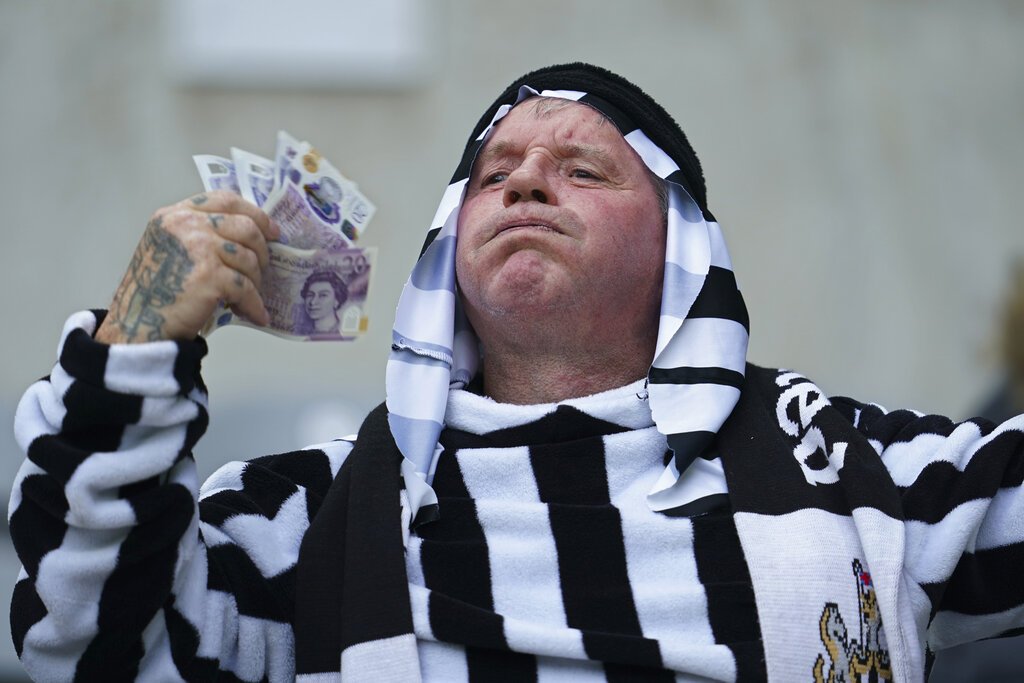
A Newcastle fan waves some notes around before the start of an English Premier League soccer match between Newcastle and Tottenham Hotspur at St. James’ Park in Newcastle, England, Sunday Oct. 17, 2021. Newcastle plays its first game under new ownership after the club was bought out by Saudi Arabia's sovereign wealth fund. (AP Photo/Jon Super)
The ruling against Manchester City has offered a clearer view into what the Premier League prosecuting and preparing to punish state owners looks like. It has exercised its domestic corporate jurisdiction, but the diplomatic and economic fallout has spread far beyond its remit. Sheikh Mansour’s company Newton Investment and Development LLC, which he fully owns, holds a majority stake in Manchester City. Mansour, a member of the royal family, vice president, and deputy prime minister, is the brother of UAE President Sheikh Mohamed bin Zayed. The direct overlap between club ownership and political office calls into question where and how, if at all, an owner’s private interests and those of a foreign government can be distinguished. The overlap is also reflected in City’s boardroom. Chairman Khaldoon Al Mubarak is a senior UAE government official, holding multiple offices which include Presidential Special Envoy to the People’s Republic of China and is the founding chairman of the Executive Affairs Authority.
The independent commission found that between 2009 and 2018, Manchester City used falsified financial accounts that relied on “sham” contracts to artificially inflate the club’s sponsorship revenues and reduce its costs, which, when corrected, reveal significant losses that far exceed the Premier League’s permitted yearly limit. It misrepresented records by more than £900 million— comprising £830 million in fake sponsorship income and over £70 million in understated costs— to disguise unpermitted owner spending. During this period, it spent that revenue on player and manager acquisition and wages— talent that won them countless football’s most prestigious trophies. City’s early success, built on false foundations, helped garner a global fanbase and eventually generate the genuine commercial income that now funds one of Europe’s best squads.
The UAE’s stake of interest in the court case was clear early on to the British government, with then-Foreign Secretary James Cleverly seeking an update in September 2023. The details of this correspondence were redacted on the grounds that releasing them could harm diplomatic relations. Additionally, two weeks before the verdict’s delivery, City Chairman Al Mubarak met with Business Secretary Jonathan Reynolds. The government insisted that he attended in his capacity as chief executive of Abu Dhabi’s sovereign wealth fund, and did not discuss Manchester City. But it is hard to separate the City chairman’s political power from his stake in the case, given that the pair discussed bilateral trade and defense. The UAE reportedly invested more than £30 billion over the past five years into British defense, life sciences, and technology companies. Therefore, the divestment threat could be a concern of the highest order to a struggling British economy.
Prime Minister Andy Burnham’s response revealed just how closely British interests had become intertwined with the UAE’s willingness to invest. Upon purchasing Manchester City, Sheikh Mansour pledged to invest in local area community work in addition to the football club. Abu Dhabi United Group partnered with Manchester’s government to build hundreds of homes in derelict “industrial wastelands” in East Manchester, helping turn them into one of Britain’s top choices for new residents. As Mayor of Greater Manchester, Burnham worked closely with Emirati investors, whose impact on the city he praised upon becoming Prime Minister. Following the Premier League’s verdict, Burnham said he would be “really concerned” if Manchester City’s Emirati owners were to sell up.
Manchester’s development story demonstrates how the UAE’s warning carries consequence. Emirati investment gave the British Foreign Office incentives to uphold their relationship, because of what they may lose if they do not. The potential cost of the Premier League enforcing its rules could reach into the tens of billions, including the loss of the Oxbridge tech hub, with serious implications for British economic policies and fiscal projections.
Burnham insisted he would steer clear of the disciplinary process, yet the prospect of losing Manchester City’s owners prompted him to publicly defend them. That compulsion is disturbing. The idea that a sporting decision could jeopardize any state’s economic and diplomatic relationship with another is preposterous, and in itself demonstrates why football clubs should not be controlled by states. Under state ownership, football clubs can and have been used as pawns to further diplomatic interests.
Although it finds itself in a precarious diplomatic position, Britain should not find itself here again. Britain’s newly established Independent Football Regulator should use its legal jurisdiction under UK law to update its owner eligibility criteria to bar foreign states, state-controlled, and state-associated entities from owning or controlling British football clubs. It should stipulate that no individual, nor anyone with close familial ties to anyone who holds political or royal office in a foreign country, would be allowed to own, serve on the board of, or advise a professional or semi-professional football club. Parliament should use the guilty verdict as a reason to sanction the UAE surgically on their ownership of Manchester City, and force them to sell, much like pro-Putin oligarch Roman Abramovich was forced to sell Chelsea in 2022. Newcastle’s Saudi owners should be offered an off-ramp, since they have not been proven to have committed any wrongdoing. They should be mandated to sell off the club in phases, to buyers of their choosing.
No foreign government should be able to hold British culture to ransom by means of its political leverage.