
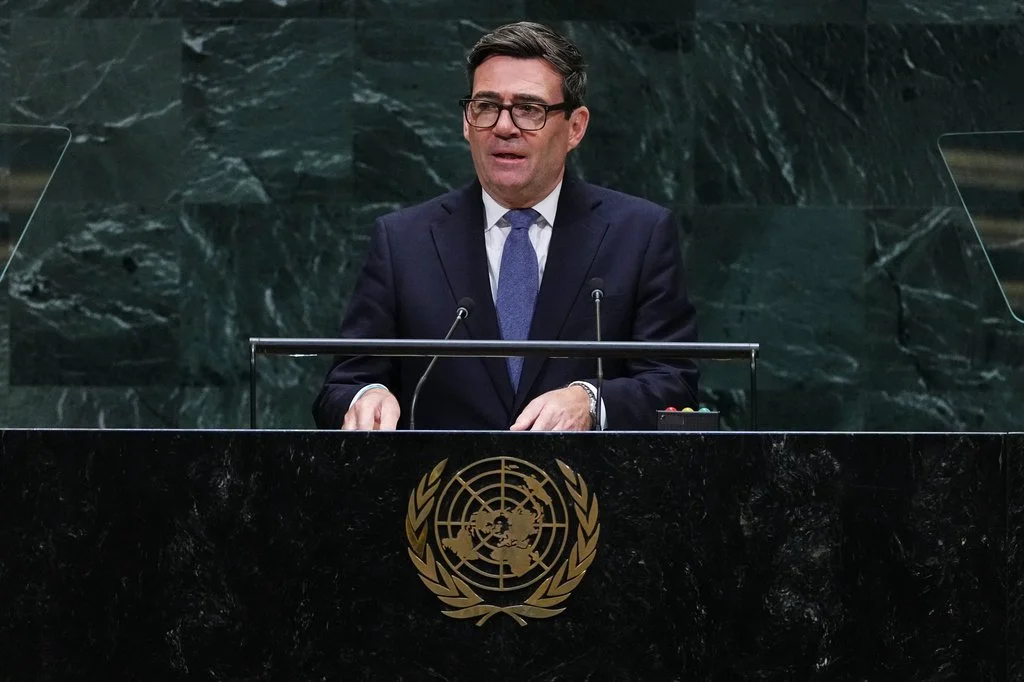
Britain’s Prime Minister Andy Burnham addresses the 81st session of the United Nations General Assembly at U.N. headquarters Tuesday, Sept. 22, 2026. (AP Photo/Frank Franklin II)
In his September 22 speech at the U.N. General Assembly, newly appointed UK Prime Minister Andy Burnham vowed to place “AI at the heart of the UK’s G20 Presidency next year”. The announcement built on a summit convened five days prior by King Charles III, with senior tech executives and British government ministers at Dumfries House, Scotland on September 17, where he urged for a timely and proportionate reaction to “deeply concerning” frontier artificial intelligence developments before the ability to do so is lost.
The UK PM revealed he will broker discussions that “work towards agreeing a single set of global principles and standards” of frontier development. The following day, Foreign Secretary Ed Miliband addressed the Security Council on AI, calling for greater public oversight of AI safety. He argued, “we cannot outsource to private companies”. Burnham’s government is seeking a return to a politics of control at-large, echoing the European Union’s legislative approach to AI regulation, following decades of outsourcing investment in public goods.
The G20 agenda rollout came out in the wake of King Charles’s aforementioned summit, at a Georgian country estate in rural Scotland— an unusual gathering place for AI and chip executives, including Nvidia CEO Jensen Huang, OpenAI CFO Sarah Friar, Anthropic Chief Global Affairs Officer Tino Cuéllar, and Google DeepMind Co-Founder and CEO Demis Hassabis. The meeting came at a time of growing calls among senior US AI executives for more rigorous oversight of frontier AI development following a series of accidental cyberhijacks by OpenAI agents.
Though the summit did not yield a measurable policy agreement, it was never intended to. In lieu, delegates “considered whether a shared set of principles could be established” as a precursor to substantive policy talks in the coming weeks and months.
Addressing attendees, King Charles echoed whistleblowers’ warnings of the “existential dangers” of the fast-growing frontiers if used in “catastrophic” ways. He also pointed to the organizations’ technologies “developing darker capacities”, alluding explicitly to their potential to “take life”. The King’s blunt forecasts were a marked difference from his usual gentle tone.
He emphasized centering “sacred” humanity in the mission of AI development and sought reassurance from the senior executives that “we will not lose control of our destiny, or our souls”. Toward the closing of his remarks, he reaffirmed his hopes that “safety [be] at [the] heart” of global attitudes in respect to AI.
The monarch’s assembly of the industry’s leaders demonstrates the utility of an international convener to the British government, at a time when it has lost its place at the center of global governance, self-admittedly. It granted British Minister for AI, Kanishka Narayan, rare face time with the tech executives in a moment that, they claim, is pivotal to AI’s future.
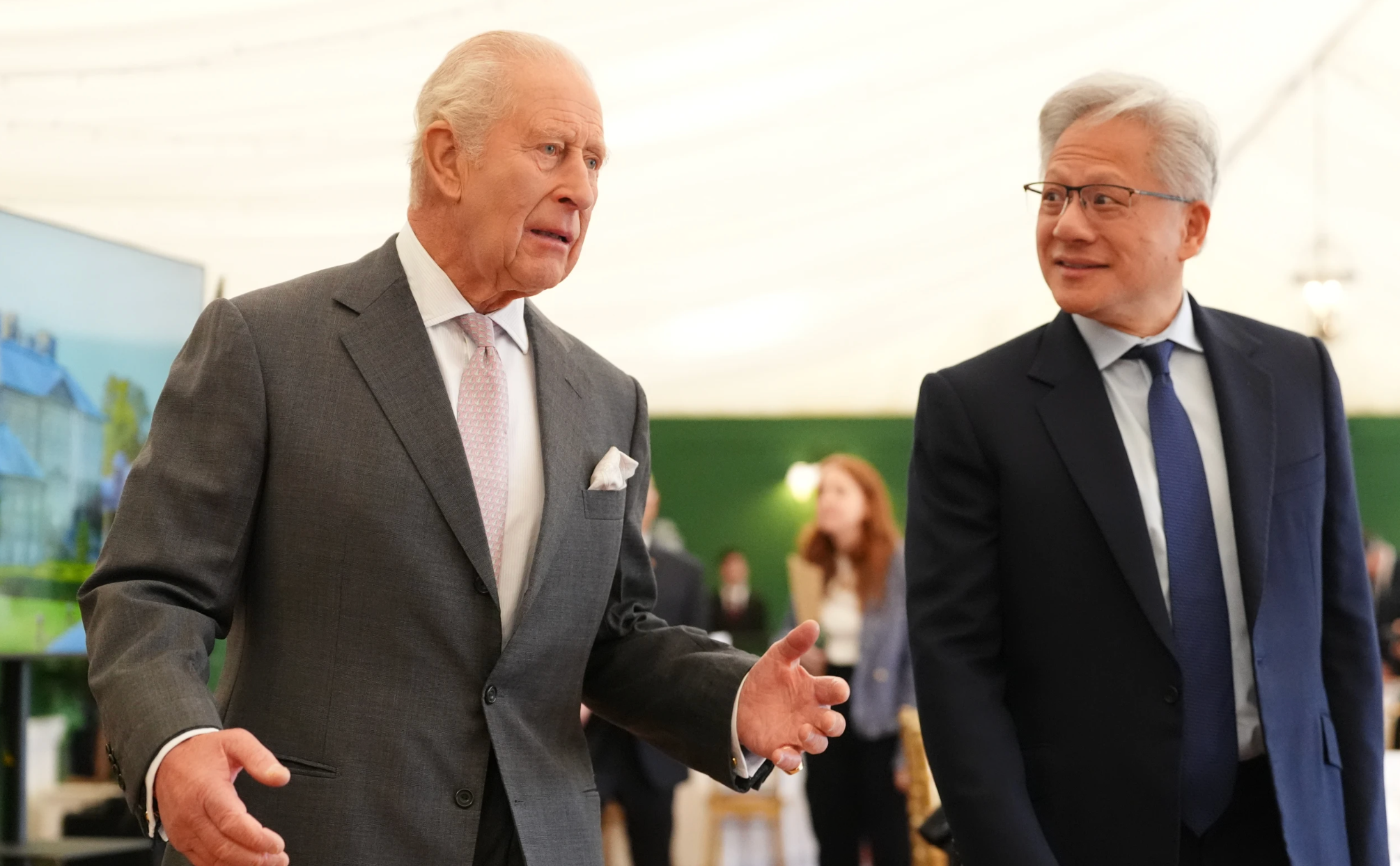
Britain’s King Charles III, left, walks with Nvidia chief executive Jensen Huang to a meeting for leaders from the artificial intelligence (AI) sector, government, and thought leaders to discuss how AI can be developed and deployed in ways that benefit society, at Dumfries House in Cumnock, Scotland, Thursday Sept. 17, 2026. (Jonathan Brady/PA via AP, Pool)
Contrary to the King’s urges, Jensen Huang insisted that the regulatory onus be on the developers. Talking to broadcasters at the summit, he stated that frontiers must be built with “responsible optimism” and they should “just hold it back” if they are not deemed fit for public use. It remains to be seen how developers could be held to such standards, whether it be codified private policy, or simply a spirit of development. Huang’s perspective highlights what may grow into a larger point of tension between the G20 and tech executives as Britain strives for an international agreement on standards, with responsibilities of governments and developers as of yet undefined.
The Dumfries summit became a further chapter in the developing series of international conferences addressing AI governance as frontier models’ capabilities loom increasingly clear and increasingly broad. King Charles built upon his message to the UK’s AI Safety Summit 2023, where more than 25 countries, including the US, China, and the EU, signed the “Bletchley Declaration”, an agreement that the states cooperate in “building a shared scientific and evidence-based understanding” of AI safety risks, and writing “risk-based policies” in response. Though Burnham’s commitments today are no more binding than Bletchley’s, they demonstrate the UK’s continued effort to reach common ground with more precise, time-bound intentions; namely, establishing one single set of principles next year in Manchester.
The high concentration of recent frontier developments in the US and China has prompted the international community’s sentiment that there should be an arbiter amidst fears of an arms race or a duopoly. Private AI investment in the US has exceeded $285 billion, more than twenty-three times that of second-placed China. That is where the United Kingdom sees its emerging niche. As the third-most privately invested-in AI incubator, and with the third most data centers, its material power may back up its desire to lead policy discussions.
Nothing enforceable has been agreed, so for this initiative to push Britain back into the diplomatic limelight, Burnham must follow up on his promise by chairing a rigorous G20 negotiation that defines governments’ responsibilities and produces genuine compromise from the US and China in particular. In the meanwhile many questions remain as to who carries the burden of regulation, and to whom, internationally, AI developers are accountable.