
The Fish Caught Between Brussels, Washington, and Moscow
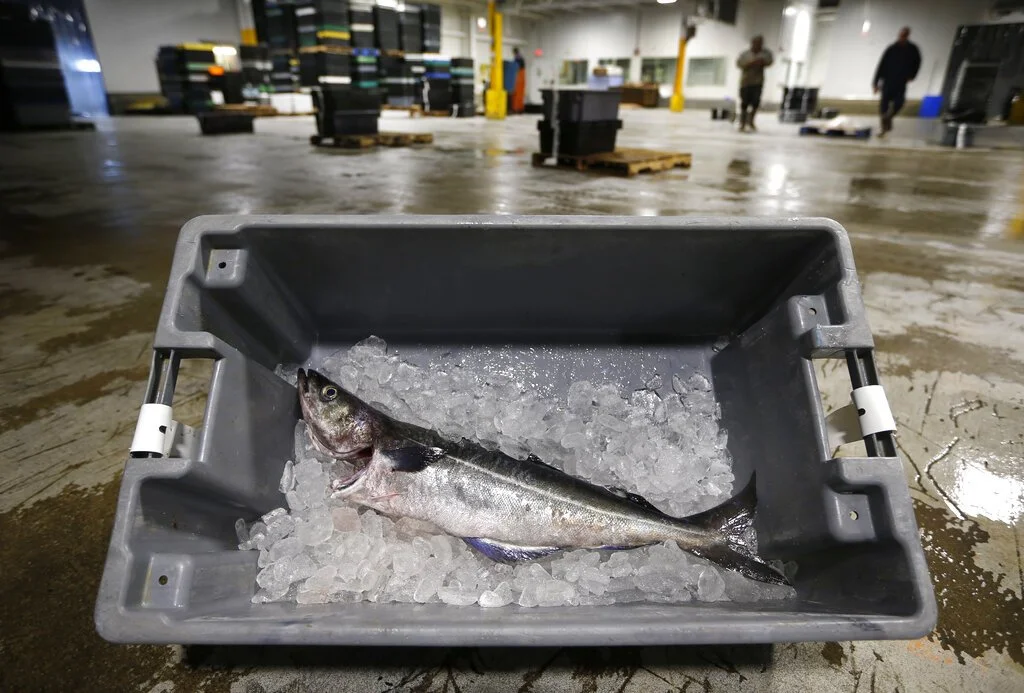
Europe relies heavily on imported Alaska pollock, with the United States and Russia dominating global supply. (AP Photo/Robert F. Bukaty)
Alaska pollock is the third most consumed fish in the European Union after tuna and salmon. Europe catches none of it. Almost all of the world's supply is caught by two countries: the United States and Russia.
This summer, thousands of tons of US seafood got caught in an unlikely place on its way to Europe: not in a fishing net, but in paperwork. Two shipments carrying nearly 16,000 metric tons of Alaska seafood, mainly pollock and flatfish, were delayed in the Netherlands over documentation problems. In Denmark, another 600 metric tons of US seafood were held under the same system, known as CATCH.
The EU launched its digital system CATCH in January to keep illegal, unreported and unregulated fishing out of the European market. In September, three Alaska seafood industry organizations published a white paper calling for reforms to CATCH. The groups say the problem is how Alaska seafood moves through the supply chain. Pollock caught by multiple vessels can be combined and processed into fillets, surimi, fish meal and oil. Tracking each finished product back through every transfer to the vessel that caught it can therefore require thousands of individual records.
That does not mean US fishing companies have to enter the data into CATCH themselves. Use of the platform is mandatory for EU importers but voluntary for exporters and authorities outside the EU. But if the exporter does not use CATCH directly, the required information must still be provided to the EU importer: A unique vessel identification number, the start date of the fishing trip, gear type, and location of the catch. Without it, the required certificate cannot be submitted.
The European Commission argues that CATCH makes import controls “more effective and harmonized across the EU.” But after American industry groups pushed for more time to comply, the EU extended the transition period for US wild-caught seafood until November 30.
The CATCH dispute comes as the EU is opening its market further to US pollock. Under the US-EU trade agreement approved this summer, the EU opened a zero-tariff quota for up to 340,000 metric tons of American Alaska pollock, rather than having it compete under the EU’s general pollock quota. CATCH, however, has created a separate regulatory obstacle for American exporters.

Blocks of Alaska pollock are processed into fish sticks. (AP Photo/Joerg Sarbach)
Russia, meanwhile, has been gaining ground in the European market. In the first six months of 2026, Russian exports of frozen Alaska pollock fillets to the EU rose to 66,000 metric tons, while US exports fell to 46,000 metric tons. Russia’s share of EU frozen Alaska pollock fillet imports consequently rose from 44 percent in the first half of 2025 to 51 percent in the first half of 2026, according to a Russian Fish Union analysis of Eurostat data reported by Interfax. Critics, among them ocean conservation advocacy group Oceana Europe, have argued that continued imports of Russian seafood are at odds with the EU’s support for Ukraine.
Russia’s growing market share predates CATCH. Price and supply help explain why. Europe’s fish-processing industry depends on large volumes of budget-friendly whitefish, and the US is the only country producing pollock at a comparable scale. But American exports typically command higher prices, while stronger domestic demand leaves less US pollock available for export.
For Europeans shopping for dinner, however, the competition may remain invisible. Whether the fish was caught by an American vessel or a Russian one, it still arrives under the same name: Alaska pollock.