
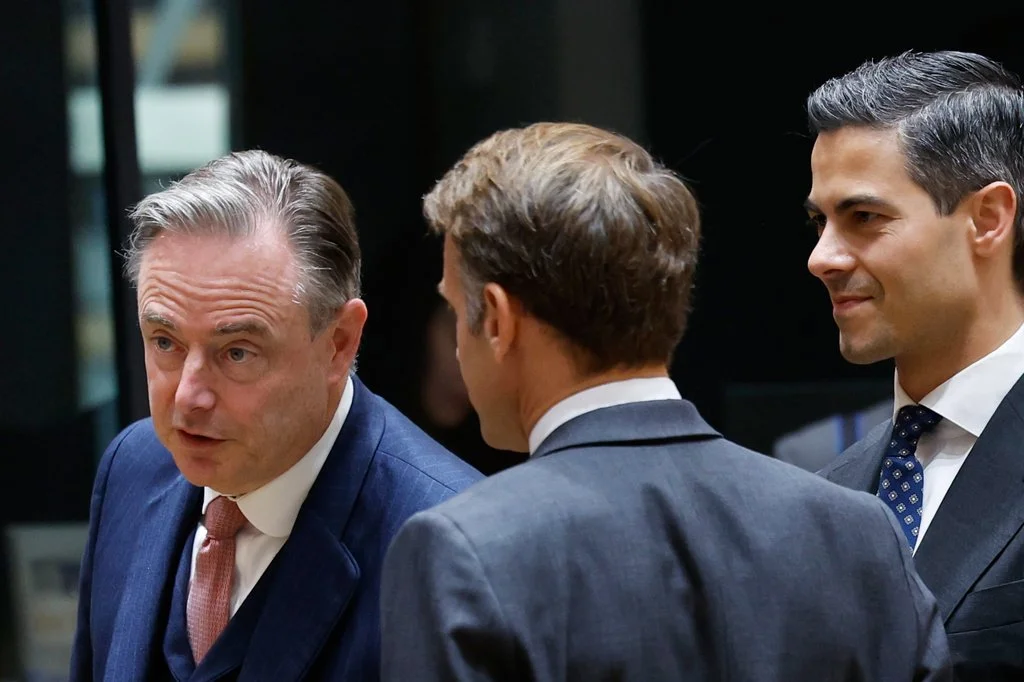
From left, Belgian Prime Minister Bart De Wever, French President Emmanuel Macron and Dutch Prime Minister Rob Jetten at an EU summit in Brussels on Oct. 15, 2026. Photo: Geert Vanden Wijngaert / AP Newsroom
Belgium’s King Philippe on Friday rejected Prime Minister Bart De Wever’s resignation and asked him to resume budget negotiations immediately. De Wever is expected to report back to the king on Nov. 16.
The decision came after a week of consultations. De Wever offered to resign on Nov. 2 after overnight budget negotiations collapsed. The king then spent the following days consulting with the leaders of all five coalition parties.
Before the consultations began, Christian Democratic and Flemish (CD&V) leader Sammy Mahdi said he was angry and warned of “Greek-style chaos” if no deal is reached. On Nov. 4, Vooruit leader Conner Rousseau told reporters that his party still wants a deal, but a fair one in which everyone does their part. Reformist Movement (MR) leader Georges-Louis Bouchez did not make any comments afterward. On Nov. 5, New Flemish Alliance (N-VA) chair Valerie Van Peel also left the palace without comments.
By the end of the week, according to the Royal Palace, all five leaders agreed that they still want to get the budget back on a more stable path over the next three years. The king received a formal commitment from each of them that their parties are willing to make concessions. He urged them to find a balance between keeping social cohesion and supporting economic growth.
Taxes remain the biggest point of disagreements inside the coalition. The Arizona coalition has spent months trying to find about €10 billion in savings by 2029. De Wever’s Flemish nationalist N-VA and the French-speaking liberal MR have pushed for spending cuts, while the Flemish socialist Vooruit, CD&V, and centrist Les Engagés want to raise €1 billion to €1.5 billion from taxing higher incomes.
Bouchez’s MR also opposes a proposed increase in value-added tax, a tax added to the price of most goods and services. MR Deputy Prime Minister David Clarinval said the package carried too much tax and blamed Vooruit for the collapse. Deputy Prime Minister Maxime Prévot of Les Engagés replied that a contribution from the wealthiest is legitimate.
The coalition has been here before. In November 2025, De Wever also went to the king and received 50 extra days to reach a deal. The parties later agreed on €9.2 billion in savings.
This time, the delay has already cost the government. On Nov. 5, De Wever told parliament that Belgium will run on “provisional twelfths” for the second year in a row. Under that system, the government can spend only one-twelfth of the previous year’s budget each month. Less than a month earlier, De Wever had said this was not an option. He called the result a major failure for his government.
He said he only wants to lead a government that makes the budget its priority. He also warned that interest payments on Belgium’s public debt could climb from about €16 billion this year to €50 billion by 2035 if conditions do not improve.
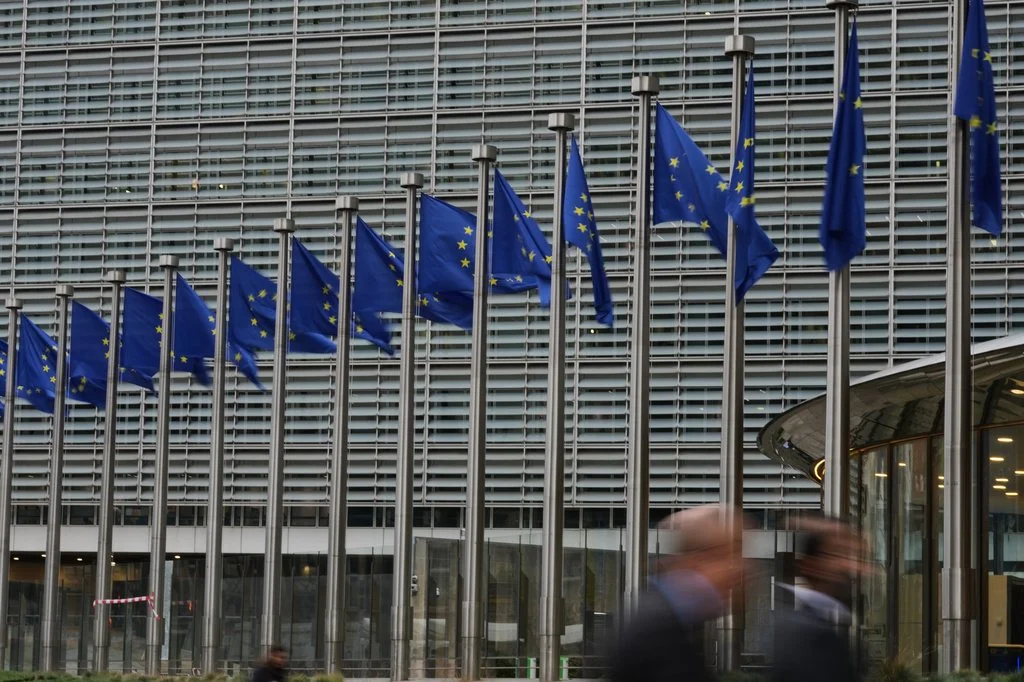
People walk past European Union flags outside EU headquarters in Brussels on Nov. 4, 2026. Photo: Virginia Mayo / AP Newsroom
Belgium’s public finances explain the pressure. According to the National Bank of Belgium, the deficit reached 5.2 percent of GDP in 2025, well above the EU’s 3 percent limit. Belgium has also been under the EU’s excessive deficit procedure since July 2024 and must bring its deficit back below that limit by 2029.
The European Commission forecast in May that Belgian debt would reach 110.5 percent of gross domestic product (GDP) this year. In the eurozone, only Greece, Italy and France carry heavier debt loads. Late on Nov. 5, Belgium’s 10-year bonds yielded 4.25 percent, up from 3.48 percent four months earlier. Germany paid 3.24 percent.
Belgium is not alone. Government debt across the eurozone rose to 88.8 percent of GDP in the second quarter of this year, according to Eurostat. Bond investors have pushed up yields on debt from Belgium, France, and other European countries seen as having weak public finances.
The pressure has redrawn Europe’s debt map. In mid-October, Belgium borrowed at almost the same rate as Greece, which was bailed out three times. Greece has since cut its debt sharply and ran a budget surplus in 2025.
France is the sharpest example. Once part of the eurozone’s low-risk core, it was paying more than Italy to borrow by mid-October. Its 10-year bonds yielded 4.79 percent on Nov. 5. On Nov. 2, the gap between French and German 10-year yields stood near 1.6 percentage points, close to its widest since the European debt crisis.
France’s budget is also stuck. On Nov. 4, the National Assembly rejected the revenue section of the 2027 budget, with 458 votes against and none in favor. The Senate will now examine the government’s original proposals. The plan aims to cut the deficit to 5 percent of GDP in 2027. Public Accounts Minister David Amiel warned that the amendments would have pushed it to 5.9 percent.
The fight has also reached the streets. Demonstrators have clashed with police in France, Spain, Italy, and Belgium in recent weeks. On Nov. 5, hundreds of thousands of protesters marched across France in a nationwide strike against the budget. The Interior Ministry counted about 575,000 people, while the General Confederation of Labor (CGT) union claimed more than 1.6 million. Belgium faces growing student protests and frequent strikes, including several “national action days” led by unions.
De Wever now has ten days to bring his coalition back to a deal before he returns to the palace.