
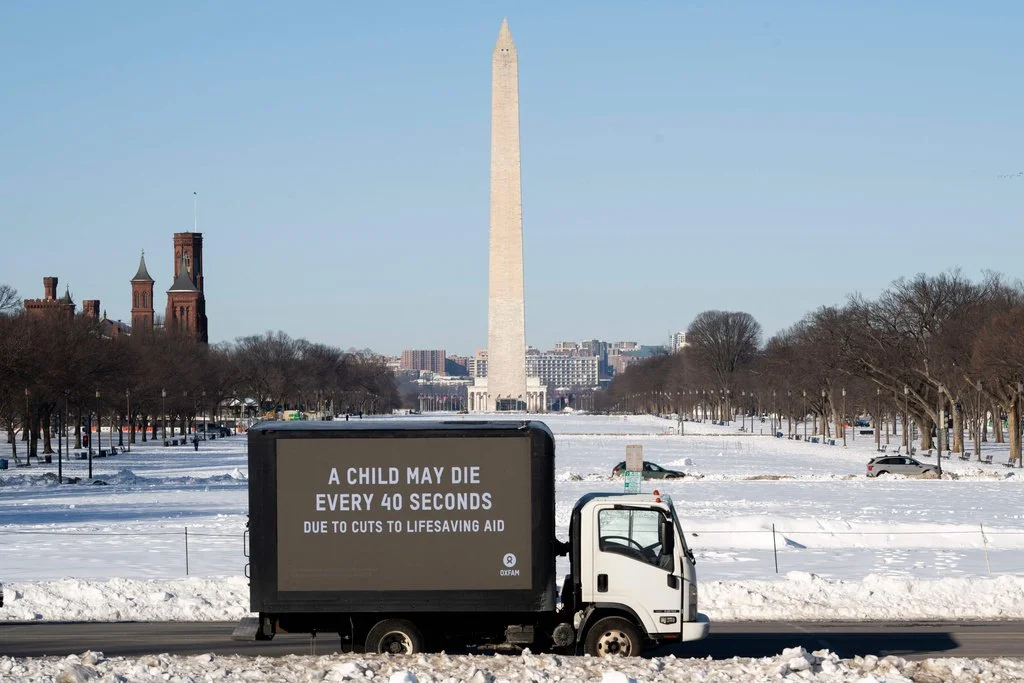
An Oxfam mobile billboard parks along the National Mall near the one year anniversary of President Trump dismantling USAID, which took away lifesaving US humanitarian aid from millions of people across the globe, Monday, Feb. 2, 2026 in Washington. (Kevin Wolf/AP Content Services for Oxfam America)
Since the beginning of Donald Trump’s second presidential term, his time in office has been marked with staggering cuts to government expenditure. Particularly in the field of foreign aid, he deemed it to be counterproductive, and thus decreed on Jan. 20, 2025 to pause all foreign aid programs for a 90-day review period. By March 10, about 83% of these programs were canceled.
While the impact has been felt on a global scale, it has hit Sub-Saharan Africa the hardest. Between 2001 and 2014, the United States Agency for International Development (USAID) provided $131.6bn in foreign aid. This aid was mainly used to support disempowered peoples, who may have been displaced or affected by conflict, natural disasters, or health epidemics. What’s important to note is that the other sectors which received the most funding were education, maternal and child health, family planning and reproductive health, and social services.
While the US has been the major provider of aid to Sub-Saharan African states, European states have also played an important role in the region. The European Union (EU) has lent aid to African states under the precursor of humanitarian aid, similar to that of the US. This entails that they provide short-term conflict relief, food, shelter, and healthcare under accordance with international law. In the wake of US budget cuts, EU member states have followed similar policies. France has cut its official development assistance (ODA) budget by 46% between 2024 and 2026, Germany’s 2026 budget halved its portion of humanitarian assistance, and the United Kingdom (UK) announced cuts to foreign aid to be realized by 2027 that mark its lowest figure ever.
Not all Africans perceive the withdrawal of aid to be a loss. While many understand the negative impacts and the short-run hardships, 25% of young Africans believe that the cuts to foreign aid could have positive effects as well, according to a survey conducted on African youth in 16 countries. The younger generations have expressed grievances as they have become politically aware; they have not seen much change on the ground despite huge numbers of foreign aid coming in for development purposes. Thus, the cuts to foreign aid have allowed these Africans to hold their leaders accountable.
This positive portrayal of USAID’s demise is also backed by its critics, who have long believed the organization to be an arm of US imperialism. According to this school of thought, aid organizations inherited the civilizing mission used by colonial empires, particularly in Africa. This also suggests that the organization only provides assistance in areas where its interests may be compromised or where it can profit off of conflict. Cameroonian economist Célestin Monga has also claimed that the International Monetary Fund is inherently a political institution, with its policies allowing Western countries to have cheaper access to resources while keeping African states addicted to the aid it receives, thus maintaining a cycle of poverty.
Many young Africans have also idolized the actions of modern leaders, particularly Ibrahim Traoré, the military leader of Burkina Faso. His portrayal as an anti-imperialist, pan-Africanist leader has reignited a political flare that many Africans thought was gone. His popularity stems from his decision to break ties with France, the former colonial power, as he claimed neo-colonial ambitions made the relationship impossible.
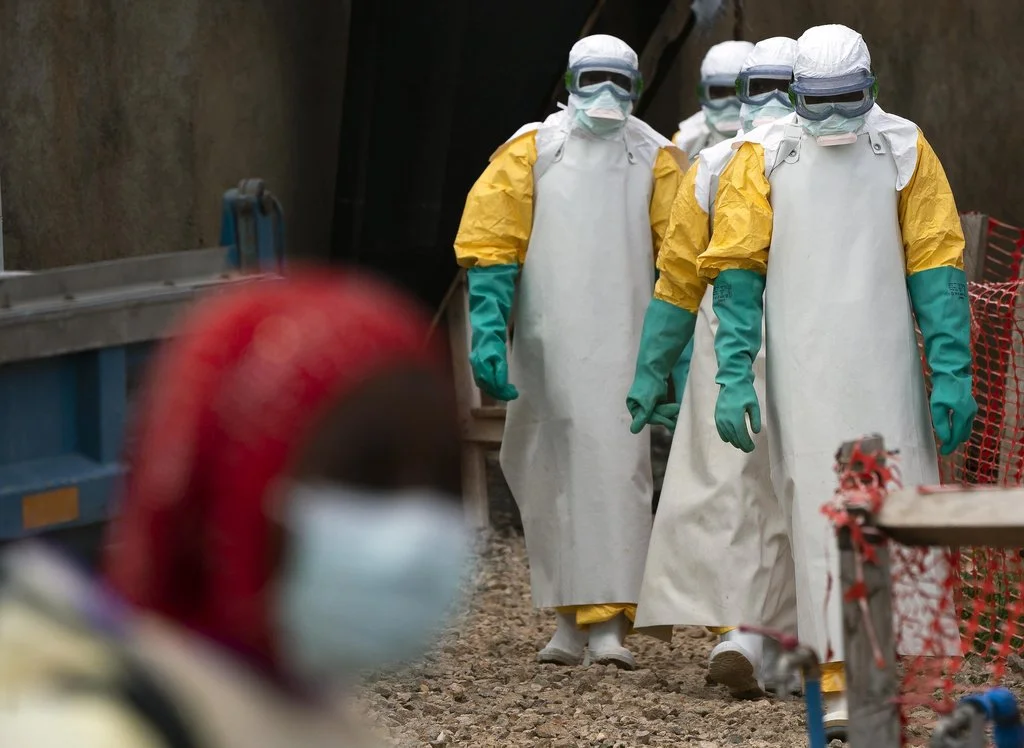
Health workers dressed in protective gear begin their shift at an Ebola treatment center in Beni, Congo DRC, Tuesday, July 16, 2019. (AP Photo/Jerome Delay, File)
What are African states doing now? Nigeria had already launched the Health Sector Renewal Initiative in 2023, which aimed to coordinate healthcare at a nation-wide level, including any third-party efforts. An emphasis has also been placed on what African states can do to help one another on a continent-wide scale. This has already existed, the Africa Centres for Disease Control and Prevention (Africa CDC) has been established since 2017, but it is still fragile and inconsistent. An Ebola outbreak in the Democratic Republic of the Congo (DRC) is still not under control after being declared in May 2026, with more than 10,000 confirmed cases and 5,000 dead, and the disease spreading across neighboring countries. The director-general of the Africa CDC has labeled the outbreak a collective failure, as the DRC government alongside donor states have been unable to coordinate the realization of aid.
Ghana has emerged as a leader of the new health movement in Africa. Ghanaian President John Mahama established the Accra Reset, a global health initiative to empower developing states to take health initiatives into their own hands. This organization produced the Sovereign Future for Health report, which highlighted the strain placed on Africa’s healthcare systems since the departure of USAID from the continent. Nigeria has paid $200M to integrate USAID workers into the public health sector, 1.4M people were undergoing treatment for HIV/AIDS in South Africa from US aid organizations before the aid was pulled back, and Ghana lost $78M without US financial assistance which led to the closure of maternal health clinics. While progress has been made, and research helps to identify areas of weakness, there is still a long way to go before self-dependency can be truly achieved.
Other foreign states have started to fill the gap left behind by USAID. China helped to finance the headquarters of the Africa CDC, and continued other infrastructural projects based on its Belt and Road Initiative, with Chinese aid to Africa reaching a peak of $3.46bn in 2024. The Gulf States of Qatar, Saudi Arabia, and the United Arab Emirates (UAE) have also attempted to fill the vacuum, with the hopes of creating spheres of influence that allow for cheap access to resources. Qatar has provided investments in energy and infrastructure, as well as portraying itself as a mediator of conflicts, which saw the DRC and the rebel group M23 sign a peace framework in Doha. Saudi Arabia has instead focused more heavily on the Sahel and East African states under its Vision 2030 program, which aims to diversify and stabilize the Saudi economy in an effort to move away from oil. Investment projects, particularly in agriculture and energy, have seen mixed results as a Saudi investment project in Ethiopia displaced farmers, who subsequently clashed with security forces, as well as protests against foreign land deals in Sudan, where land was to be sold to Saudi Arabia. The UAE too has seen its fair share of criticism. Similar to Saudi Arabia, the basis of Emirati humanitarian aid is the need to diversify away from oil, and it has also focused extensively on East Africa. While presenting itself as a humanitarian donor in Sudan, it has financed and exacerbated a conflict that has been considered a genocide, drawing heavy international backlash.
So has Africa become fully independent and self-sufficient? Not quite, the story is much more complicated than ‘Africa with or without the presence of USAID.’ Africa’s resource abundance makes it a hard target to pass by, and so many foreign states want a piece. Despite this, Africa is entering a unique era. It has the possibility to determine in what form this foreign aid will take. Undoubtedly many African states have acknowledged the need to reform their domestic healthcare systems, given the case of Nigeria, as well as reforming the Africa CDC. This also stems from the sudden accountability African leaders must take for development policies now; USAID will no longer take the backlash from failure. The short-term will be harsh, as evident in the DRC’s Ebola outbreak, but the future can be decided by the policies taken by African states today.