
Singapore to Cane Scammers as Crime Syndicates Proliferate in Southeast Asia

Singaporean Prime Minister Lawrence Wong at 28th ASEAN Plus Three Summit in Kuala Lumpur, Malaysia, Monday, Oct. 27, 2025. Photo: AP News
The island nation of Singapore has passed a new policy of mandatory caning for online scammers. Those targeted include syndicate members, recruiters, and their accomplices with the minimum sentence being 6 strokes of the rattan cane. The move comes as countries around the world, such as the US, China, South Korea, and Kenya grapple with a brutal and lucrative industry that generates an estimated $64 billion annually.
Government minister Sim Ann argued that these harsher punishments are necessary to curb “the most prevalent crime type”, accounting for 60% of crimes committed and costing Singaporeans S$3.7 billion ($2.8 billion), between 2020 and 2025. Caning is by no means an unusual punishment. Channel NewsAsia tallied 96 crimes that carry discretionary caning and 65 that mandate it. The city-state’s insistence on this punishment even led to a diplomatic incident with then-President Bill Clinton over the caning of American teenager Michael Fay.
The allure of utilizing corporal punishment on scammers reflects a deeper frustration and anger towards crime syndicates that cluster in Southeast Asian countries like Myanmar, Cambodia, and Laos. The exploitation runs across both ends of the business model, starting with complex job advertisement schemes that lure unsuspecting workers seeking well-paying jobs. Sometimes victims even go through multiple rounds of sham interviews before being flown out to cities like Bangkok and driven over the border to Myanmar or Cambodia, until they come face to face with armed guards.
Inside, there are widespread accounts of abuse, torture, modern-day slavery, as well as physical and sexual violence. Amnesty International spent 18 months in 50 of these compounds across Cambodia, detailing the slavery and torture caused to victims of these trafficking rings. One survivor recounted how compound bosses physically abused a Vietnamese man for 25 minutes, “They just keep beating [the Vietnamese person] until their body was…purple…then [using] the electric baton. Beat the Vietnamese until he can’t scream, can’t get up…then the boss tell me that they wait until another compound want to buy him.” Another victim recounts sleeping in a cell with 7 other people, working 17 hours a day, and witnessing the deaths of three people—one by suicide, the other two were pushed off a building.
The product these victims are forced to sell are known as pig butchering scams. Scammers first build close relationships with victims, typically in richer Global North countries, and once trust has been established, they start encouraging their victims to pay them or invest in phony cryptocurrency schemes. There are variations of these like romance scams and investment fraud but the intended result is still the same:to slaughter the pigs they have been fattening, hence the name. Globally, it has been estimated that $75 billion have been lost to pig butchering scams from 2020 to 2024.
Experts have claimed that the key to understanding how these criminal organizations spread lies not just in their sophisticated operations, but how they have managed to slot into systems of patronage and corruption. Criminal organizations have learned to ally themselves with police officers, tycoons, and government officials to shield them from scrutiny. Cambodia expert Sebastian Strangio has written extensively on how corruption is built on the principle of reciprocal benefit, with everyone gaining from the flow of money and power. Considering the fact that cybercrime is now worth 60% of the country’s GDP, it is hard to see how there can be much movement on this front.
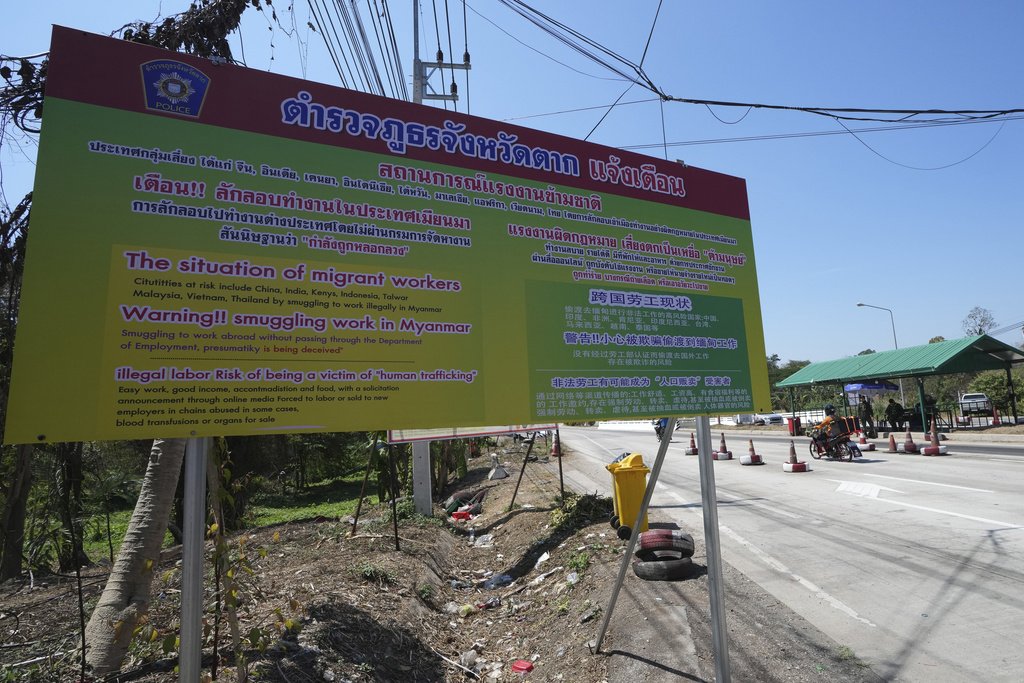
Sign near military checkpoint warns in Thai, English and Chinese of the danger of being trafficked into scam compounds in Mae Sot, Thailand, Wednesday, Feb. 26, 2025. Photo: AP News
In recent years, the majority of these scam compounds have shifted to Myanmar and particularly in the border regions near Thailand. The additional component of regional instability caused by civil war and decades of prior conflicts has left an environment for criminal gangs to thrive. Both rebel-aligned armies and the military junta have relied on taxes from gangs to fund their ongoing war. In 2023, the UN estimated that at least 120,000 people were trafficked into Myanmar and another 100,000 in Cambodia.
Despite piecemeal responses from countries around the world, scam operations are only expanding. The Guardian has shown that since 2021, the number of scam compounds along the Myanmar-Thai border has more than doubled. The infamous KK Park compound has expanded significantly and although the junta has claimed control of the park and announced it has stopped the compound’s operations, the BBC reports that scams are still being run from the park.
Singapore’s move towards harsher punishment for the kingpins has inspired calls in Taiwan to follow suit. However, not everyone is convinced. Human Rights Watch has condemned the practice of judicial caning as “inherently cruel” while questions remain on the efficacy of such a law when most cybercrimes are committed outside the country.
Tags: Singapore | Cybercrime | Myanmar | Cambodia | Trafficking | Southeast Asia | Human Rights