
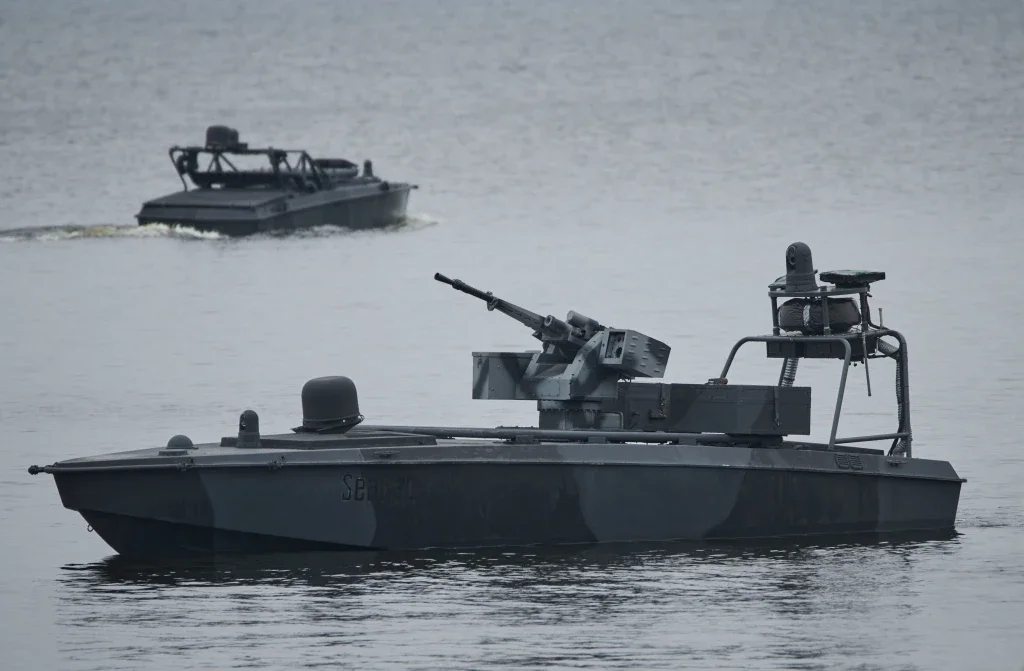
Sea Baby drones ride on the water during a demonstration by Ukraine’s Security Service in an undisclosed location in Ukraine, Oct. 17, 2025. (AP Photo/Efrem Lukatsky, File)
In a global economy built around tightly coordinated supply chains, disruption does not always begin with territorial control; it can begin with the infrastructure that keeps energy moving. Recent drone strikes on oil tankers in the Black Sea show how attacks on energy systems trigger cascading effects and introduce risks ranging from immediate environmental damage to broader instability across global energy markets. The affected corridor is not marginal, as Black Sea terminals handle more than 2% of global crude oil. Even localized disruptions can ripple across international energy systems, from potential spills to the inefficient rerouting of fossil fuels through strained systems. These disruptions reshape energy flows beyond the battlefield.
This disruption is part of a broader pattern where armed conflict produces widespread ecological damage. In Ukraine, the war drove large-scale environmental destruction, ranging from landscape fires to farmland contamination. The conflict effectively turned the country into a high-emission zone, as military operations increased emissions through fuel-intensive logistics, explosive detonations, and burning landscapes. Estimates suggest that 36% of war-related greenhouse gas emissions originate from military activities. Total war-related emissions reached nearly 230 million tons of carbon dioxide equivalent, surpassing the annual output of entire countries.
Despite these well-documented impacts, emissions generated by military activity remain largely excluded from global climate accounting frameworks. Experts describe this omission as a “military emissions gap,” where reporting systems exclude data that shapes international climate policy. Current systems either omit or inconsistently track military emissions, creating a significant gap in the data used to inform climate governance. Experts estimate that militaries account for 5.5% of global emissions, yet no country must formally report this data. This results in a structural blind spot, where one of the most resource-intensive sectors operates with limited transparency and minimal accountability.
International institutions increasingly acknowledge the environmental consequences of conflict, documenting how warfare damages ecosystems, infrastructure, and public health systems. The United Nations emphasizes that conflict degrades natural resources and contributes to long-term instability, however, formal climate governance structures only weakly integrate these impacts. No binding universal treaty comprehensively governs conflict-related environmental harm, leaving significant gaps in accountability and enforcement. This absence is not purely technical, as it reflects how states negotiate environmental protections within global frameworks, treating certain harms as exceptions rather than central components of climate accountability.
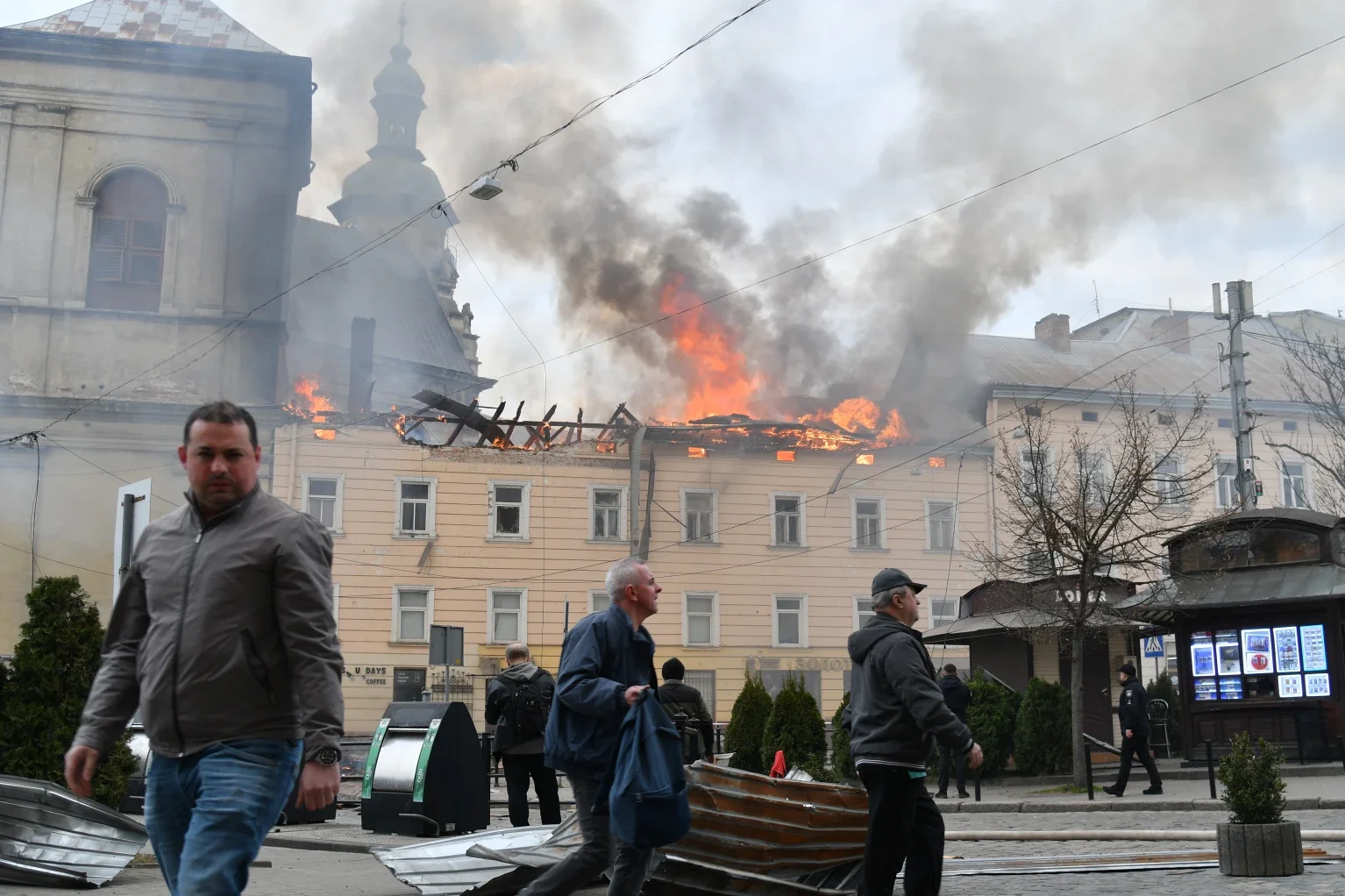
Fire and smoke rises above the city center following Russia’s drone attack in Lviv, Ukraine, Tuesday, March 24, 2026. (AP Photo/Mykola Tys)
During the development of the Kyoto Protocol, states pushed for exemptions to shield military activity from emissions constraints. They argued that such limits could compromise national security and operational readiness. These negotiations created provisions that allowed states to exclude or report military emissions separately. Far from being marginal, negotiations treated these exemptions as priorities, reflecting how security concerns can override environmental accountability in global governance systems.
This raises a deeper question about how environmental knowledge is produced. Climate policy relies on data to define responsibility, yet not all emissions are visible within these systems. Existing emissions inventories often fail to distinctly categorize military activity, making isolating key emission sources within global datasets difficult. When military emissions are difficult to measure, their absence creates the appearance that they are marginal. In reality, this absence reflects a form of “constructed invisibility,” where what is not counted becomes easier to ignore. Rather than a neutral gap, the lack of data reveals how institutional priorities selectively produce knowledge. These priorities determine what the world considers measurable, relevant, and actionable.
The consequences of this exclusion extend beyond measurement. When military emissions are undercounted, global climate targets rely on incomplete data. This weakens mitigation strategies and distorts accountability across states. These effects are not evenly distributed, and conflict-affected regions experience the most acute environmental consequences, ranging from ecosystem destruction to resource contamination. Meanwhile, these emissions remain largely unaccounted for in global systems. As a result, climate governance risks reinforcing inequalities.
Addressing climate change requires more than technological innovation, requiring confronting the political boundaries that define what is counted in the first place. As long as military emissions remain partially excluded from climate accounting, global efforts to mitigate harm will remain incomplete. What remains uncounted is not just data, but responsibility.