
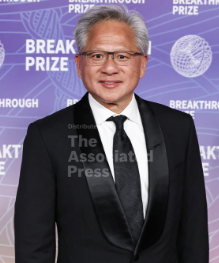
CEO of NVIDIA Jensen Huang arrives at the 12th Annual Breakthrough Prize Ceremony 2026 held at the Barker Hangar on April 18, 2026 in Santa Monica, Los Angeles, California, United States. (Photo by Xavier Collin/Image Press Agency/Sipa USA)(Sipa via AP Images)
In NVDA’s previous fiscal quarter, sales of licensed Hopper data center products to China amounted to $2.4 billion. However, this quarter has seen zero revenue from these sales in Nvidia’s forecast. Colette Kress, who was serving as interim CEO at the time, stated during the November 17 earnings call that shipments have paused, but did not give any indication of a resumption date.
In the most recent quarter,Nvidia’s total global revenue was $115.8 billion, meaning that these licensed Hopper sales to China accounted for approximately 2% of NVDA’s global revenue. However, investors may be more interested in what happens from the other side of the deal. Although Nvidia has fought hard to gain the right to sell its high-end chips to Chinese customers, it could still be that despite gaining it back, many of those companies have decided to go elsewhere.
The shipment halt also comes at a time when NVDA is facing questions about its internal oversight and national security responsibilities. The company recently announced the creation of a National Security and Export Control Oversight Committee, which will oversee matters relating to export restrictions and national security. Reports concerning Alice Huang have also raised questions about the company’s internal operations. However, NVDA has not confirmed whether any of these developments contributed to the decision to stop shipments.On Nov. 23, Nvidia reinstated Jensen Huang as CEO following a unanimous decision by its board of directors. However, the company confirmed that its internal investigation would continue. Although Huang's return may provide some reassurance to Chinese customers, it does not necessarily mean that shipments will resume.
In January of this year, the Commerce Department announced that individual applications for exporting NVIDIA H200 chips to China would be subject to review. To obtain these chips, buyers must meet security conditions, and chips must be independently tested in the United States. Despite this, by November several major internet companies in China had received batches of approximately 10,000 H200 chips. If these chips perform well, and the company decides to order a further 10,000 chips, the purchasing managers may be unsure as to what date these can be expected to arrive.
Responsibility for causing this standstill is uncertain. Although NVDA confirmed that shipments had stopped, the company did not provide a reason or indicate when deliveries might resume. Even with Huang returning as CEO, Chinese companies still face uncertainty over when shipments will resume. Companies that are looking to expand their operations may not be willing to wait indefinitely for Nvidia.
The USA had previously approved certain sales, while it was also reported that Beijing had withheld approval for large-scale H200 imports.

The Nvidia logo is displayed on a phone in the commune of Veranne, France, on November 12, 2026. (Photo by Romain Doucelin/NurPhoto via AP)
Chinese customers are aware of the speed at which economics can change for chips. In April 2025, the U.S. informed Nvidia that it would need a license to sell H20 chips to China. Within a month of this, Nvidia had made a $4.5 billion write-off for overstocked chips and firm orders. Although H20 is a different product to H200, it does give an idea of the potential impact on a company if the rules change. When presenting to a board of directors, one of the first points a director may ask in relation to committing millions to buying more of Nvidia’s chips would be how much money could be lost if the rules in the middle of scaling changed.
Beijing, meanwhile, has strong incentives to support domestic chip suppliers. In November 2025, Reuters reported that new data centre projects in China using state funding are required to use locally made AI chips. Some projects in development have even been asked to remove foreign chips (Reuters). The Congressional Research Service outlines how China has used state funding to improve its semiconductor manufacturing. Therefore, by getting state-funded orders, domestic chip manufacturers gain an extremely valuable advantage. Not only do they have a first customer to trial their product at scale, but they can also work out any issues with it before having to win business from a private customer.
This gives good weight to considering early orders as significant. It is known that training the DeepSeek V3 model required approximately 2.8 million hours of computing on H800 Nvidia processors (DeepSeek). The cluster contained 2,048 H800s (Stanford). Other than the immediate benefits, this would mean that a large team of people has become experienced in getting models running on Nvidia hardware. They have even created a detailed resource for others to learn from. If a Chinese competitor gains any portion of future projects, they can begin developing similar knowledge based around their own chips.
However, wanting to support local alternatives in China and being able to do so are separate. On the 19th November, Reuters reported that Taiwan Semiconductor Manufacturing Company was limiting some orders from Chinese chip designers. Even if a company designs a promising chip, it may still be difficult to find a manufacturer willing and able to produce it in the correct volumes. This adds weight to why the $2.4 billion disclosed by Nvidia is notable. While Beijing was encouraging domestic alternatives, Chinese companies were still willing to spend large amounts of money on Nvidia products. Therefore, Nvidia has significant incentive to protect its market in China. It would be unwise to assume that customers have no alternatives.
However, there is strong reasoning for limiting these sales. The computing power purchased to create commercial AI models can be applied to military uses. As outlined in an analysis by the Congressional Research Service, this has caused concern in U.S. policymakers for many years. Given the impressive results DeepSeek can achieve with previous-generation Nvidia hardware, decisions regarding newer chips should be taken seriously. However, when compared to credible evidence that a customer intends to use American technology in a way that is a threat to U.S. security, Nvidia’s desire to make a sale should be considered much less significant. A more difficult decision is made regarding customers who have previously been investigated and approved by American officials.
Clearer guidance should be given to these customers regarding what they can plan for. In January, the Commerce Department outlined conditions for initial sales to occur. Customers must be vetted, and chips must be independently tested. Exporters must also prove that exporting to China will leave enough capacity to service U.S. customers (Commerce Department). To continue this guidance, it would be sensible to outline in public what changes would lead to re-evaluation, and how well-behaved customers should approach repeat orders. While the ability to quickly revoke licenses should remain in place, companies should be given enough information to determine whether it would be viable to build a second site with the same equipment.
More clarity should also be provided by Nvidia. The quarterly statement provides insight into how fast the data center market is growing. The earnings call provides insight into how much revenue came from China in licensed Hoppers. Next time a statement is released, it would be useful to know whether customers in China are ordering, whether any orders are on backorder, and what would be needed for shipments to resume. Depending on a company having a backlog of willing customers, or customers beginning to shift future orders to a competitor, it could be reasonable for an investor to value these businesses very differently. Both situations could result in $0 revenue being forecasted in the quarter.
In particular, investors should be paying attention to companies that have already ordered 10,000 H200 chips. These companies have invested money in Nvidia, have technical staff familiar with the equipment, and have an incentive to return. In addition, these companies operate in a country that is willing to apply state funding to help give competing products a foothold. Following Nvidia’s latest disclosure, this company must make a decision. It can choose to wait, delay scaling, or allow another chip manufacturer to receive a portion of its order. The last option would be most concerning for Nvidia. While Huang’s return may help NVDA maintain its relationships with Chinese customers, these companies still need to be able to plan their future investments.
If a customer becomes experienced in managing a portion of their business without Nvidia, even with a new license, it may be that they never commit the full order to Nvidia.