
House Armed Services Committee Chairman Rep. Mac Thornberry, R-Texas, accompanied by Republican members of the House, speaks at a news conference on Capitol Hill in Washington, Thursday, May 19, 2016, on the passage of the National Defense Authorization Act (NDAA). (AP Photo/Andrew Harnik)
This November’s midterm elections brought a blue wave that signaled renewed opposition to President Trump. When Democrats take control of both chambers of Congress in January, one test of their relationship with the White House will be whether they can agree on a defense budget.
For Wesley McGovern, a junior studying international relations at NYU, the stakes of a budget standoff extend well beyond Capitol Hill. In an interview with IR Insider, McGovern drew on his time on the Hill to explain how partisan gridlock can leave the Pentagon operating under continuing resolutions, delaying the purchase of equipment it may need for the next crisis.
Drawing on his background as a Berkley Institute Fellow, where he studies Civil Discourse and Civic Solutions, McGovern agreed that polarization is a much more serious risk than Americans may realize. “Political polarization is certainly a national security issue,” McGovern said. He pointed to this summer’s fight over the National Defense Authorization Act (NDAA) and its fallout this fall as an example of how partisan divisions can complicate defense policymaking. When those divisions stall funding negotiations, he argued, continuing resolutions (CRs) can delay procurement and limit the Pentagon’s ability to respond to emerging threats.

Chief of Staff of the Air Force Gen. Kenneth Wilsbach testifies during a Senate Appropriations Committee subcommittee hearing on the President's Fiscal Year 2027 Budget Request for the Department of the Air Force on Capitol Hill, Tuesday, June 9, 2026, in Washington. (AP Photo/Mariam Zuhaib)
The NDAA sets defense policy and authorizes programs; Congress then supplies money through separate legislation. On July 22, the House passed its $1.15 trillion version on a razor-thin 4-vote margin. 216-212. Only six Democrats supported it, and seven Republicans opposed it. Unlike previous votes, such as the Foreign Intelligence Surveillance Act (FISA) vote, this one split the House largely along party lines. Reflecting on his time on the Hill this summer, McGovern pointed out that Section 219 of the NDAA was one point of bipartisan opposition. Wesley pointed out that, ironically, in a field where legal doctrine carries such high stakes and should be written as clearly as possible, the “jury is still out on figuring out what exactly Section 219 means.” For critics, the provision would further entangle the U.S.-Israel defense technology cooperation in areas including missile defense, artificial intelligence, and cybersecurity. This contention was bipartisan, with Rep. Thomas Massie (R-Ky.) and Rep. Ro Khanna (D-Calif.) among the lawmakers who proposed striking the entire section. Critics like Massie argued that Section 219’s entanglement “of technical and infrastructural coupling can constrain future policy choices and make disentanglement from Israeli security priorities politically and technically difficult, regardless of what the statute says about sovereignty on paper.” In contrast, proponents of Section 219 argue that it formalizes and streamlines long-standing cooperative defense programs, speeds innovation, and gives U.S. forces access to proven defense technologies without creating a joint military command.
The dissonance over Section 219 can indicate the serious harm partisan politics might do to US national security as a whole in the future. McGovern worries that some in Congress will treat cuts to the Pentagon budget as a way to express frustration with Israel policy, even though the two are largely separate. “Cooperation with Israel isn’t charity; it makes our military better,” he said, pointing to jointly developed systems like Arrow 3 and Iron Dome, which the U.S. Army has bought for its own use. Most U.S. aid to Israel runs through the State Department’s budget, so cutting defense spending would weaken U.S. readiness without meaningfully changing Israeli policy."
According to the American Enterprise Institute, American military bases abroad are already falling apart. As reported by Mackenzie Eaglen, a senior fellow at the American Enterprise Institute (AEI), the U.S. currently has a “facility backlog of $200 billion dollars and our maintenance accounts are funded at only 75% of what they need.” From a budgeting perspective, procurement gets put on the chopping block because funds need to be allocated to personnel costs themselves. This results in outdated budgets for the military, which leads to contract delays. Air Force officials told the Government Accountability Office that CR restrictions delayed a contract for hardware kits used to upgrade the F-15’s electronic warfare system. Across the Government Accountability Office’s (GAO’s) sample, 36 of 74 acquisition programs reported schedule effects from CRs.
McGovern emphasized that “people really don’t realize the urgency here.”
When Congress hasn’t agreed on full-year funding, it can pass a continuing resolution (CR) as a stopgap, a temporary measure that keeps federal agencies running while lawmakers finish negotiating the budget. A short-term CR generally keeps existing programs funded at the previous year’s rate until a new deadline. In practical terms, imagine a Navy program that bought 10 aircraft last year and wants to increase production to 15 this year. Under a CR, the Navy can generally keep buying aircraft at the old rate while negotiations over the annual spending bill continue. To increase that rate, however, the Navy usually has to wait for Congress to pass the spending bill or write an exception into the CR. This is how a budget delay can affect what the military can buy even while the government stays open.
Starting around fiscal year 2011, FY2019 was the only year the Department of Defense (DoD) received its full-year regular appropriations bill on time before the October 1 start of the fiscal year. According to the Department of Defense, the Pentagon has spent 14 of the last 15 years operating under a CR. In total, it adds up to 1,793 days spent on temporary funding. Nearly five years total.
For the war in Iran, this becomes a serious issue. The core issue with CRs is that they generally freeze funding at last year’s level. That means that even as wartime demand increases, the Pentagon can remain tied to purchasing levels set before the war began. By August 2026, the U.S. military had reportedly used roughly 1,700 Patriot interceptors and 200 THAAD interceptors. As Wes argues, a CR can delay orders to replenish those stocks. Without a firm commitment from the government to buy more interceptors, defense contractors have little incentive to increase production to match wartime demand.

The USS Abraham Lincoln aircraft carrier returns to San Diego Bay after deployment Thursday, Oct. 8, 2026. (AP Photo/Jae C. Hong)
Even beyond an active war, continuing resolutions can affect how long Navy ships spend in the yard and how long sailors remain away from home. For example, Navy officials told the Government Accountability Office that they postponed the start of maintenance on the USS Bataan by four months, from April to August 2024, to avoid potential funding disruptions under a continuing resolution. This delayed maintenance issue is compounded when we take into consideration the considerable downsizing the US Navy undertook since the height of the Reagan buildup in 1987. At its height, the Navy had 598 battle force ships, but by October 2025 it had 293, yet we spend more on our fleets now than we did then. This smaller fleet number means maintenance delays due to CRs can affect two crews. If a ship is late to relieve a crew at sea, that crew may have to stay on deployment unless another vessel can take its place.

Erbin Dela Cruz, right, is greeted by his mother Ana Dela Cruz after the USS Abraham Lincoln aircraft carrier returned to Naval Air Station North Island after deployment Thursday, Oct. 8, 2026, in Coronado, Calif. (AP Photo/Gregory Bull)
These projections and hypothetical worries all became a reality this year. In May, the USS Gerald R. Ford returned after 326 days deployed to Europe, the Caribbean and the Middle East. On October 8, the USS Abraham Lincoln returned to San Diego after 321 days. Defense Secretary Pete Hegseth told Congress that operational demands drove the Ford’s extensions and that Navy officials had raised concerns about readiness and maintenance. Aboard the Lincoln, the strain was also personal. Sailors and Navy mental health professionals told Military Times that the psychiatric support available aboard carriers struggled to meet crews’ needs during prolonged combat deployments.
McGovern also points to what a funding freeze means for the Navy’s purchasing power. Even a budget increase that keeps pace with inflation across the economy can leave the Navy able to buy less. From 1980 to 2022, the cost of the labor and materials used in naval shipbuilding rose, on average, 1.2 percentage points faster each year than prices across the economy. Defense analyst Mackenzie Eaglen put a dollar figure on the broader Pentagon problem. She estimated that the Defense Department lost $16.9 billion in purchasing power while it operated under a continuing resolution during the first five months of fiscal year 2022. For a Navy trying to replace an aging ship, last year’s dollars have to cover this year’s shipyard costs, which just isn’t economically sensible given inflation.
Money is only part of this, though. McGovern traced some of the strain on shipyards to the consolidation of defense contractors after the Cold War. At the Pentagon’s 1993 “Last Supper,” as Wesley calls it, Clinton administration officials warned industry executives that falling procurement budgets at the end of the Cold War marked the “end of history [war]” and asked for a consolidation of nearly 51 prime defense contractors into 5. What this means for America today is, as McGovern puts it: “companies are not incentivized to increase spending if historically executives have said America would not buy from them and signaled low demand.”
This becomes seriously exigent when branches of the US Military are so invaluable to the international community. The US Navy, as McGovern contends, very legitimately holds up the stability of international naval navigation and trade. During its 2023-24 Middle East deployment, the USS Dwight D. Eisenhower carrier strike group escorted 28 vessels through waterways including the Red Sea and the Strait of Hormuz. Further, by January 4, 2024, about 1,500 merchant ships had safely transited the Red Sea because of the U.S.-led Operation Prosperity Guardian, which began in December. As even stronger evidence of the US Navy’s indispensable role for stability, McGovern pointed to the crisis in the Strait of Hormuz, arguing that rising oil prices and disruptions to supply chains felt so abnormal to Americans at home precisely because the U.S. Navy, when adequately funded and at work, helps keep such disruptions from becoming commonplace.

Speaker of the House Mike Johnson, R-La., leaves the chamber as members debate a series of measures including a continuing resolution to fund the government and a spending package for the Iran war, at the Capitol in Washington, Tuesday, July 21, 2026. (AP Photo/J. Scott Applewhite)
The immediate cause of concerns around CRs involves the time sensitivity of it all. December 11 is the upcoming funding deadline, on which the current continuing resolution (CR) expires. January 3 is when Democrats take control of Congress, and as explained by McGovern, by design, shutdowns and CRs are built to pressure the other side into caving by cutting off funds to constituents in the military. That is: the exigency of the military’s funding being frozen poses a huge national security issue, which is what actually gives shutdowns and CRs weight. CRs/shutdowns/CR standoffs are set up as a political tool; in fact, McGovern could think of only two times during/nearing a government shutdown when Congress authorized defense spending under CRs. The Pay Our Military Act, which provided funding to continue paying service members on duty, and the Department of Defense Survivor Benefits Continuing Appropriations Resolution, which funded death benefits for surviving families.
McGovern was as quick to offer solutions as he was to diagnose the crisis, bringing the perspective of a new generation of international affairs scholars at NYU to the question of how Washington can limit the damage continuing resolutions do to defense procurement and American foreign policy.
In a shared opinion, McGovern and I both agreed that partisan disagreement over the NDAA is not inherently incorrect. For lawmakers opposed to the Iran war, any added dollar for defense can look like a dollar for the war, even if that isn't the case.
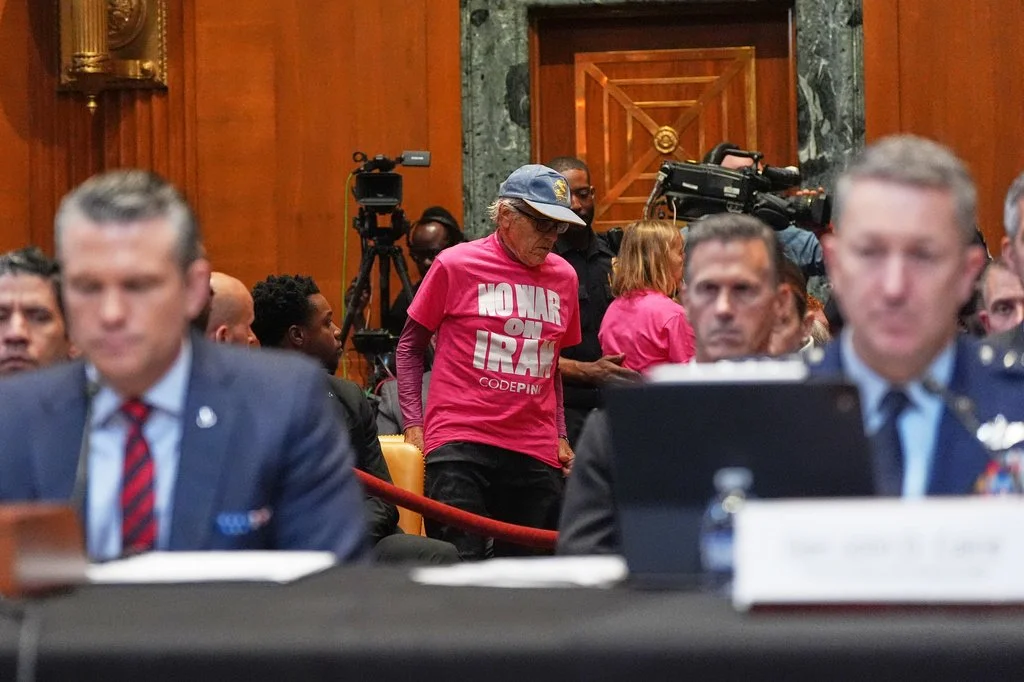
Protesters leave as Defense Secretary Pete Hegseth and Chairman of the Joint Chiefs of Staff Gen. Dan Caine testify at a Senate Appropriations subcommittee hearing on the budget request for the Department of Defense, Tuesday, May 12, 2026, in Washington. (AP Photo/Alex Brandon)
However, Wes argues that there are smarter ways to address that concern. Congress can distinguish the cost of the war in Iran from the broader needs of America’s military. In other words, lawmakers need to see the forest for the trees and avoid cutting the Pentagon’s legs out from under it to rein in spending on one war at the cost of weakening America’s strongest pillar of foreign policy.
One solution McGovern points to is Congress signing more long-term contracts with defense primes, which would break from post-Cold War defense prime consolidation trends, and signal to defense contractors (such as Lockheed Martin, Huntington Ingalls Industries, Boeing, etc.) that they should invest and build more industrial capacity.
Additionally, McGovern suggested tapping into Congress’s New Start Authority Section 229 of the Fiscal 2024 NDAA. Section 229 allows the Secretary of a military department to use specific authorities, established pursuant to 10 U.S.C. § 3601, to initiate urgent or emerging operational development activities for a period of up to one year. Use of these authorities is limited to the purpose of leveraging an emergent technological advancement of value to the national defense to address a military service-specific need, or to provide a rapid response to an emerging threat identified by a military service. By doing this, Congress could justify appropriating funds to emerging programs that otherwise would be frozen by the CR. For emerging technologies, McGovern finds the case easy to make, with the most obvious example being the huge gap between the US and China in hypersonic missiles. China fielded its DF-17 hypersonic missile system in 2020. Six years later, this October 2026, the U.S. Army said it was still completing the training and readiness work needed to fully field its own ground-launched system, Dark Eagle. For McGovern’s broader point, there's a concrete concern here. According to the Congressional Research Service, funding delays tied to a continuing resolution pushed back the Army’s order for its third Dark Eagle battery’s launchers and related equipment by six months.
To address another concern with CRs and procurement, McGovern said that, going forward, production increases and new program starts should be written into every CR. McGovern explains, “you could have a CR that halts at last year’s funding but still keeps allowances for new programs and equipping our military. In an ideal world, government shutdowns themselves would be illegal,” but with this obviously being a pipe dream, altering the CRs themselves to mitigate the fallout of an expected shutdown would greatly reduce the adverse effects it has on the very serious issue of national security and upholding our credibility with our military abroad.
Of course, these are all collaborative issues, and among the myriad bureaucratic hurdles, the tallest one might be the simple fact that only one on-time budget has been sent from the Executive Office to Congress since fiscal year 2012. The simplest fix might be holding the executive to a timely standard so that, if the budget is submitted on time, Congress has enough time to vote on it before it runs out of appropriations.
The concerns for national security work bottom-up as well. With political instability and dysfunction running high, disengagement, political apathy, declines in patriotism, and volunteerism all run parallel in magnitude. On an insightful note, McGovern articulated the shared opinion that “you can love a country and not the administration,” and that conflating the two can lead to an unfortunate calculus that equates withdrawal from political engagement with a loss of betterment as a whole. For McGovern, that is the real cost of gridlock: a country that can’t agree on a budget can’t prepare for tomorrow’s crisis, and a public that has tuned out won’t notice until the bill comes due.
A special thank you to this week’s featured student: Wesley McGovern! A Junior in NYU CAS’s International Relations program, Wes is a true inspiration to everyone in the department. As a National Defense Fellow at the Ronald Reagan Presidential Foundation and Institute, a recently published writer in The National Interest, and an active Research Assistant for NYU’s Max Weber Chair in European and Mediterranean Studies, Wes truly embodies the student work ethic and ingenuity being built at NYU.