
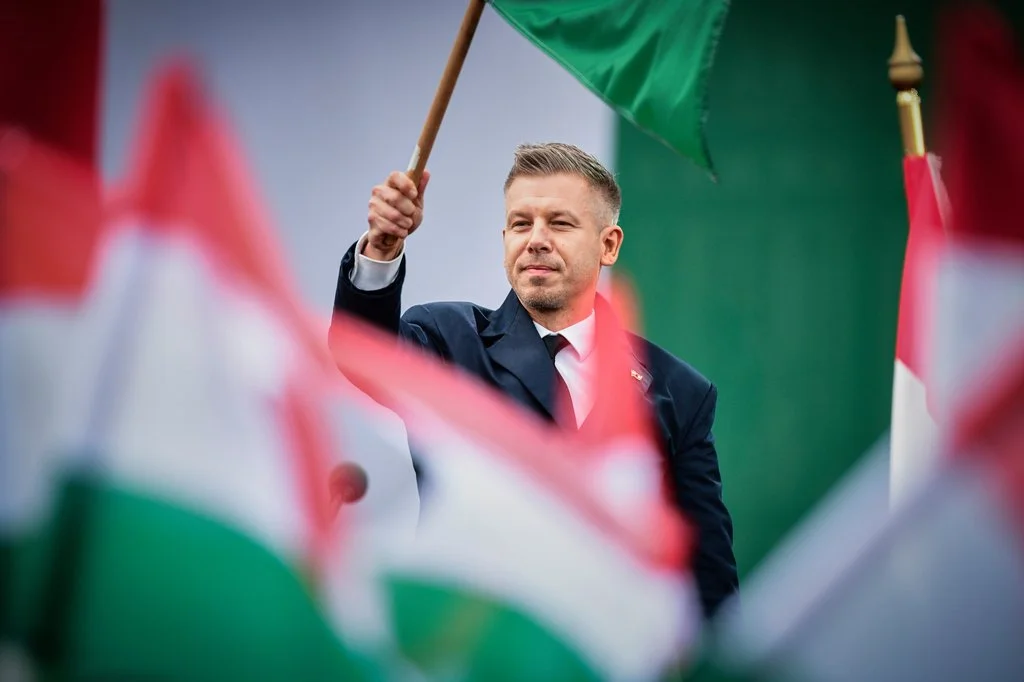
Hungarian Prime Minister Péter Magyar waves the Hungarian flag during ceremonies marking the 70th anniversary of the 1956 Hungarian Revolution against Soviet-backed communist rule in Budapest, Hungary, Friday, Oct. 23, 2026. (AP Photo/Pavel Bogolepov)
On Friday, Oct. 23, guests from across Europe gathered in Budapest at the invitation of recently elected Hungarian Prime Minister Péter Magyar, in commemoration of the 70th anniversary of the 1956 Hungarian Revolution against Soviet communism.
This year’s anniversary commemoration comes at a pivotal moment in Hungary’s history. This past April, Magyar unseated incumbent Prime Minister Viktor Orbán, Hungary’s pro-Russia, anti-Europe populist leader of 16 years, in a landslide election. Since then, Magyar has been making strides to undo Orbán’s destructive impact on Hungary’s democratic institutions and international affairs. Alluding to Orbán in his commemoration speech on Friday, Magyar proclaimed that “Since 1956, every Hungarian leader, and I repeat every Hungarian leader, must know that his power can never be more important than the freedom of his country.” He went on to say that during the revolution in 1956, “Hungarians made a clear choice: We belong to a free and democratic Europe.”
The Hungarian Revolution of 1956 was a revolt against the Hungarian People’s Republic, a one-party, communist ruled Soviet satellite state established in 1949. Its early years had seen mass repression, political instability, and widespread economic hardship. Following Stalin’s death in 1953, reformist Imre Nagy briefly replaced Hungarian communist leader Mátyás Rákosi as prime minister, though Rákosi remained party leader. Two years later, he was ousted and hard-line rule returned.
In 1956, worker protests broke out against Poland’s ruling party, inspiring the Hungarian people. By October 1956, student-led protests had begun, fueled by a mixture of influence from Polish protests and deep personal grievances that had been building for years. The students issued numerous demands, including for economic reforms and the complete withdrawal of the Soviet military from the country. On Oct.23, clashes between protesters and local security ensued, and on the night of Oct. 23, communist leader Ernő Gerő called upon Soviet troops stationed in Hungary to intervene. The next day, Nagy was reappointed Prime Minister, and immediately called for a ceasefire on Oct. 28. He promised immediate political reforms, and on Nov. 1declared Hungarian neutrality and appealed to a hesitant United Nations for support against the Soviets.
Alarmed, Nikita Khrushchev sent the Soviet Army to invade Hungary on Nov. 4, with the entire revolt crushed by Nov. 11. Nagy was seized by Soviet forces on Nov. 22, and in June 1958 he was executed for treason after a secret trial. About 2,500 Hungarians and 700 Soviet soldiers died in the conflict, and an estimated 200,000 refugees fled after the revolt was crushed.
The Revolution shook world order. Though it had been swiftly overcome by the USSR, it was one of the most blatant shows of dissent from a Soviet satellite country the world had seen yet. While Stalin had kept the inner workings and troubles of the Soviet regime behind closed doors, the events in Hungary alluded to its fracture. Even more notably, it had managed to scare Khrushchev, the leader of a nation that posited itself as fearless and unfazed by conflict. It set the precedent for the eventual crumbling of the Soviet Union and its satellite states, exposing public dissatisfaction and putting the Hungarian people at the center of a disgruntled and restless population.
In an address to tens of thousands in Budapest on Friday, Magyar paid his respects to the bravery of the Hungarians who stood up against Soviet oppression in 1956, placing flowers at the graveside of those killed in the uprising. He also made a point of inviting a number of European dignitaries in an effort to rebuild the bridge between Hungary and the rest of Europe. In attendance was European Commission President Ursula von der Leyen, who praised Magyar during her speech at the event for his administration’s “renewed commitment to our common future,” and the reforms it had begun to carry out.
Orbán took a different approach in his 2023 commemoration of the Revolution. In a speech given at the event, he compared Hungary’s membership in the EU to its 4 decades of Soviet occupation, accusing the organization of wanting to strip the nation of its identity by forcing the model of liberal democracy, which he claimed Hungarians rejected, upon it. He alleged that Brussels, the de facto capital of the EU, used methods against Hungary that drew parallels between Brussels and Moscow, saying the EU was pressuring Hungary in ways that recalled Soviet domination. While Russia had previously been the enemy, it was now the West that was as bad as the Soviets.
Magyar called the Hungarian Revolution one of the brightest moments in the nation’s history, championing the bravery of the Hungarian people who gave their lives standing up against tyranny. They had faced the communist regime head-on, fighting for a better life for themselves, He told the Associated Press days before the anniversary. He emphasized the importance of the rest of the world recognizing the Hungarian people’s resistance against tyranny as demonstrated by the martyrs.
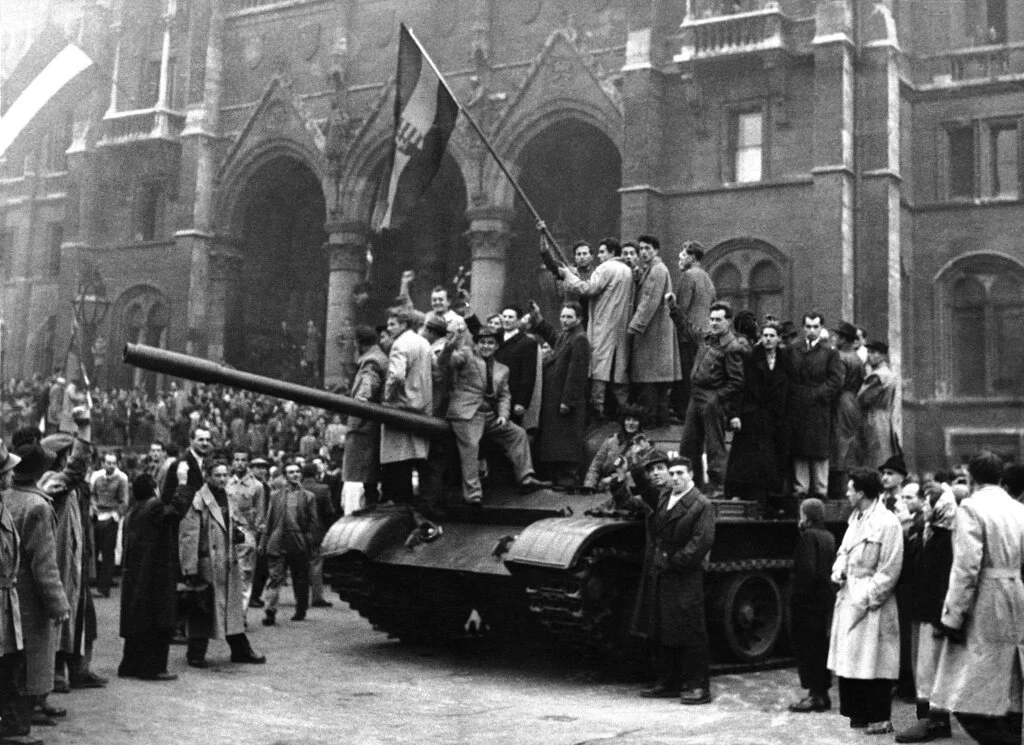
Rebels wave the Hungarian tricolour, with the Kossuth symbol bearing the cross of St. Istvan, from a tank captured in the main square in front of the Houses of Parliament in Budapest, Hungary, Nov. 2, 1956. (AP Photo)
In the pivotal election, Magyar’s center-right Tisza Party amassed a two-thirds majority in the Hungarian parliament, as Orbán’s Fidesz Party did in most of its terms. While Fidesz used this to rewrite the electoral system in its favor, pass a new constitution beneficial to it, and reshape the judicial system, Tisza claims a different prerogative. Magyar has pledged to cooperate with fellow European countries, ending Hungary’s era of obstructing Europe-wide policies, while also representing the desires of the Hungarian people.
He has promised an overhaul of government structures, restoring the rule of law and strengthening governmental institutions to be more independent to combat corruption. He has already begun to remove Orbán loyalists who have been cemented into political roles, notably pressuring Hungarian President Tamás Sulyok into resigning from his role through a passed constitutional amendment ending his term. Remarkably, Magyar’s administration has declared that it will end Hungary’s dependence on Russian energy by 2035, undoing one of the largest pillars of Orbán’s reign.
Hungary’s transition out of Orbán in numerous ways parallels its transition out of the Soviet era. Following the collapse of communism in 1989, Hungary quickly pursued democratization: it established a democratic political system, opened to a free-market economy, and gradually acceded to supranational organizations such as NATO in 1999 and the EU in 2004. They made strides to transition out of Soviet influence, to globalize and acclimate to the greater West. They followed the formula of the West, distancing themselves from a legacy as a communist nation.
Orbán’s reign dismantled both Hungary’s democratization and its openness to the West. During his second term as Prime Minister, beginning in 2010, he took advantage of the supermajority his party had gained in parliament from the nation’s instability to consolidate control. Over 16 years, Orbán and his far-right Fidesz party dismantled Hungary’s reputation on the world stage. The administration took control of the media landscape, repressed civil society and nonprofit organizations, and dismantled democratic judicial and legislative norms. Internationally, he positioned himself as the antagonist of the European Union, consistently obstructing the bloc’s decisions from being passed and making it clear he was a strong ally of Putin in his battle with the West.
His actions brought forth concern from fellow EU and NATO countries. For over a decade, the European Commission accused him of dismantling democratic institutions, controlling the media, and infringing on the rights of minorities. Orbán’s de-democratization and de-westernization led to the freeze of billions of euros in cohesion funds given to Hungary, meant to help bring its economy and infrastructure to EU standards.
Orbán and his Fidesz administration echoed some of the instruments used by the Soviets in their repression of Hungary in the 20th century. His actions and behavior bore many similarities to those of the communist leaders who had come before him. The difference was that he had to be more discreet: he lacked the Soviet safety net of before, being held accountable by the EU. He mirrored a number of Putin’s ways of governance, yet he lacked the bountiful resources of Russia. Through this lens, his temporarily successful repressive regime was doomed to fail.
While we should not blindly trust Magyar’s ambitious promises, his victory has undeniably been a beacon of hope for Hungarians, particularly the nation’s young population. If he adheres to his campaign of reform, lasting change is undeniably possible for the nation. The new regime also gives the rest of the world an opportunity that in 1956 they rejected: during the Revolution, when Imre Nagy called for international support against the looming Soviets, the West was too reluctant to send help for fear of a global confrontation. Though one cannot assume that intervention would’ve saved the nation, it is undeniable that the lack of help gave Khrushchev an easy win.
This time, with widening hope of true reform under Magyar’s administration, the world has an opportunity to learn from the past. While internal reform is the foundation of a new Hungary, international support and cooperation with the new regime is the key to solidifying change. Though it might be blind optimism, I do believe that there is tangible possibility for change as demonstrated by the past. Whereas once reformists were left on their own, the support possible through EU cooperation makes a reformed Hungary plausible. A post-Orbán Hungary has the potential to make reforms and satisfy citizens’ desires that have been decades in the making.