
Op-Ed: Rejoin Is Labour’s Brexit
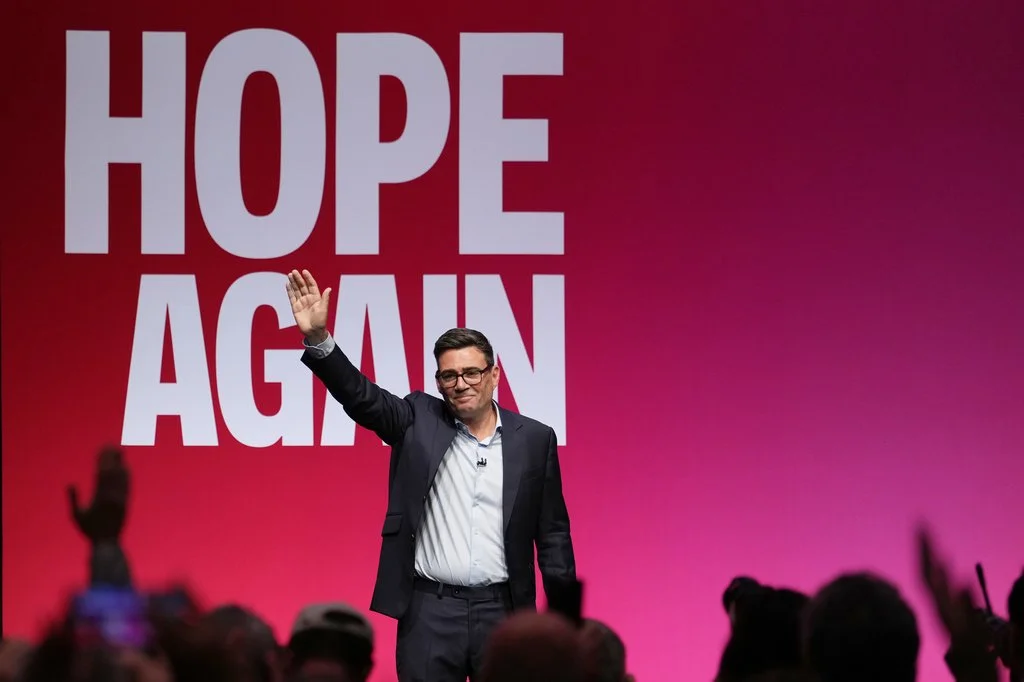
Andy Burnham waves on stage at the Labour Party conference in Liverpool, England, on September 29, 2026. Photo: Jon Super / AP Newsroom
On September 29, Prime Minister Andy Burnham told the Labour Party conference in Liverpool that Brexit had “done more harm than good.” The next day, in a BBC radio interview, he said Britain could “go all the way” and rejoin the bloc, breaking a taboo for a sitting prime minister. Burnham backed Remain in 2016 and has said he hopes Britain will rejoin in his lifetime. But the more revealing part of his speech is less where he wants to take Britain than how he argues for it: why he now thinks Europe would help. Much of his argument assumes that problems largely made at home can be addressed by changing Britain’s relationship with Brussels. That was the logic of Leave in 2016, pointed in the opposite direction: an external fix for an internal problem. Brexit and Rejoin are not equal in their economic effects, but they tell voters the same story, and this time it is Labour telling it.
The Leave campaign offered voters an external explanation for internal decline. Stagnant wages, strained public services, and struggling towns were all traced back to Brussels. Burnham now admits that the promise failed. He told his party that Brexit failed to deliver on its pledge of taking back control and left the country weaker. The cost has been visible in Downing Street, where Burnham is the seventh prime minister in a decade. Once Brussels was gone as a target, frustration turned on whoever was in charge.
Yet Burnham’s alternative still follows the same logic. He said Brexit had triggered “a decade of low growth.” He told the conference that Britain now needed to restore higher growth and prosperity, and he tied that recovery to a long-term relationship with what he called “our largest market.” Closer trade could well help growth; the trouble is how much the promise is asked to carry. Leave voters were offered the same kind of promise, and they have already seen how it turned out.
Burnham presents his plan as a menu. “We could stay as we are,” he told the BBC, before mentioning a customs union, the single market, and eventually full membership. Most of these options only exist on paper. The single market requires free movement, which Labour Party Manifesto 2024 ruled out along with a customs union. A customs union would not bring back free movement, but it would cost Britain its independent trade policy. Earlier this year, Brussels quickly rebuffed a British attempt to rejoin the single market for goods only. Even while welcoming a British return, French President Emmanuel Macron warned that Britain cannot “pick and choose” among the EU’s freedoms. Strip away the blocked options, and only the 2016 question remains: in or out.
Even if the menu does not work as policy, it still does useful work inside the Labour Party. In May, when former Health Secretary Wes Streeting called Brexit a “catastrophic mistake” and said Britain should one day return to the EU, Burnham’s allies were not pleased. They complained that Streeting had handed Reform UK a major campaign issue in Makerfield, a fiercely pro-Brexit seat that Burnham needed to win to return to Parliament. Burnham himself insisted he did not want to reopen the Brexit debate. Four months later, he reopened it himself.
David Henig, an expert on UK-EU relations, told AFP he does not think Burnham is yet committed to rejoining. That matters because the cabinet is divided. Business Secretary Jonathan Reynolds has warned against revisiting the membership debate, and Anand Menon of UK in a Changing Europe told AFP that Burnham has “quite a few people in his cabinet” who would rather he not focus on Europe. Asked whether an in-out referendum could appear in a future manifesto, Burnham said “things are possible.” Whatever he intends, no one in Labour yet has to lose the argument.
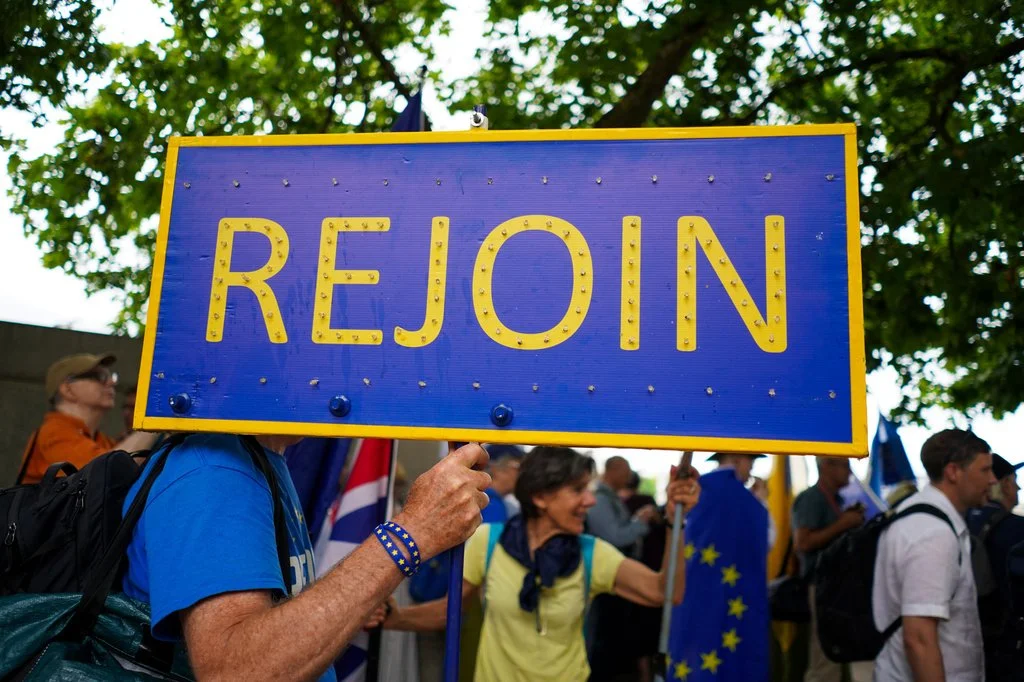
A person holds a sign reading “REJOIN” as others carry European Union and British flags in London, England, on June 20, 2026. Photo: Alberto Pezzali / AP Newsroom
Outside Labour, the numbers look friendlier. YouGov’s tracker had 59 percent of Britons backing a return to the EU in late September, and Labour has since opened a five-point lead over Reform UK. But a polling majority is not a voting majority. In 2016, over half of those who had skipped the previous general election turned out for the referendum, and six in ten of them voted Leave. The new majority is built differently. Pollster John Curtice says most 2016 voters have not changed their minds. Much of the shift comes from people too young to vote ten years ago, and only 37 percent of 18-to-24-year-olds voted at the last general election. Curtice also warns that a future referendum could still be lost once the euro and Schengen come up. A soft majority is a thin base for an external fix. Reform, meanwhile, gets back the target it lost when Britain left. Its deputy leader Richard Tice accused Burnham of trying to sneak Britain back into Brussels “via the back door.”
The external fix also runs into the other side of the table. The November summit is meant to finish deals Keir Starmer left behind, covering food safety standards, youth mobility, and carbon markets. According to AFP, talks are believed to have stalled over British concerns about the EU’s “Made in Europe” plans. Earlier, talks on Britain joining the EU’s 150 billion euro defense loan scheme collapsed over how much Britain would contribute. These are concrete trades, and in concrete trades, leverage matters.
Youth mobility shows how the rejoin debate could complicate those trades. Britain has pushed to cap visas for young Europeans below 50,000, while Brussels has reportedly wanted up to 150,000. Full membership would involve accepting free movement again. A government that openly lists that option may find it harder to argue that 150,000 young Europeans is too many. Burnham has said better access for some British industries might mean accepting some EU rules, and that he needs to know whether voters would back that.
That is a question about which rules Britain should accept from Brussels. For most of his career, Burnham asked a different one: how much power Westminster should hand to the regions. As mayor of Greater Manchester, he made devolution his project. Joel Reland of UK in a Changing Europe described his growth agenda as “more about restructuring power within the UK rather than building bridges beyond the UK.” That approach seems closer to many of the problems that Leave voters raised in 2016, including wages, housing, and towns that felt forgotten. Those are not mainly trade problems, even if Brexit has hurt trade. The Centre for European Reform estimates that Brexit has cut UK exports to the EU by about 12 percent, and goods exports by about 16 percent. Closer ties with Europe could recover some of that lost trade. But no trade deal decides how power and investment are shared inside Britain. That is a question for Westminster, and one Burnham spent years answering in Manchester.
Burnham is right that Brexit failed to deliver what it promised. But his answer repeats Brexit’s promise in reverse, placing the fix for Britain’s problems in its relationship with Brussels. Closer ties may undo some of the damage. They cannot do the work that only Westminster can do. Until Labour admits that, Rejoin remains Labour’s Brexit.