
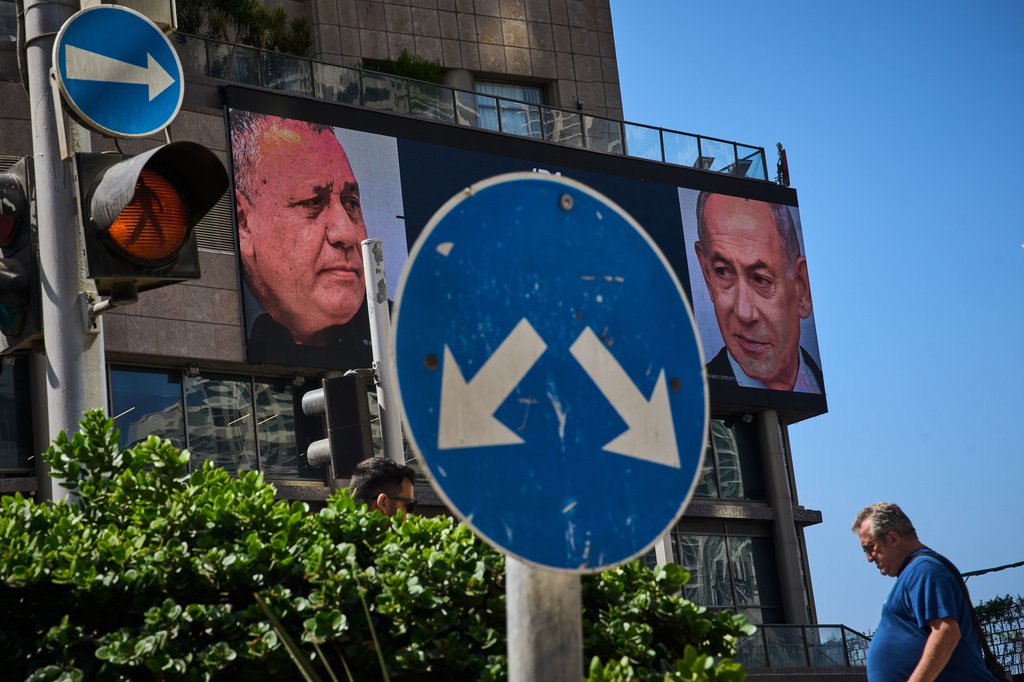
Television channel advertisement featuring Israeli Prime Minister Benjamin Netanyahu, right, and his main rival, opposition candidate Gadi Eisenkot, ahead of Israel's general election, in Ramat Gan, Israel, Wednesday, Sept. 23, 2026. AP Photo/Oded Balilty
This past Oct. 7 marked three years since Hamas' attack on Israel, the deadliest day in the country's history. Twenty days later, Israel will hold its first national election since the incursion. The past three years have been a tumultuous time for Israel and the Middle East as a whole. The Hamas attack triggered a violent response by Israel, with wars in Gaza, Lebanon, and Iran, as well as skirmishes in Syria and Yemen. This election extends beyond national politics, as any new government will profoundly shape the region's stability and its strained relationships with the international community. The election is a referendum on the current government's aggressive defence doctrine led by Prime Minister Benjamin Netanyahu. Israelis have a choice to either continue his violence against Israel’s enemies or pursue a policy of national defence that prioritizes stability and peace.
Since its inception in 1948, much of Israel’s politics has been directed by a state of fear. The concept of total annihilation has never been far from the country’s collective consciousness. Israel’s history is marred by war with its neighbors, terrorism both within its borders and abroad, and international political condemnation over its very existence, all of which create an anxiety that puts national security as the utmost concern among many Israeli voters. National elections are primarily a vote for a leader's ability to protect the country. No other politician has been more successful at building their persona around this platform than Netanyahu, Israel's longest-serving prime minister. His political career has been built on capitalizing on Israelis’ fear and anxiety. Netanyahu relies on the threat of terrorism, war, and violence against Israel to reinforce an image that he is the nation’s protector. By perpetuating the conflicts with Iran, Hezbollah, Hamas, and not showing any solution other than their total annihilation, Netanyahu creates existential dangers to Israel, portraying military deterrence as the sole solution and thus feeding Israelis’ fear of annihilation. When faced with limited political candidates and external threats, most voters will favor their existing government because security through militarism is often seen as the safer option.
Since 2009, except for two brief periods, Netanyahu has served as the prime minister. His position of power has come from leading a coalition of nationalist, far-right, ultra-Orthodox parties, which in turn has pushed the pendulum of Israeli politics further to the right. This alliance of nationalist, conservative parties has focused their political agenda on national security and military defence. Their strategy has been to proactively use force to ensure the protection of the state. External threats must be met with pre-emptive strikes rather than detente. Netanyahu himself claimed, “We changed Israel's security doctrine. We initiate. We attack. We surprise. And we attack those enemies that seek our destruction, that seek to kill us. We attack them before they have a chance to do so.” But after more than three years of war in the Gaza Strip, questions over the failure to stop Hamas on Oct. 7, and 15 years of Netanyahu leadership, Israelis may have had enough of his fear-mongering and active military campaigns. Oct. 27 of this year will decide if the time is ripe for significant changes to how the country is governed.
Netanyahu’s political brand is protection, yet the worst attack in Israeli history occurred under his watch. In the wake of Oct. 7, Netanyahu’s leadership has attempted to reassert the facade of control, engaging in conflict with Hamas, Hezbollah, Iran, and the Houthis. However, these wars have been shaped around unachievable goals and have arguably made the nation more dangerous. Public opinion polls suggest Israelis are divided on whether these military campaigns have been successful. These conflicts have mostly added to regional instability and tensions, the same conditions that have fostered the growth of Israel's regional rivals. In Netanyahu’s attempt to reassert a domestic sense of control, he has continued to level Gaza using it as a demonstration force, all while further endangering the country. While voters will weigh whether Netanyahu can truly protect the country and if his coalition's reliance on force as a deterrent has truly bolstered security, replacing him may not be enough to change the course of Israeli politics.
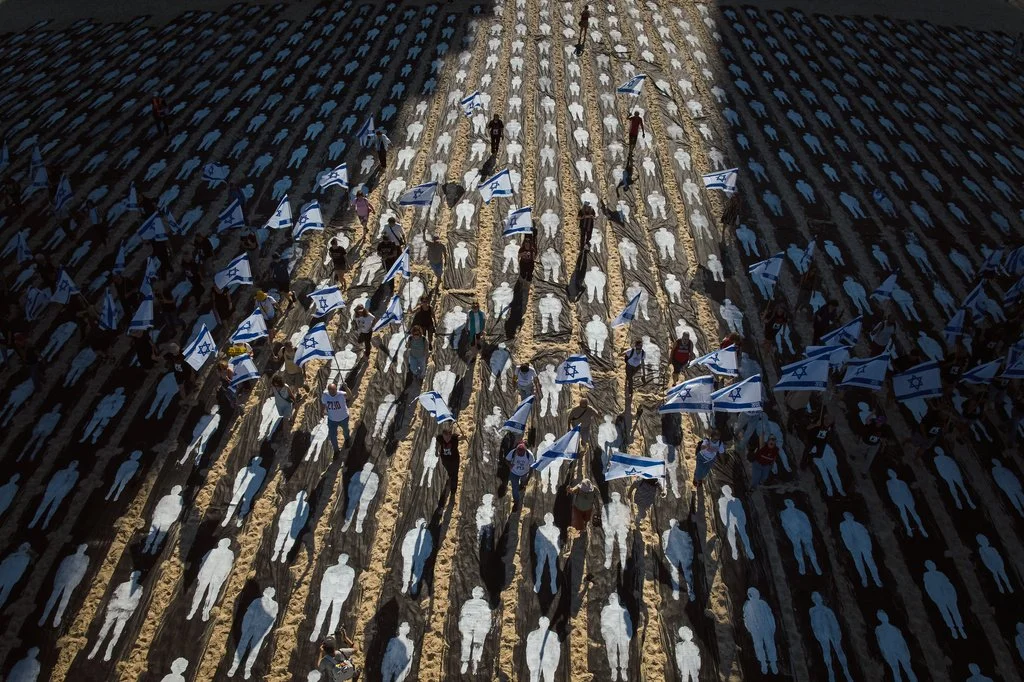
People walk through an installation marking the third anniversary of the Oct. 7, 2023, Hamas attack on Israel, on the beachfront in Tel Aviv, Israel, Wednesday, Oct. 7, 2026. AP Photo/Oded Balilty
Gadi Eisenkot, a former chief of staff of the Israel Defence Forces and one of Netanyahu’s principal challengers, offers a change in leadership while maintaining the national security status quo. Eisenkot’s campaign has pushed for a state commission of inquiry to investigate Oct. 7, while Netanyahu has refused the independent investigation. Controversy has grown amid reports that Netanyahu received warnings about the impending attack. In September 2026, The Washington Post reported allegations that both the UAE and Egypt warned about the attacks. Eisinkot has also criticized Netanyahu’s handling of the war, yet underneath he mirrors many of Netanyahu’s security beliefs. Eisinkot similarly does not believe in Palestinian statehood and has continued to voice support for preemptive military conflict. Even if voters reject Netanyahu’s leadership, the next government will continue to rely on military force as its primary means of addressing threats. The importance of the Oct. 27 election stems from an underlying shift in Israeli voters' beliefs: Netanyahu has unintentionally exposed the failures of his own ideology.
If Netanyahu is proven to have known about, yet ignored, warnings about an intrusion, it will likely end his political career and cripple the future of his Likud Party. Historically, failure to protect the state has led to major political fallout. After the Yom Kippur War in 1973, Israel faced a crisis of confidence in its political and military leadership. Egypt and Syria’s surprise attack exposed serious failures in Israeli intelligence and military preparedness. Israel’s Prime Minister at the time, Golda Meir, came under public criticism, and the Agranat Commission was established to investigate the failures surrounding the war. Although the commission focused its criticism on the military and intelligence establishment, public anger increasingly turned toward Meir's government, leading to her resignation. The Labor Party, which had held power since 1948, lost its political dominance and fell completely from power in 1977, giving way to the Likud party, ending an era of Israeli politics and marking the beginning of the dominance of right-wing politics. Today, Netanyahu leads the Likud party and has continued to push Israeli politics to the extreme right.
Oct. 7 will not create the same political outcome as 1973, which immediately shifted the political sphere of Israel, but it has created the conditions for Israeli voters to question the security doctrine that has defined the far right. Despite years of military campaigns and preliminary strikes, Israel is repeatedly caught in recurring conflicts without lasting political settlements or resolutions. A new government will bring greater accountability and a new approach to international relationships, but nothing will drastically change until Israel sees the power of negotiation. If Israel continues to measure security solely through military power, it will only perpetuate a cycle of escalation and bloodshed.
The last three years have been spearheaded by Netanyahu’s ambitious regional goals aimed at disabling militia groups such as Hamas and Hezbollah and fighting direct conflict against Iran and the Houthis. Across all four fronts, Israel has neglected to address the primary social and political problems which have led to these conflicts.
If Netanyahu truly intended to pursue a secure state through the disarmament of Hezbollah and delegitimization of Hamas, he should work diplomatically to achieve those goals. Hezbollah has largely backed its existence as a group to resist Israel. Meanwhile, a true push for a two-state solution could counter Hamas’ narrative of armed struggle being the sole solution to achieve rights and statehood. Instead, Israel has favored military force, despite this strategy not resulting in a safer environment. Hamas, Hezbollah, the Houthis, and Iran have all been weakened, yet the region has grown ever more volatile. The continued extreme use of force by Israel has also reaffirmed the political narratives essential to many of these organizations' existence, revealing the failure of Netanyahu’s security strategy. Military confrontation has not created any systematic change for the security of Israel and safety for Israelis.
The choices Israelis face in this election will shape the next generation of Israeli security, not because of the choice between Eisenkot and Netanyahu, but because it could create an opportunity to reassess the political direction Israel has taken over the last decades. Change will begin with a government willing to investigate its own failures and reconsider the consequences of militarism. Three years of war have demonstrated Israel’s inability to produce meaningful security changes. Oct. 7 may ultimately become modern Israel’s 1973 moment. One that will slowly force Israelis to reflect inward on a nation that is so consumed by fear it sees defense preemptively as the only security.