
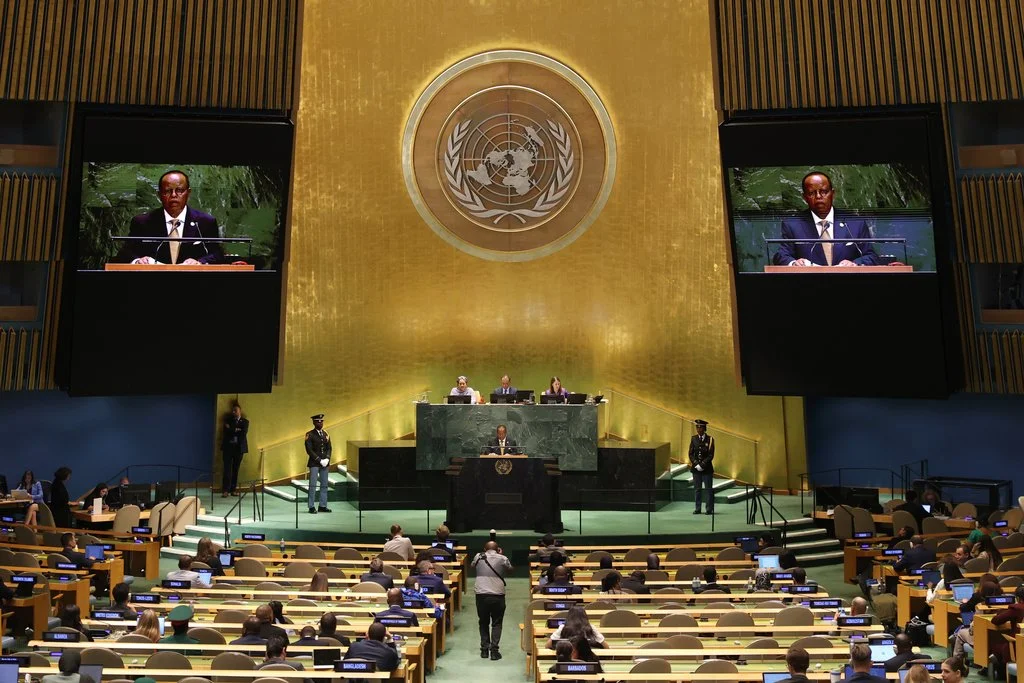
President of Ethiopia, Taye Atske Selassie Amde, addresses the 80th session of the United Nations General Assembly, Thursday, Sept. 25, 2025, at U.N. headquarters. (AP Photo/Pamela Smith)
With the renewed Tigray war in Ethiopia, intergovernmental organizations like the United Nations are expressing alarm at the impact of the escalating fighting on civilians. Airstrikes in September 2026 hit five schools, resulting in deaths and injuries, along other incidents of killing, torture, arbitaray detention of civillians, including children. The Secretary-General on Children and Armed Conflict for the period January to December 2025, documented 130 grave violations against 72 children, with a total of 45 children killed and maimed during the war, alongside cases of sexual violence, attacks on school and hospitals, abduction, and the denial of humanitarian access.
Although international frameworks such as the Geneva Conventions and the UN Convention on the Rights of the Child (UNCRC) exist, children in war zones cannot wait for a ceasefire to be protected. As the fighting in northern Ethiopia has been ongoing for years, it has exposed the gap between the promises of international human rights frameworks and the lived reality of bombed schools and sexual violence against children. International institutions must move beyond the abstract legal frameworks that exist only on paper and stop trading civilian human rights and lived realities for short-term political compromises.
Under international law, war crimes and human rights accountability in Ethiopia are governed by treaties like the Geneva Conventions and the International Covenant on Civil and Political Rights (ICCPR), alongside oversight mechanisms such as the UN International Commission of Human Rights Experts on Ethiopia (ICHREE). Yet while the names of these treaties and commissions grow longer each and every year, the actual protection and justice delivered to civilians and children remain nowhere to be seen.
Dating back to the November 2022 Pretoria Agreement, a fragile peace deal had temporarily halted the conflict. During that postwar period, millions of Ethiopians hoped that they would get their justice delivered for the atrocities during the war. However, instead of investigating abuses, accountability efforts were disregarded as international investigative mandates expired, the Ethiopian government abandoned the transitional justice process, and allegations of war crimes were left unpunished. When the conflict erupted again in September 2026, it brought a fresh wave of human rights abuses when the devastation of the previous conflict had not even been addressed.
To address these grave human rights violations in Ethiopia, in December 2021, the UN Human Rights Council established the International Commission of Human Rights Experts on Ethiopia (ICHREE). Comprising of three human rights experts appointed by the President of the Human Rights Council, the ICHREE investigated and documented widespread human rights abuses during the Tigray War. The commission investigated and verified 54 cases of mass killings, widespread and systematic sexual violence, forced displacement, and use of starvation as a weapon of war.
Although successful in establishing a specific mandate for the situation in Tigray, the commission faced intense opposition from the Ethiopian government, refusing to cooperate with investigators and give access to conflict zones. The Ethiopian government objected to the commission, arguing that the Pretoria Agreement and the implementation of the Transitional Justice Policy would suffice the reconstruction and justice process of these wartime atrocities and grave human rights violations. Even though human rights experts criticized the transitional justice process as “deeply flawed” and continued to document the ongoing rape and sexual violence in Tigray, and human rights organizations like Amnesty, Human Rights Watch, and Physicians for Human Rights urged for an extension of the ICHREE, the UN Human Rights Council failed to renew its mandate. The African Union also ended its own investigation earlier in the year, citing the Ethiopian government is investigating abuses and holding perpetrators accountable under the Pretoria Agreement.
However, it is clear from the renewed fighting from September 2026 that the Ethiopian government’s implementation of the transitional justice process has not been effective. Despite many human rights organizations pleading for continued accountability and justice, if UN member states bow to diplomatic pressure from the Ethiopian government to prematurely end the mandate, who will stand on the side of the people?
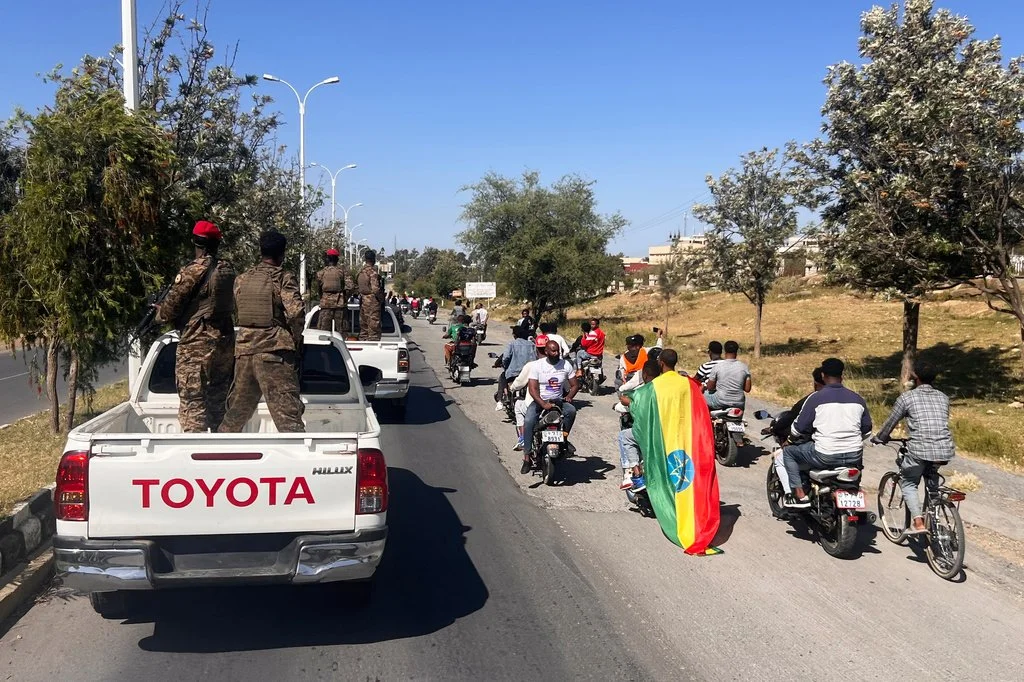
In this photo taken with a smartphone, supporters and soldiers participate in a procession welcoming former Tigray leader Getachew Reda in Mekelle, Ethiopia, Sunday, Oct. 11, 2026. (AP Photo/Filmon Equar Hailu)
Looking at UN mechanisms that did remain in place like the UN Security Council Resolution 1612, creating the Monitoring and Reporting Mechanism (MRM) and the Working Group on Children and Armed Conflict, this resolution transformed how the UN tracks crimes against children in conflict zones. The MRM provides systematic gathering of accurate and objective information on six grave violations committed against children in zones of armed conflict. These violations include killing and maiming of children, recruitment and use of children by armed forces and armed groups, sexual violence against children, attacks against schools or hospitals, abduction of children, and the denial of humanitarian access for children.
However, this mechanism is powerless without government cooperation from a government that isn’t willing to cooperate. Additionally, the documentation happens after the tragedy has already happened, requires strict evidentiary standards before an incident is officially counted, and “pending verification” status delays urgent humanitarian action. Addressing human rights violations cannot be treated as a slow, procedural checklist while children and civilians are actively being harmed.
Despite tireless efforts by NGOs, legal practitioners, humanitarian workers, and health care professionals to build a credible justice and accountability system in Ethiopia, Ethiopia keeps resetting to trapping civilians and children in an endless cycle of committing human rights violations and impunity. Since at least April 2026, Human Rights Watch (HRW) reported that regional authorities in Tigray have been unlawfully abducting and recruiting children as young as 15 for employment. Interviewees indicated that new recruits were held in administrative offices, jails, or schools then transferred to military camps for training.
Breaking this cycle requires international institutions to move from passive documentation to active intervention. Verified grave violations against children and civilians must trigger targeted action against responsible groups instead of bowing to political pressure and leaving international law on autopilot while civilians bear the crash. Until international institutions prioritize the lived realities of civilians over short-term diplomatic compromises, frameworks like the ICHREE and MRM will remain insufficient to protect and deliver the justice people deserve.