
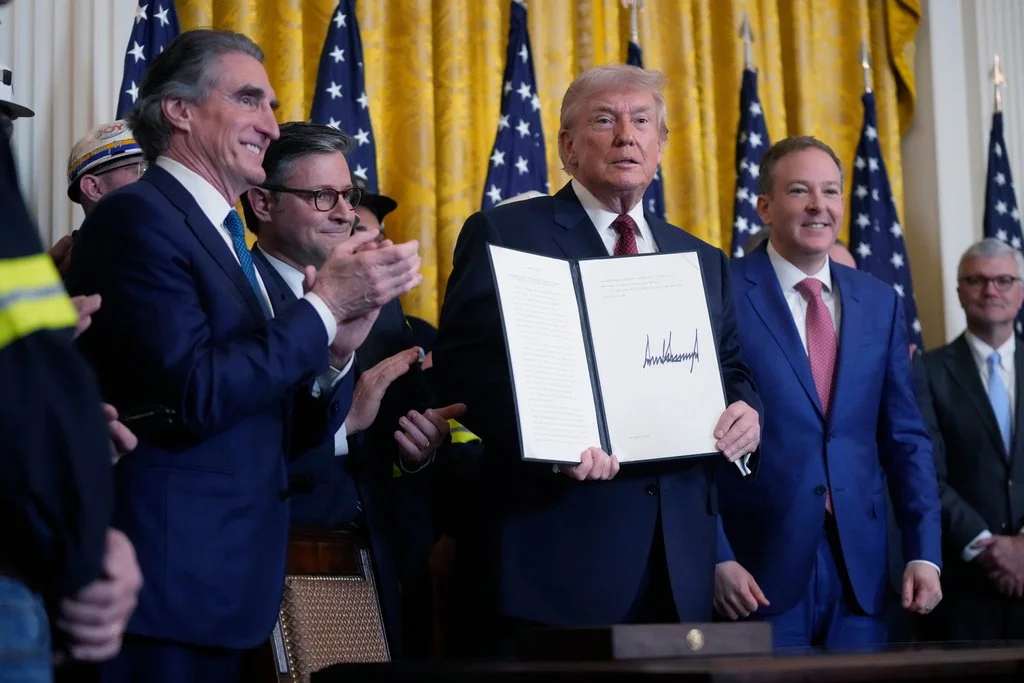
President Donald Trump holds up an executive order he just signed during an event on coal power in the East Room at the White House, Wednesday, Feb. 11, 2026, in Washington. Looking on at right is EPA Administrator Lee Zeldin, House Speaker Mike Johnson, center, and Interior Secretary Doug Burgum at left. (AP Photo/Mark Schiefelbein)
President Donald Trump holds up an executive order he just signed during an event on coal power in the East Room at the White House, Wednesday, Feb. 11, 2026, in Washington. Looking on at right is EPA Administrator Lee Zeldin, House Speaker Mike Johnson, center, and Interior Secretary Doug Burgum at left. (AP Photo/Mark Schiefelbein)
President Trump has made his anti-environmental agenda incredibly clear. Since the start of his second term, he has proposed more than 580 initiatives to roll back or threaten the environment and, consequently, the American people’s health.
To support Trump’s reckless anti-environmental stance, he nominated former New York congressman and failed governor-elect Lee Zeldin to lead the US Environmental Protection Agency (EPA). Zeldin is a Trump loyalist who voted against certifying former President Biden as the winner of the 2020 election. His environmental credentials include having previously cast doubt on the severity of climate change and receiving a score of 14 percent from the League of Conservation Voters for his congressional voting record on environmental issues.
Since he was appointed administrator of the EPA, Zeldin has radically altered the agency’s purpose: to protect the environment and public health. His policies and actions have heavily favored fossil fuels over clean energy. At the same time, his massive deregulation plan follows Trump’s rhetoric that dismantling and weakening the EPA will allow the economy to thrive.
Zeldin made his economic agenda clear in February, when the EPA published the “Powering the Great American Comeback” five-pillar plan, which the Associated Press noted had four of the five pillars as economic objectives. These goals are indeed at odds with the EPA’s purpose. Pillar 2 plans to make the United States energy-dominant (essentially investing more in fossil fuels), Pillar 4 declares that the United States will become the AI capital of the world, and Pillar 5 aims to empower the automobile industry.
Zeldin told reporters that he wants to protect Americans facing an expensive economy, and he will do so by dismantling policies aimed at protecting the environment. Zeldin is adamant that the benefits of climate mitigation do not outweigh the steep costs and time it will take to see results.
Zeldin’s outlook on the environment has two catastrophic consequences: it supports actions that worsen climate change and human health, and it promotes the misconception that accounting for and protecting the environment is economically infeasible.
Scientists and climate researchers have heavily criticized policies and actions by the Trump administration and the EPA under Zeldin, which they warn are contributing to higher pollution levels and increasing risks to human health. By weakening or removing protections for areas such as clean air and water, the Associated Press predicts a high risk that billions of dollars will be wasted and tens of thousands of lives will be lost annually.
Trump and Zeldin’s agenda heavily favors protecting businesses, rather than the American people. For example, Zeldin’s EPA published a fact sheet criticizing an EPA rule issued during former President Biden’s presidency that required fossil fuel plants to reduce their carbon emissions. Zeldin complained that the rule was too expensive and subsequently removed the regulation on fossil-fuel power plant companies. Zeldin focused on the fact that the rule cost $15 billion over 20 years and conveniently ignored that the regulation had been saving $20 billion a year, comprising climate, health, and compliance costs.
Given the staggering numbers and long-term benefits of investing in the environment, why do Trump and Zeldin look the other way? The reason is one word: privilege. Both Trump and Zeldin have been lucky enough not to directly experience the damaging effects of the climate crisis. They might never truly experience the pain or fear that come from climate disasters and unhealthy environments, but their children and grandchildren will, and so will many people around the world.
In many places, the effects of climate change and pollutants are ever-present. Yet, the EPA under Zeldin has cut its offices focused on environmental justice. These offices seek to work with minority and low-income communities that are at higher risk for environmental health issues, including disproportionate levels of pollution. Zeldin has been incredibly proud of this devastating move, praising the reversal of what he calls “discrimination programs,” aligning with Trump’s agenda to end diversity, equity, and inclusion. These measures are extremely out of touch and act as a reminder that Trump’s Republican Party does not care about everyday Americans.
Protecting the environment isn’t just about the planet; it’s about the people as well. They are interconnected, and thus it’s essential to consider the environment in politics and business.
Another recent EPA action illustrates this. Currently, wetlands in the United States are threatened by the changed interpretation of “waters of the United States” under the 1972 Clean Water Act. Following the 2023 decision in Sackett v. EPA, the EPA’s power to oversee waterways has been reduced. The court’s majority opinion stated that the Clean Water Act would apply only to “relatively permanent” waters, which has led to confusion about whether wetlands remain protected. To rectify this, in November 2025, the EPA and the Army Corps decided to restrict the definition, thereby removing protections for 81 percent of US wetlands. Then, in September 2026, the proposed change was revised to produce a stricter definition, now removing protections for 94 percent of wetlands. As of November 2026, the proposal is still being finalized.
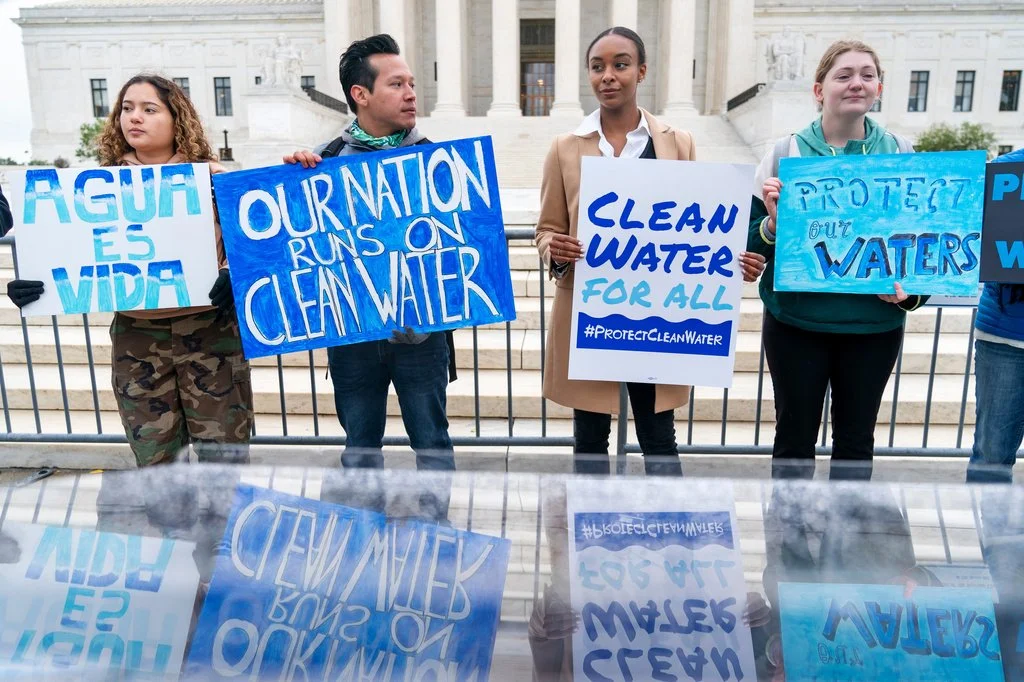
FILE - Bethsaida Sigaran, left, of Baltimore, her brother Jaime Sigaran, with American Rivers, and Thea Louis, with Clean Water Action, join other supporters of the Clean Water Act as they demonstrate outside the Supreme Court, Oct. 3, 2022, in Washington, as the court begins arguments in Sackett v. Environmental Protection Agency (EPA). (AP Photo/Jacquelyn Martin, File)
Wetlands provide incredible free ecosystem services, including filtering drinking water that communities rely on and providing flood protection. While Trump hopes to support diverse businesses, from agriculture to fossil fuels, that will drain these wetlands to use the terrain for their own economic gain, communities will face the cost of flooding and higher water bills.
The EPA has argued that its plan is all about affordability, allowing farmers and private landowners to avoid the bureaucracy and costs of obtaining a permit to build on wetlands. Conveniently, the administration has failed to comment on the detrimental effects on clean water and increased flooding for residents.
While Trump and Zeldin may preach that environmental deregulation is in Americans’ interests, it is clear that instead of benefiting, Americans are paying the price.
The problem isn’t that addressing climate issues is impractical or too expensive. Solutions exist, and as time goes on and we continue to do nothing or make it worse, we risk facing bigger consequences.
The answer to needed climate action are political measures and regulations. We cannot have selfish politicians who represent the American people and fail to deliver protections from humankind’s biggest threat.
The right to a healthy environment is a human right. It’s long overdue, especially in the United States, for the environment to become a top priority. Otherwise, not only will we live in an unaffordable world, but we won’t have any world at all.