
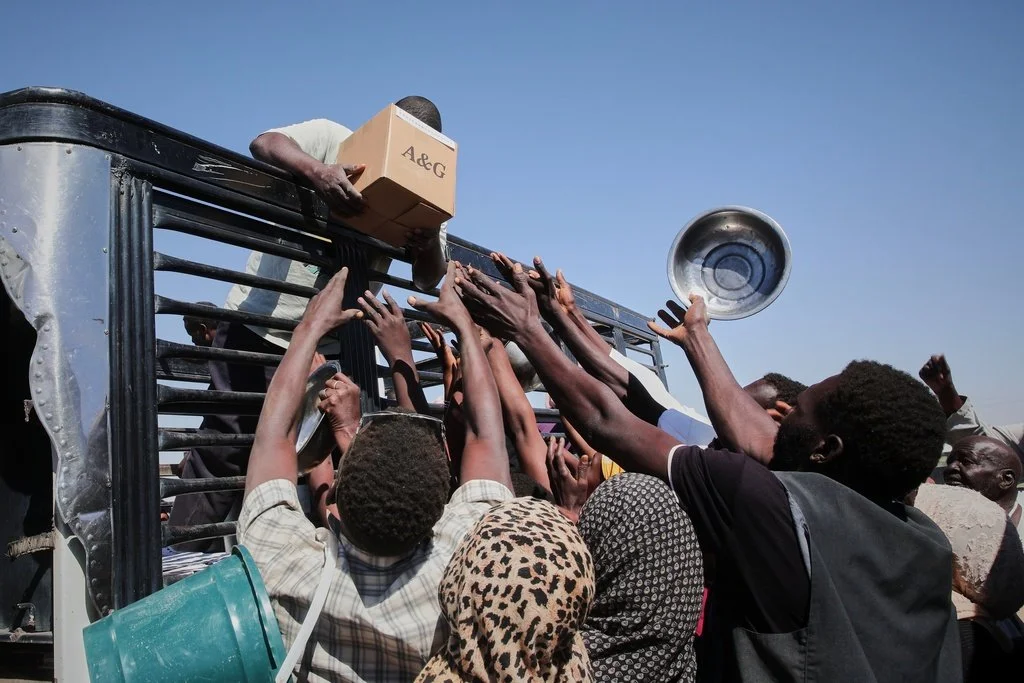
FILE.- Sudanese families displaced from El-Fasher reach out as aid workers distribute food supplies at the newly established El-Afadh camp in Al Dabbah, in Sudan's Northern State, Sunday, Nov. 16, 2025. (AP Photo/Marwan Ali, File)
The Responsibility to Protect is an international norm asserting that world leaders should act to safeguard civilians of a country if its own government is unable to do so. Celebrated as a victory for human dignity, it reflects the idea that preventing atrocities such as crimes against humanity is a global responsibility. Unfortunately, international human rights protection often struggles to translate into effective action. Responses from global institutions are more often limited to condemnations or sanctions that carry few immediate solutions for the victims of violence. As a result, the enforcement of the Responsibility to Protect norm often appears selective and inconsistent as it raises questions about whether the international community is capable of effectively protecting civilians and holding perpetrators accountable.
These limitations are displayed in Sudan. April 2023 marked the beginning of the war between the Sudanese Armed Forces (SAF) and Rapid Support Forces (RSF). Due to the power struggle for military leadership, famine and mass killings have taken over the country as survivors recall “piles of dead bodies along roads” and “systematic sexual violence, including gang rape”. With over 150,000 dead, one begins to question where global accountability lies. The international community's failure to aid Sudan stems less from a physical inability to act and more from the political priorities that shape when and where states choose to intervene.
Whether this behavior is unethical or realistic remains debated, since governments are responsible for protecting their own national interests. Leaders are expected to justify foreign involvement to citizens, many of whom may question why their national resources are spent on conflicts abroad over domestic benefit. Regardless of how this is viewed, there are consequences. Attention and resources are both limited and unevenly distributed, which often causes some crises to receive far less urgency than others. One could claim that Sudan has been placed into the category of low priority despite the scale of violence faced by its people. Humanitarian aid is often rooted in sympathy, but because sympathy varies among individuals, aid that offers little to no political return can be difficult to justify to those who solely prioritize national interest. As a result, this focus on national gain over human suffering is dangerous as it paves a path that allows exploitation and intensified suffering.
Reports from the United Nations (UN) in 2025 and 2026 classify the United Arab Emirates (UAE) as a primary benefactor of the RSF as “armaments and supplies were disguised as humanitarian aid” and sent through networks in African countries. By supporting the RSF, the UAE secured dominance over Sudanese gold. In this context, human rights have been sidelined and hardship is treated as an acceptable cost when material gain is prioritized over life. The dynamic illustrates how Sudan is treated more as a resource hub than a sovereign nation where access to minerals outweighs concern for the well-being of its citizens. With the continuous involvement of more states, the conflict begins to reflect a geopolitical competition.
The SAF receives backing from countries like Egypt, for protecting Nile water rights, and Turkey, for aiming to increase its influence in the Red Sea through a strategic alliance. As a result, the conflict is no longer a struggle over Sudan's domestic leadership, but one shaped by competing foreign interests attempting to influence the outcome in ways that serve their own strategic goals. As the scale of suffering intensifies, international investigators have begun examining whether the violence constitutes crimes under international law.
A recent investigation by the UN focuses on the severity of the violence, concluding that “the violent takeover bore the hallmarks of a genocide”. In response, sanctions were imposed on leaders of the RSF with the intention of holding them accountable for their actions. As for what this means for Sudan, sanctions on individuals involve travel bans and financial restrictions, however, the effectiveness of these measures is uncertain. Armed groups often rely on illegal economic networks, therefore the placement of these sanctions is largely symbolic of international condemnation. Human rights law relies on states to enforce its rulings, but as long as foreign governments continue to support competing groups, diplomatic measures are limited in their ability to stop the violence. Thus, Sudan stands as a clear gap between the promise of global accountability and the reality of limited enforcement.

United Nations peacekeepers stand near an airstrip in Akobo, South Sudan, Saturday, Feb. 21, 2026. (AP Photo/Florence Miettaux)
When rules aren't enforced, they lose authority. If one comes to find that violations carry few impactful consequences, they will be less likely to abide by international law. As seen with the Responsibility to Protect, its reliance on countries creates a bystander effect; although many were in support of the norm and are expected to act, no single state fully feels responsible. The UN alone does not have the ability and resources to intervene everywhere, and without action from influential countries, civilians bear the consequences of being trapped in conflict. Aid requires coordination, negotiation, compliance, and access to reach the most vulnerable communities. It's a logistical complexity that further highlights how protection cannot be guaranteed—yet when significant economic or strategic interests are at stake, such obstacles rarely prevent states from acting and mobilizing resources.
The slow response to the atrocities that have taken place in Sudan, millions displaced, thousands dead, and even more in weak and injured conditions for nearly three years, reinforces the precedent that international law does not protect everyone.. How can one claim that international law is effective when the public eye has a clear visual of human suffering? Countries are failing to act decisively, and some situations are so complex that even those who want to help are unable to provide efficient solutions. Who bears the responsibility of protecting human rights? These promises of solidarity appear meaningless words on paper as civilians continue to face heinous violence and hardship.