

Secretary of Defense Pete Hegseth gives a State of the Force address at Marine Corps Base Quantico, Wednesday, Sept. 30, 2026 in Quantico, Va. (Alex Wong/Pool Photo via AP)
This September at the State of Force Address in Quantico, Virginia, Secretary of War Pete Hegseth announced FORTRESS (Federal Operations for Resilience, Troop Resources, Energy, Supply, and Survivability) America, a program designed to prepare major US military institutions to survive independently amid global crises, including natural disasters, war, supply chain disruptions, and cyberattacks. The speech delivered at the Marine Corps Base was based on the Pentagon’s FORTRESS America memorandum, which articulated that the program aims to “strengthen the Nation’s military capacity from the inside out,” organizing around “five pillars: energy independence; supply-chain and defense-industrial base resilience; a strategic defense reserve; installation hardening and cyber resilience; and resilience in space and spectrum.” The memorandum emphasized that the obvious military bolstering is not a “retreat” and is instead “the foundation from which American strength is projected- a homeland that cannot be starved out, shut down, or cut off.”
As reported by Fox News Digital, through FORTRESS, the Pentagon will prepare military bases by tasking them to keep essential operations running “for at least 90 days without outside support as it prepares for the possibility of a major war that could cripple power grids, disrupt supply chains and threaten critical infrastructure on American soil.” The goal of the 90-day independence exercise is to ensure that American forces can continue fighting even if the civilian systems they depend on are disrupted. Pentagon chief spokesperson Sean Parnell corroborated the account by highlighting the risk of not conducting the crisis preparation exercise, telling Fox, “We don't want to rely on standard civilian municipal infrastructure to run our national defense. We simply can't. It's an intolerable risk.”
Beyond the exercises of preparing US military bases for 90 days without outside support, “The Pentagon is also laying the groundwork for civilian factories to shift to defense production during a crisis, while preparing alternative supply chains and strategic reserves to keep weapons, fuel and other essential materials flowing.” Through the Civil Reserve Manufacturing Network, the Pentagon plans to identify commercial factories that can shift to defense production during a crisis, expanding FORTRESS’s focus beyond military preparation.
A major driver of FORTRESS is the Pentagon’s concern about overreliance on civilian power grids and growing insecurity in global supply chains during cyberattacks, natural disasters, or war. To address energy security and power grid independence, “FORTRESS envisions portable nuclear reactors, large-scale battery storage and microgrids capable of disconnecting military installations from the civilian electrical grid, allowing them to continue operating during prolonged power disruptions.” Concerning supply chain security, FORTRESS establishes a “requirement for at least two qualified supply or production pathways, reducing the risk that the loss of a single factory, supplier or industrial capability could interrupt military operations.”
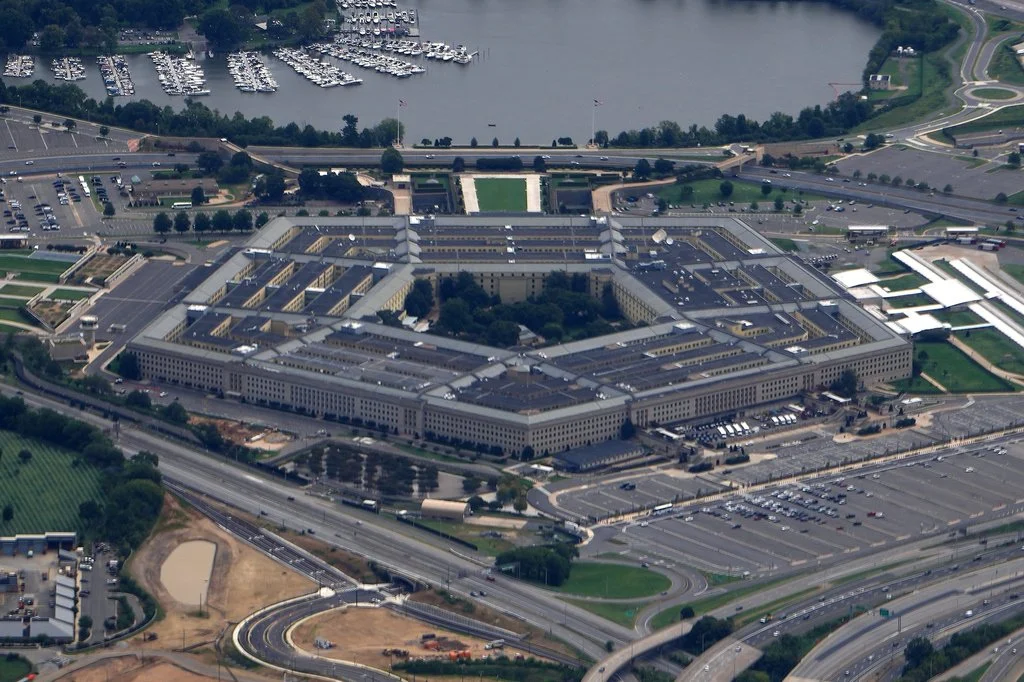
The Pentagon is pictured as Air Force One with President Donald Trump on board flies over Washington en route to Alcoa, Tenn., Saturday, Sept. 26, 2026. (AP Photo/Julia Demaree Nikhinson)
While focused on the military, the US’s initiatives align with a broader global trend of disaster and war-preparation measures observed by international contemporaries. As reported by the Guardian, “governments around the world are spearheading new campaigns to encourage the general public to be prepared for a host of emergencies that could disrupt essential services, including cyber-attacks and natural disasters.” In the UK, the “Be Ready” campaign urged the public to stock up on supplies to last 72 hours. Similarly, Sweden has previously published updated guidance for its population via the “In Case of Crisis or War” booklet, which was mailed to 5.2 million households this November, following increased anxiety around cybersecurity amid the continued Russian invasion of Ukraine.
Expert opinion on the global trend remains mixed, with some arguing that the emergence of a new “risk society” might prompt civilians and everyday life to think about themselves differently, while others feel that FORTRESS only highlights the vast differences in needs for individual preparedness vs. institutional preparedness. Lynn Budd, former president of the National Emergency Management Association (NEMA), a nonpartisan, non-profit organization dedicated to US emergency preparedness, and current director of the Wyoming office of homeland security, believes leaders increasingly understand that cyber-attacks pose a growing threat. Budd argues that its existence should encourage everyday Americans to consider their own preparedness strategies: ‘People can think about [Fortress] and think, if our military is doing that, shouldn’t I be thinking about that too?’” In contrast, Dr. Tom Chandler, director of the National Center for Disaster Preparedness at Columbia University, argued that the Pentagon’s plan highlights the vast differences between individual and institutional preparedness.Military installations in the United States have very specific and unique operational responsibilities, and these requirements are oftentimes very different than what is required for ordinary households.”
While opinions remain in the air and no attack on American soil seems imminent, the US’s recent initiatives will raise new questions about what contemporary brinkmanship might look like for the rest of Trump’s term. In the aftermath of the Democratic wave in the midterms, eyes will be on how both Trump and Hegseth handle the ongoing war in the Middle East and where they allocate resources, at home or abroad.