
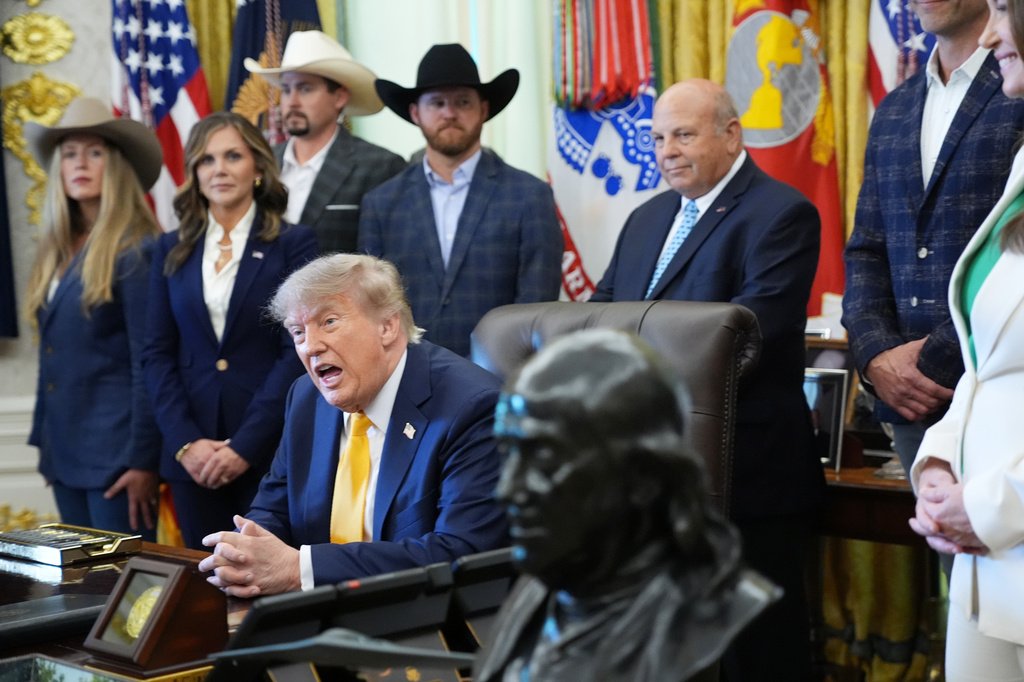
President Donald Trump announces action to help farmers and ranchers, as a group of farmers and ranchers stand behind in the Oval Office of the White House. (Photo: AP News /Jacquelyn Martin)
For 94 years, Kansas refused to send a Democrat to the U.S. Senate. This month it did, and the reasons run straight through its feedlots.
Democrats made a huge wave across the U.S. on Nov. 3. The party solidified control of both chambers of Congress, according to an NPR analysis of Associated Press race calls. Democrats broke five former Republican trifectas in Georgia, Iowa, New Hampshire, Ohio, and Texas, and flipped nine Republican Senate seats, including Kansas, South Carolina, and North Carolina. The rural voter base and tensions between the agricultural sector and the Republican Party before the midterms contributed to this shift.
In October, a coalition of more than 40 farmers and agricultural industry groups formally delivered a letter to Washington’s leaders, warning that the administration’s crackdown on immigration was hurting farmers and the food supply and risked raising grocery prices. Weeks earlier, in late September, U.S. immigration agents had conducted operations across southwest Kansas. The Kansas Livestock Association, alongside associations from Texas and Oklahoma, reported repeated workforce disruptions at feedlots, processing plants and other agricultural operations, and the cattle supply chain stalled. These disruptions weren’t the only pressure on ranchers across the country. In August, Trump signed a proclamation temporarily expanding the tariff-free quota for foreign beef trimmings. The controversial move sent cattle futures to eight-month lows, and U.S. Cattlemen’s Association President Justin Tupper stated: “You don’t put America first by putting U.S. cattle producers last.”
These tensions stemmed from policy. This year, the administration went after the agricultural industry from several directions. It frightened away the rural workforce and brought in foreign competition. Then, when the political damage became obvious, it turned to federal checks as a last resort to buy back loyalty. Rural voters put up with Trump’s first-term trade war with China, viewing tariffs as short-term pain for a long-term fight. This year, a different story emerged. Ranchers were hit by several forces at once, with an election only weeks away.
The Kansas operation, dubbed “Operation Safe Community,” landed in what the industry calls the Golden Triangle of meatpacking: Dodge City, Garden City and Liberal. The region accounts for more than 20 percent of the nation’s daily fed-cattle slaughter, and its plants rely heavily on immigrant labor. At the start of the pandemic, roughly 45 percent of America’s meatpacking workers were foreign-born.
Over three days, federal agents arrested 104 people. Ryan Kriegshauser, the U.S. attorney for Kansas, said the operation targeted noncitizens with prior criminal convictions, and Homeland Security Secretary Markwayne Mullin said agents were going after “heinous criminals.” The Department of Homeland Security insisted it was not raiding worksites. On the ground, those distinctions meant little. Agents pulled over residents who were in the country legally, and workers, many of them documented, stayed home rather than risk a stop. Some plants temporarily shut down and sent cattle back to the feedlots, where every extra day costs ranchers feed, money and animal health.
The people who spoke up are what made this moment politically significant. The warning of a “massive chilling effect” on legal, skilled workers came from the trade associations of Republican ranch country, not from immigrant advocates. Both of Kansas’s Republican senators, Roger Marshall and Jerry Moran, urged ICE to coordinate with local law enforcement. Democratic Gov. Laura Kelly traveled to Dodge City and apologized to meatpacking workers and community leaders.
The October letter carried that warning nationally. Its signers included the Milk Producers Council, the Texas International Produce Association, Indiana Dairy Producers and, again, the Kansas Livestock Association. The association’s chief executive, Matt Teagarden, chairs the agricultural council of the American Business Immigration Coalition, which organized the letter. Agriculture has long preferred to lobby quietly, and this time it chose to go public. As one signer, Christian Herr of PennAg Industries Association, told The Washington Post, “some of the president’s most loyal supporters are fading fast.”
The White House cannot claim it wasn’t warned. In 2025, after heavy industry lobbying, the administration briefly told ICE to avoid raids on farms and hotels, then reversed course. It understood how much those industries depend on immigrant labor. It chose enforcement anyway, in the states where it had the most to lose.
The raids landed on an industry already at odds with the White House over trade. Years of drought had shrunk the national cattle herd to about 86.2 million head at the start of 2026, the smallest since the 1950s. Short supply pushed beef to record prices, with ground beef averaging about $6.89 a pound in July. For shoppers, that was a burden. For ranchers coming out of lean years, it was finally a reason to rebuild their herds.
The administration’s answer was imports. In February, it quadrupled the low-tariff quota for Argentine beef to 80,000 metric tons. On Aug. 21, Trump announced that up to 300,000 metric tons of beef trimmings for ground beef, roughly 660 million pounds, could enter the U.S. over 90 days without out-of-quota tariffs. Exporters promised to sell it at 25 percent below market. Critics mocked it as “mystery meat.” The National Cattlemen’s Beef Association warned the plan would hurt ranchers and discourage herd expansion. Sen. Deb Fischer, a Nebraska Republican, argued that flooding the market undermined the real long-term fix: growing the domestic herd.
The two policies worked against each other. The raids raised the cost of turning cattle into beef by scaring off the workforce. The imports lowered the price ranchers receive by adding foreign competition. The raids added to the price pressure the imports were supposed to relieve, and ranchers lost money both ways.
By October, the White House appeared to recognize the damage. Two weeks before the midterms, Trump promised an $8 billion bailout for farmers, in addition to $12 billion in “bridge payments” announced last December. The Washington Post’s editorial board counted $55 billion in direct federal payments to farmers this fiscal year, nearly five times the 2017 level.
But checks do not fix a balance sheet. Farm bankruptcies rose 46 percent in 2025, to 315 filings, and USDA projects that total farm debt will reach a record $624.7 billion this year. Inflation-adjusted net farm income is expected to fall 5.5 percent in 2026, while production expenses climb to nearly $493 billion. A one-time payment cannot replace a reliable workforce or a predictable market, and farmers know the difference. To many of them, the last-minute aid looked less like relief and more like an attempt to buy back goodwill the administration’s own policies had spent.
The erosion appeared in polling months before November. A Reuters/Ipsos poll in June put Trump’s approval among rural Americans at 50 percent, a low for his second term, with disapproval up to 48 percent from 34 percent early in 2025. On the economy, rural voters were harsher: only 31 percent approved. Those are striking numbers for the bloc that has anchored his coalition since 2016.
On Nov. 3, it showed up in the results. A Washington Post analysis found that rural counties moved more than 15 points toward Democrats compared with 2024. In Kansas, which Trump carried by more than 16 points in 2024, Adam Hamilton, a Methodist pastor who campaigned on affordability, defeated Marshall by roughly seven points. In Iowa, Democrats won the governor’s race, an open Senate seat and three of the state’s four House seats, and turnout reached 63 percent, the highest in 30 years. CNN attributed Josh Turek’s Senate win in part to farm-country anxiety over diesel, fertilizer and tariffs. In Texas, all 171 rural counties moved toward Democrats in the governor and Senate races. Aaron Lehman, president of the Iowa Farmers Union, credited the party’s gains in Iowa and Kansas to agricultural issues ranging from trade disruption to fertilizer and diesel prices.
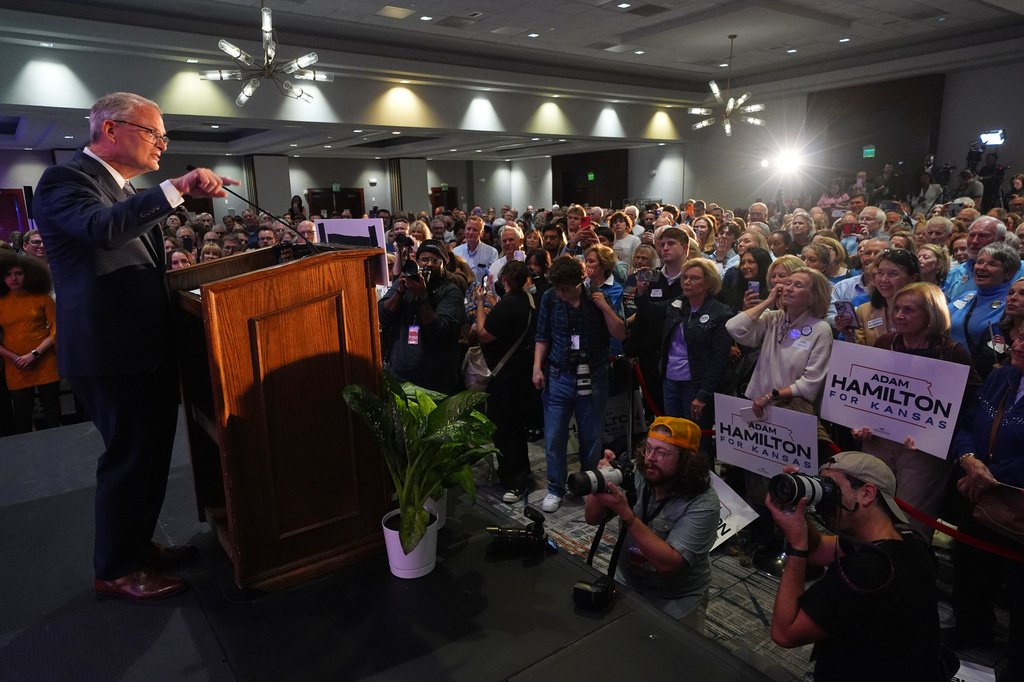
Democratic Senate candidate Adam Hamilton speaks to supporters during an election night event. (Photo: AP News/Charlie Riedel)
Some rural voters didn’t switch parties. They stayed home. In Texas, about 90 percent of the counties where turnout fell were rural, according to The Texas Tribune. For Republicans, that may be the more troubling signal. A better argument can win back a swing voter. A loyal voter who concludes the party no longer has their interests at heart is much harder to bring back.
Caution is warranted. No exit poll can separate the effect of an immigration sweep in Kansas from the price of diesel, the war with Iran, or national frustration with the president. AP VoteCast found that many Kansas voters doubted Marshall’s personal character. Iowa Democrats rebuilt a statewide organization that had withered. A wave this large has many causes.
Still, the pattern in the beef states is hard to ignore. For years, Republicans asked rural voters to absorb economic pain in exchange for cultural alignment and a promise to be put first. This year, the administration asked ranchers to accept labor shortages in the name of enforcement and foreign competition in the name of affordability, then offered checks to make up for it. Rural voters did the math.
The lesson applies to both parties. Rural America is not a guaranteed vote. These voters judge a party by what it does to their bottom line. Democrats now hold Senate seats in Kansas and Iowa that looked out of reach a year ago, and they will keep them only if they deliver. That starts with a workable farm labor system, such as the H-2A overhaul in the Securing Agriculture’s Workforce Act from Rep. Glenn Thompson, a Pennsylvania Republican. It also means a trade policy ranchers can plan around and support for rebuilding the cattle herd, not undercutting it. Because Thompson is a Republican, his bill is an early test of whether the new majority can work across party lines for the voters who just elected it.
Republicans face a harder question: whether their immigration and trade agenda can coexist with the people who feed the country. If it cannot, the party will have to choose between them. For 94 years, Kansas ranchers had no reason to vote for a Democrat. This fall, Washington gave them several.